News · 19 September 2026 · 4 min read
The block sat empty for four years
The ATO confirmed a foreign investor was ordered to pay $370,000 for failing to build on residential land within four years. For anyone buying nearby, the empty block is not scenery — approved-but-unbuilt supply, achieved rent, days on market and buyer depth on that exact street decide what the purchase is worth.
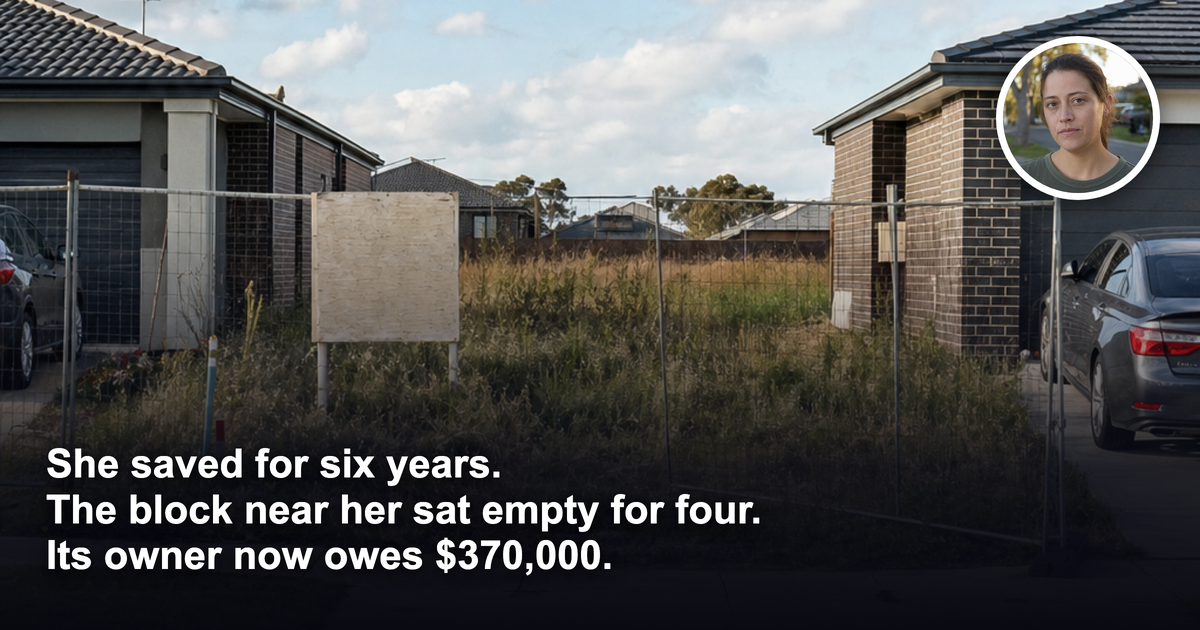
Two streets from where she rents, there is a block of land with a driveway crossover, a survey peg and nothing else. It has been like that for as long as she has been saving — knee-high grass behind a sagging wire fence, a faded sign, a gap in a street of finished homes.
This week the Australian Taxation Office made that kind of block national news. It confirmed a foreign investor was ordered by the Federal Court to pay $370,000 for failing to start building a home on residential land within four years, and used the case to put every "land banking" investor on notice.
"This case should serve as a warning to foreign investors and their advisers," ATO assistant commissioner Jennifer Moltisanti said. Buying residential land in Australia, she said, "comes with clear and enforceable obligations", and "where foreign investors do not comply, we will take firm action, including court proceedings, to uphold the law and protect Australia's national interests."
The person
Call her Renee. She is 31, has been saving for a deposit for six years, and walks past that empty block most days. Every year it stays empty is a year the street she wants to buy into grows by one more approval and no more homes.
Composite illustration. "Renee" is not a real person and is not connected to the ATO case or to the investor penalised in it. Nothing here is presented as testimony from anyone involved.
The question
If the land was always going to be held rather than built on, the neighbourhood had already lost the home. So the real question for anyone buying nearby is not who owns that block. It is: what does approved-but-unbuilt land on my street do to the value of the home I am about to buy?
The rule most buyers have never read
Foreign investors who buy vacant residential land in Australia are generally required to build on it within four years. The condition exists precisely because the alternative — buying land and sitting on it while prices move — takes supply out of the market without adding a single dwelling.
Two things are worth separating carefully.
The first is the reported fact: one investor, one Federal Court order, $370,000, and a regulator signalling it will litigate. That is verified, and it is new this week.
The second is interpretation, and it is ours: enforcement of a four-year rule tells you the rule has been tested — not that every empty block near you is about to become a house. A penalty is not a construction timetable. Land can change hands, an approval can lapse, a build can start in year five, or the lot can sit exactly as it is.
Why a vacant block is a live pricing input
A street is not a suburb. Suburb medians blend the finished side of a neighbourhood with the unfinished side, and empty or approved-but-unbuilt land is one of the sharpest differences between the two.
When Ripehouse Advisory scores a street, unbuilt supply is not a footnote — it is a scoring input. What we measure on the exact street rather than the postcode:
- Approved-but-unbuilt competing supply. How many dwellings are already approved within walking distance that have not been built? Each one is a future competitor to your resale, and they can all arrive at once.
- Days on market for that exact stock type. A three-bedroom house on a street with three empty lots does not sell like the same house on a completed street.
- Achieved versus advertised rent. Advertised rent is an asking price. Achieved rent is what tenants actually paid — and it is the number that survives a street with construction at both ends.
- Street-level vacancy and heatmaps. Vacancy moves block by block, not by suburb name.
- Buyer depth on exit. The question that decides whether a paper gain is real: when you sell, how many buyers are genuinely active for that stock type on that street?
- R-Score. Our composite score for exactly this — pulling the street-level measures into one comparable number instead of a suburb average.
What it means for you
If you are buying near vacant land, the empty block is information, not scenery. Three practical steps:
- Count the unbuilt approvals within a few hundred metres, not the suburb-wide pipeline. That is your real future competition.
- Ask what the land has done for the last four years, not what a brochure says it will do next year. A history of inaction is the most honest forecast you will get.
- Compare achieved rent and days on market on that street against the completed street one block over. If the gap is material, you have just priced the risk the median hid from you.
None of this argues against buying. It argues for buying the right street. Property still does what it has always done for patient owners — but the asset, the street and the data behind them decide the outcome, not the headline. The investor in the ATO's case was penalised for treating land as a parking space. The lesson for everyone else is the mirror image: the ground around your purchase is doing something all the time, whether or not anyone is building on it.
That is the whole argument for street-level data. A suburb tells you what happened. A street tells you what is about to.
General information only. It does not take into account your objectives, financial situation or needs, and it is not a forecast or a recommendation to buy or sell any particular property.
For buyers wary of approved-but-unbuilt supply distorting prices, the Ripehouse Advisory webinar shows how to test that risk against street-level rent, demand and vacancy data before you commit.
Frequently asked questions
What did the ATO case about the empty block actually involve?
The ATO confirmed a foreign investor was ordered by the Federal Court to pay $370,000 for failing to start building a home on residential land within four years. The regulator said the case was a warning that it will take firm action where foreign investors do not comply.
Why does an empty block next door matter if I'm buying a house nearby in Australia?
The article says an empty block is not just scenery because approved-but-unbuilt land can change street-level supply and affect value. It can influence days on market, rent achieved, and how many buyers are active when you later sell.
What should I look at before buying near vacant residential land?
Focus on the exact street, not just the suburb median. The article recommends counting approved-but-unbuilt homes nearby, comparing achieved rent and days on market, and checking buyer depth for that stock type.
Does the Federal Court penalty mean every empty block will have to be built on immediately?
No. The article says a penalty is not a construction timetable, and an empty lot can still sit unchanged, change hands, or start building later. The case only shows that the four-year rule has been enforced.
What is the main risk of buying on a street with a lot of unbuilt supply?
The main risk is extra future competition on your street, which can weigh on resale, rent, and buyer demand. The article says suburb averages can hide this, so street-level data is needed to price the risk properly.
General information only. It does not take your objectives, financial situation or needs into account, and nothing here is legal, financial, taxation or investment advice specific to your circumstances.