News · 21 September 2026 · 5 min read
One "no" at a front door has cost this property owner $6,300
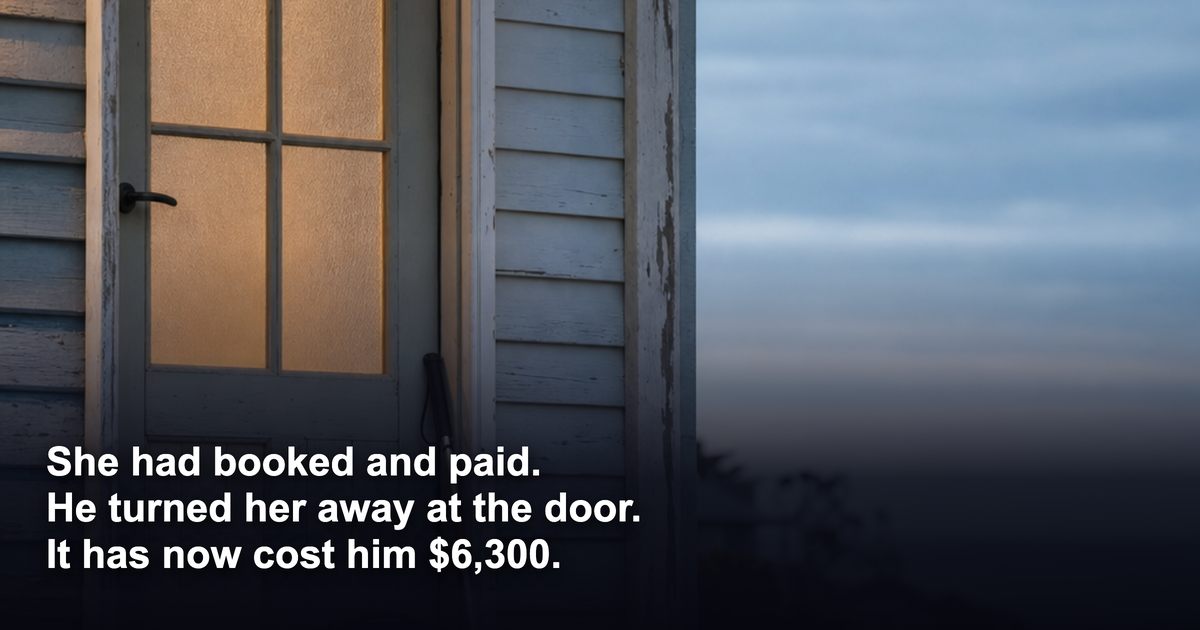
A legally blind Queensland woman was turned away from a short-stay property because she had a guide dog, and told a $100 cleaning fee applied if she stayed. QCAT has ordered the owner to pay her $3,500 for breaching anti-discrimination law, on top of a $2,800 Magistrates Court fine over the same incident. One refusal, $6,300, and a long fight she had to run herself. Here is what it means for anyone who lets a property, and the street-level checks that stop you learning the expensive facts after settlement.
Most property mistakes never announce themselves. They sit quietly inside a purchase — the wrong street, the wrong stock type, the wrong assumption — and surface years later as a bill. Occasionally the bill arrives fast, on camera, with a tribunal reference attached.
In December 2024, at a short-stay property called "Sunny's Piece of Paradise" at Agnes Water in Queensland, the owner refused entry to a paying guest because she arrived with a guide dog. That decision, made in a few seconds at a front door, has now cost him $6,300 across two entirely separate legal tracks: a $3,500 compensation order from the Queensland Civil and Administrative Tribunal for breaching the state's anti-discrimination laws, and an earlier $2,800 fine from a Magistrates Court for breaching the Guide, Hearing and Assistance Dogs Act over the same incident. QCAT set a payment deadline in late September.
As Kenji Sato reported for ABC News on 21 September, this was not a paperwork dispute. It was recorded.
The person it was actually done to
Janice Whittle is a legally blind woman from Moreton Bay. When she was turned away at Agnes Water she recorded the confrontation using AI smart glasses, and that video was played at the tribunal hearing.
On the recording, the owner, Brendan Farrugia, tells her he would not have allowed her to book in the first place had he known she had a guide dog. He says he has a "no pets" policy. He says she would need to pay a $100 cleaning fee if she wanted to stay.
Both positions are unlawful in Queensland. It is illegal to refuse service to a guide dog user, and illegal to charge an additional cleaning fee because of a guide dog.
Why was she ready to record at all? Ms Whittle said she bought the smart glasses because she had been repeatedly refused service in restaurants, hotels, airports and other venues.
"I've been abused pretty much all my life and I've never stood up for myself," she said. "Well, things change."
"I couldn't put up with it anymore and I want people to know it's against the law to refuse a guide dog."
Sam Tracy, practice director at Basic Rights Queensland, which advised her, called it "a very significant case in regards to disability discrimination in Queensland". "We don't often see decisions where compensation is reached, they're often settled," he said. "This case represents not only a significant use of the protections under state law, but also under anti-discrimination law." Guide dog users, he said, face this kind of discrimination daily, and it almost never reaches a court.
Mr Farrugia told 612 ABC Brisbane he had "made a mistake" and would follow the tribunal's orders. "It happened, I made a mistake, let's move forward," he said, adding, "I'm a business owner, doing what I can, in these challenging economic times." He asked the ABC to "please leave me alone".
Note the shape of it. A woman who had already been refused service enough times to start wearing a camera had to run a long tribunal process to establish something the law had settled years ago. The penalty is real, but she is the one who did the work.
The question
Here is the uncomfortable question for anyone who owns, or is about to own, an income-producing property: how much of what you are actually required to do — and what your asset will actually deliver — did you verify before you committed?
The owner's error was assuming a house rule was his to write. It was not. The law had already decided that question, and not knowing cost him $6,300, in public. The deeper pattern is the part worth studying: he found out the real rules of his own operation after the money was in and the guest was at the door.
That is how most bad property outcomes happen. Not through one dramatic confrontation, but through assumptions nobody ever tested against data.
The answer, with numbers
Headlines and assumptions are not diligence. Measured evidence is. Before Ripehouse Advisory puts a property in front of a client, we test the things owners usually discover too late.
R-Score. One comparable score that compresses supply, demand, yield and growth drivers, so a location is ranked against every other location in the country rather than against a marketing adjective.
Street-level heatmaps. Suburbs are not uniform. The strong end and the weak end of a single street routinely behave like different markets. We map performance down to the street, because the street is what you buy.
Achieved versus advertised rent. The rent in a listing is a hope. The rent comparable properties actually achieved is a fact. The gap between the two is where cashflow forecasts quietly die.
Street-level vacancy. Suburb-wide vacancy averages hide pockets of empty stock. We look at vacancy on the streets immediately around the asset.
Days on market for that exact stock type. A three-bedroom house on 600 square metres and a two-bedroom unit in the same postcode are different products with different liquidity. We measure how long your stock type takes to move.
Approved-but-unbuilt competing supply. The competition that hurts you in three years is sitting in a council approvals register today. Count it before you buy, not when it is craned in next door.
Buyer depth on exit. An asset you cannot sell into a deep buyer pool is not an investment, it is a commitment.
None of this is an argument against property. It is the argument for property done properly: the right asset, on the right street, bought on verified numbers, with your obligations understood before somebody is standing at your door.
What it means for you
If you let a property, short-stay or otherwise, your obligations are neither optional nor intuitive. In Queensland, refusing a guide dog user or charging them an extra cleaning fee is unlawful. Obligations differ by state and by whether a property is let short-stay, under a residential tenancy, or another way, so get your own legal advice rather than assuming your house rules are the last word.
And if you are buying: the most expensive facts about a property are almost always the ones you learn after settlement.
Ripehouse Advisory has no connection to any party in this case, and nothing here is a comment on anyone not named in the reporting. This article is general information only, not legal or financial advice. Capital is at risk in any property purchase.
Before you commit, verify
One refusal cost one operator $6,300. Untested assumptions on a purchase cost far more, far more quietly. If you want the street-level numbers on a location you are considering — R-Score, achieved rents, real vacancy, real competing supply, real exit depth — that is what we do.
Source: ABC News, reporting by Kenji Sato, 21 September 2026.
General information only. It does not take your objectives, financial situation or needs into account, and nothing here is legal, financial, taxation or investment advice specific to your circumstances.