News · 19 September 2026 · 5 min read
The inquiry is public. The loss is private.
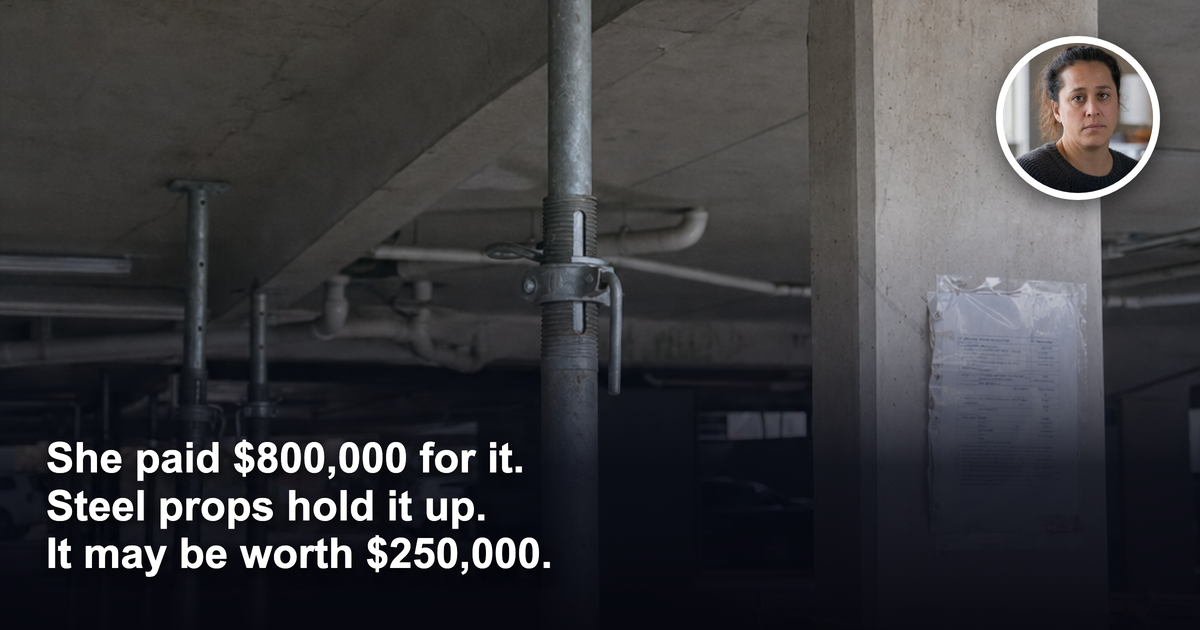
Thousands of Toplace owners are paying privately for a collapse now playing out in public at ICAC. Apartments that sold for $800,000 may be worth as little as $250,000, with steel props holding up the building since 2022. The defect was invisible at purchase — the risk profile of the street was not.
Jean Nassif appeared before the NSW Independent Commission Against Corruption twice this week — by video link from Beirut, protesting his innocence, wanted by NSW Police on fraud charges. The hearings are televised, transcribed and dissected.
And somewhere in Sydney, an owner opens a strata levy notice and pays, again, for a building quietly eating her family's future.
That is the part nobody livestreams. The inquiry runs in public. The loss sits privately on ordinary owners' balance sheets — and no ICAC finding repairs a structural beam or restores a valuation.
The person
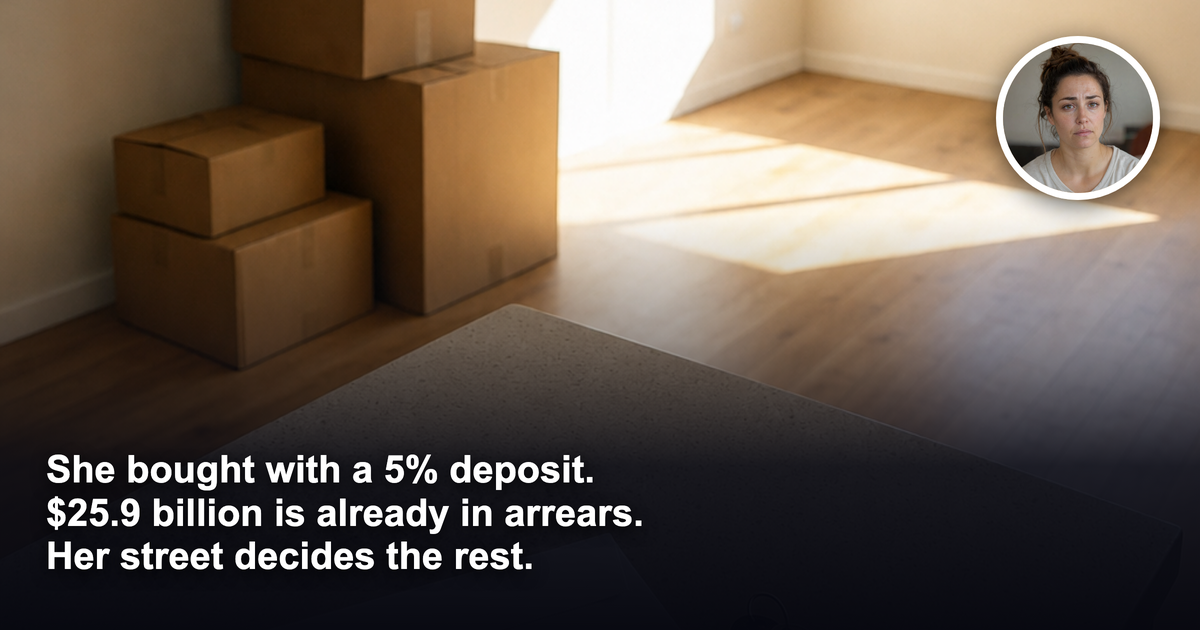
Call her Danielle. She's 38, with two young children, and she owns an apartment in a tower built by a developer that no longer exists. She bought believing a certified, council-approved, brand-new apartment was the safe option. She now owes more than it is worth, can't refinance, and can't sell without crystallising a loss that would take a decade to rebuild.
Composite illustration. "Danielle" is not a real person; she is a composite drawn from the publicly reported experiences of Toplace owners. She is not the owner named below.
You don't need a composite to see the damage. Michael Jones is real, and told his story to the ABC this week. He bought his first home in 2017 — a two-bedroom apartment at Toplace's Vicinity complex in Sydney — while his wife was pregnant with their first child. Nine years and two more children later, the family has outgrown the apartment and cannot leave it.
"It certainly puts off the dreams and aspirations that you would have when you're my age," he said. "I would have expected by now that I would have a house that fits the amount of people that we have."
Then, with hard-earned humour: "The irony of having the last name Jones and not even being able to 'keep up with the Joneses' is not lost on me."
The question
How does a buyer who did everything right — new building, large developer, bank-approved loan — lose more than half their equity because of decisions made years earlier, by people they never met, in a process they could not see?
That is the question the ICAC hearings circle but do not answer. Nassif, 58, denied he was corrupt and blamed former Liberal minister David Elliott and former state building commissioner David Chandler for Toplace's demise. Neither is accused of any wrongdoing. Mr Chandler, who found multiple defects across several Toplace buildings, used his own appearance to point at the "real victims": the owners and occupiers.
Anthony Whealy KC, a former ICAC assistant commissioner and chair of the Centre for Public Integrity, says the inquiry has "shone a very unedifying light" on dealings between the state's Liberal Party, lobbyists and developers — but warns proving it goes beyond the ugly side of politics will be difficult.
Translation: the public process may produce headlines. It will not produce Michael Jones a house.
The answer, in numbers
The private ledger at Vicinity, per the ABC's reporting:
- Temporary steel props have held up parts of the building since 2022, after engineers raised concerns about key structural beams.
- Repair estimates run into the millions. One structural issue alone is estimated at $11 million.
- Mr Jones projects he has spent an additional $150,000 on strata costs and repairs since 2017.
- Apartments that once sold for as much as $800,000 may now be worth as little as $250,000 to $380,000 — a write-down of roughly 50 to 70 per cent.
- Many owners cannot refinance, cannot sell without huge losses, and carry full debt on homes they cannot leave. Some neighbours have taken on extra jobs.
Karen Stiles, who heads the Owners Corporation Network, put it plainly to the ABC: "It was hell on earth for the owners. Tenants too were subjected to disruptions, poor living conditions, noise, and stress." She described residents forced out with little warning, sometimes unable to retrieve pets or belongings, and one elderly couple who built a makeshift dam in their lounge room to hold back floodwater. Many owners, she said, were left grieving the "death of their dream home".
Thousands of owners are affected. None of them signed off on a beam.
What it means for you
The defect was invisible at the point of purchase. The risk profile of the asset was not.
A defect event does not destroy every building equally. What decides whether a structural problem is an expensive inconvenience or a total loss of liquidity is the market underneath the asset — and that is measurable before you buy.
At Ripehouse Advisory we run every asset through street-level data rather than suburb averages, because suburb averages hide exactly this. The measures that matter here:
- R-Score and street heatmaps. Density risk concentrates on a handful of streets, not across a suburb. A street carrying a cluster of towers thrown up fast by a few builders behaves nothing like the street two blocks over.
- Days on market for that exact stock type. Not houses. Not "units". The precise stock type, on that street. Slow days on market before a defect event becomes no days on market after one.
- Buyer depth on exit. How many genuine buyers clear at your price band on that street in a normal month? If the answer is "a handful", one bad inspection report removes all of them.
- Approved-but-unbuilt competing supply. Every approved tower not yet built is a competitor you will be selling against. Heavy pipeline plus a defect history is how an $800,000 apartment becomes a $250,000 apartment.
- Achieved versus advertised rent, and street-level vacancy. The gap between advertised and actually banked tells you whether the street has real demand or marketing.
Danielle's problem is not that she bought an apartment. It is that she bought on a street with thin exit-buyer depth, heavy competing supply and a builder concentration nobody showed her — so when the defect arrived, there was no market to absorb it.
None of that required insider knowledge. It required data at the street, not the postcode.
The reframe
The honest conclusion is not "never buy apartments". It is that inquiries and regulators are a poor substitute for due diligence: they arrive years late and compensate nobody. You cannot audit a developer's integrity from the outside. You can measure whether the asset you are buying is one you can leave.
The right asset, on the right street, chosen on real data, beats headlines. It also beats inquiries.
Looking at high-density stock right now? Check the street-level numbers before you sign: R-Score, days on market for that exact stock type, buyer depth on exit, approved-but-unbuilt pipeline. Talk to Ripehouse Advisory before you commit, not after the props go in.
General information only. This article does not take into account your objectives, financial situation or needs, and is not personal financial, legal or tax advice. Property investment carries risk, including capital loss. Seek professional advice for your own circumstances.
Source: ABC News, 19 September 2026 — reporting by Chantelle Al-Khouri and Pablo Viñales.
Frequently asked questions
Why are Toplace apartment owners still losing money even though the ICAC inquiry is public?
Because the inquiry may produce headlines, but it does not fix structural defects or restore a property’s value. Owners still face strata levies, repair costs and falling valuations privately.
What happened to the Vicinity apartments in Sydney under Toplace?
Engineers raised concerns about key structural beams, and temporary steel props have held up parts of the building since 2022. Repair estimates run into the millions, including one structural issue estimated at $11 million.
How much value can a defect-laden apartment lose in this kind of situation?
In the article’s example, apartments that sold for up to $800,000 may now be worth as little as $250,000 to $380,000. That is roughly a 50 to 70 per cent write-down.
What makes a property hard to sell after a defect is discovered?
The key issue is whether there is a market underneath the asset. If there is thin buyer depth, heavy competing supply and slow days on market, a defect can leave owners with few or no genuine exit buyers.
What should buyers look at before buying a high-density apartment in NSW?
The article says to check street-level numbers rather than suburb averages, including R-Score, days on market for that exact stock type, buyer depth on exit, approved-but-unbuilt competing supply, and achieved versus advertised rent with street-level vacancy.
General information only. It does not take your objectives, financial situation or needs into account, and nothing here is legal, financial, taxation or investment advice specific to your circumstances.