News · 12 October 2026 · 4 min read
Told to sell while the profit is still $270,000: what Melbourne's 40 per cent ex-rental listings mean for her
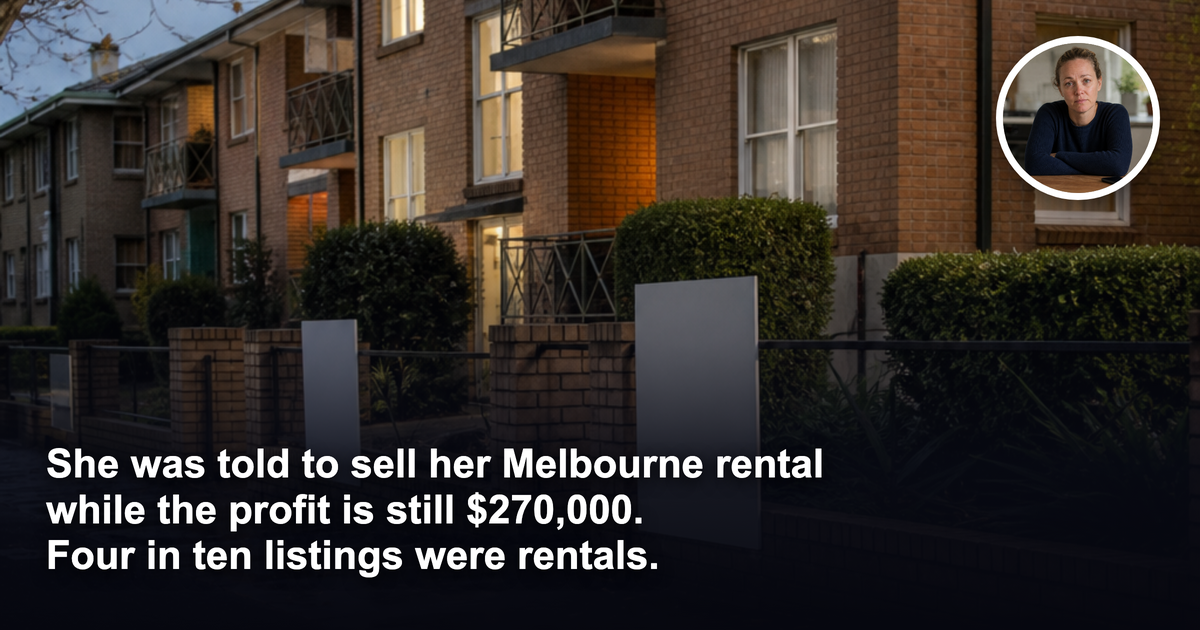
She is 37 and she kept the unit.
She is 37 and she kept the unit.
Eight years ago she bought a two-bedroom unit in Melbourne's inner north. Three years ago she moved in with her partner and his place became home. The unit became her one investment. The rent covered most of the mortgage, the land tax bill arrived every year and got bigger, and she told herself it was a long game.
She is a composite illustration, not a real person. The decision she is facing is very real.
This week an agent who sold a unit two doors down rang her. His pitch was simple. Melbourne sellers who were landlords are walking away with a median profit of about $270,000, realestate.com.au reported on 11 October. Prices for units like hers have softened. Everyone else is getting out. She should too, while the number still has a two in front of it.
Then she read the rest of the article. Former rentals now make up 40 per cent of all Melbourne listings, after the state's tax changes raised the cost of holding an investment property.
Forty per cent.
The question
"If four in ten homes for sale in Melbourne were rentals, and the owners are all selling, am I the last one standing? Do I take the $270,000 and go, or is everyone selling at exactly the moment I should be buying?"
The answer: the $270,000 belongs to someone else
Start with the number, because it is doing more work than it has earned.
A median profit of $270,000 is an exit snapshot. It describes what a large group of Melbourne landlords made between the day they bought and the day they sold, as reported by realestate.com.au. It says nothing about what she would make. Her purchase price, her loan balance, her selling costs and her capital gains tax position are her own. Half the sellers in that group made less than $270,000. Some made a loss. The median hides both ends.
The second thing the number does not tell her is why those owners sold. The article is clear on that. Victoria changed the tax settings on investment property and the cost of holding went up. Owners who were already thin on cash flow ran the sums again and decided the state had made the decision for them. That is a policy outcome, and policy can move again. The $270,000 is what the market paid them to leave, and that alone is no reason for her to follow.
What 40 per cent actually changes
This is the part that matters for anyone holding or buying in Melbourne.
When four in ten listings were recently rentals, two things happen at once.
Buyers get choice. More stock on the same street, and more vendors who have already decided to leave and are pricing to go. A buyer with pre-approval and patience is in a stronger position in some streets than they have been in years.
Tenants lose choice. Every one of those listings was a rental until recently. Some will be bought by investors and stay rentals. Many will be bought by owner-occupiers and leave the rental pool for good. Fewer rentals, same number of renters.
For her, holding a unit that is already tenanted, the second effect is the one nobody puts in a headline. The competition she faces for a good tenant is falling, while the competition she would face for a buyer is rising.
That does not settle it. Selling may still be right for her. If the holding cost after tax has turned the unit into a drain she cannot carry, or if the capital would work harder somewhere with stronger fundamentals, then exiting into a market full of buyers is a sane choice. But she should make it on her own numbers, with her accountant, and with a clear view of what the land tax actually costs her each year against the rent. The decision belongs in a spreadsheet, with the tax on one line and the rent on the next.
The expensive mistake
The expensive mistake is treating a market-wide number as a personal instruction.
"Forty per cent of listings" is a Melbourne figure, and only Melbourne. "Median profit $270,000" is a crowd outcome, and only the crowd's. Investors who sell because a crowd is selling tend to sell into the heaviest supply at the exact moment buyers have the most choice, and then pay a premium to get back in somewhere else once the headlines change.
Two streets in the same Melbourne suburb can be having completely different outcomes right now. One has six ex-rentals on the market and three of them are stale. The next street has none, a waiting list of tenants, and an owner-occupier who just paid above the last sale. Melbourne-wide averages cannot see that. A street-level view can.
The Ripehouse reframe
What we would tell her is the same thing we tell clients in every state.
Policy moves holding costs. It does not change whether a street is a good place to own. The asset, the street and the data decide that, and they decide it over years rather than news cycles.
Our clients' portfolios have grown at a median of +19.0 per cent a year on a 5-year rolling basis, against roughly 6.3 per cent for the combined capitals over the same period (CoreLogic/Cotality benchmark). Past performance is not a guarantee of future results. We publish the full spread, including the portfolios that underperformed, because a median on its own tells you as little about an investor as $270,000 tells you about her.
If she holds, she holds because her street and her numbers say so. If she sells, she sells for the same reason, and she buys the next one on structure, with the holding costs priced in from day one.
Want to see how we test a hold-or-sell decision like this street by street? Join Jacob's free live webinar.
General information only. It does not take your objectives, financial situation or needs into account, and nothing here is legal, financial, taxation or investment advice specific to your circumstances.