
News · 20 October 2026 · 5 min read
Three strikes and a $50m regulator: what Victoria's landlord licence proposal means for your next purchase
Three strikes. That is the number in the Victorian Greens' new election policy, and it is the number every investor with equity should sit with for a minute before deciding where their next property goes.
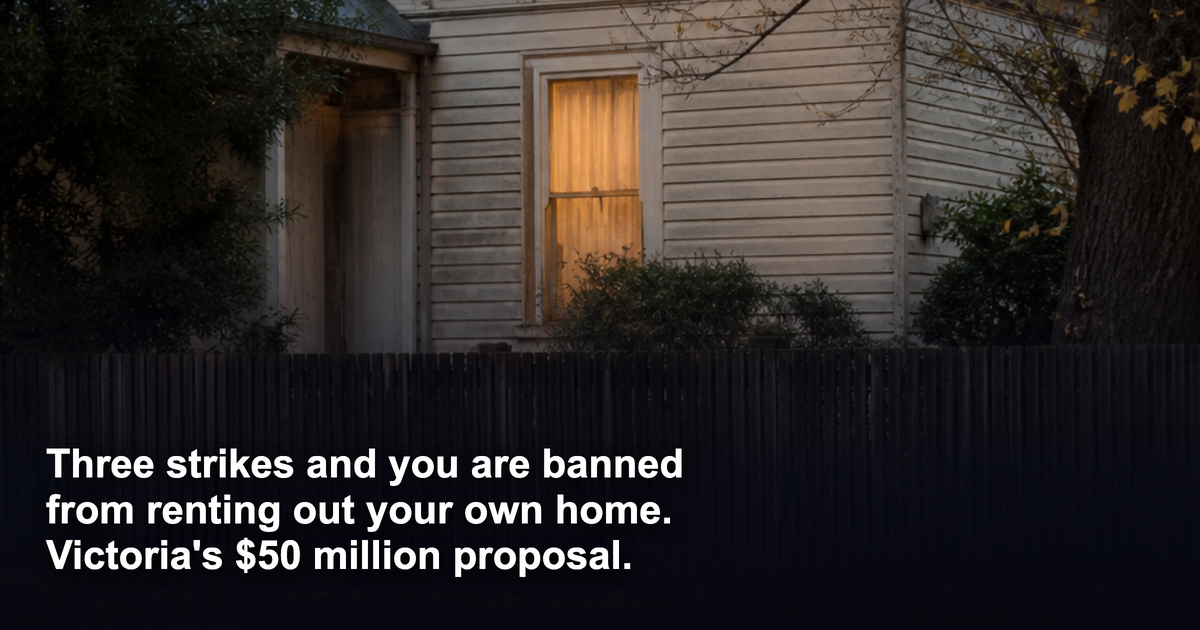
Three strikes. That is the number in the Victorian Greens' new election policy, and it is the number every investor with equity should sit with for a minute before deciding where their next property goes.
Under the proposal, reported by realestate.com.au on 20 October, a Victorian landlord would need a licence to rent out a home. Three breaches of renter standards and that licence could be revoked, which would mean a ban on renting out property in the state. An independent regulator would run it, at an estimated set-up cost of $50 million, along with a public landlord register.
It is a proposal from a minor party ahead of a state election. It is not law and it may never be.
But if you are a homeowner with usable equity and you are weighing Victoria against Queensland, South Australia, Western Australia or New South Wales for your next purchase, this is useful information. The rules a state writes for landlords are an input to the return on that property, in the same way that land tax, vacancy and days on market are.
What changed
Two things happened on the same day.
First, the Victorian government switched on its latest round of rental reforms. Landlords now have to give renters advance notice, with evidence, before claiming on a bond. Landlords and their agents must keep records proving a home met rental regulations before it was advertised. A gasfitter check is required within the six months before draughtproofing work, and draughtproofing itself becomes compulsory from 1 July next year. The Minister for Renters put the running total at more than 150 renter reforms.
Second, the Greens announced the licensing scheme. Three strikes, a regulator, a register. The party's spokesperson for renters said that in Victoria you need a licence to keep bees or use a metal detector, so landlords should need one too.
The detail nobody puts in the headline is this. The Greens went to the last Victorian election with four rental policies: a rent freeze, an end to no-grounds evictions, a ban on rental bidding and minimum standards. Three of the four have since been implemented. Only the rent freeze was knocked back.
So a minor-party proposal in Victoria has a reasonable track record of becoming law a few years later, in some form. That is the base rate an investor should price.
What it means if you have equity or cash to deploy
For a renter, the policy is pitched as protection. Tenants Victoria pointed out there are two million renters in the state and that compliance with minimum standards is their second biggest priority.
For an investor, it is a change in the risk attached to one line of the spreadsheet: compliance.
A licensing regime with a strike count turns a maintenance oversight into a potential business-ending event. A missed repair, a heating unit that does not meet the standard, a mould problem that drags on. Each one of those already costs money. Under a three-strikes rule, each one would also count against a licence.
That shifts value toward two things.
- Compliance-ready stock. A property that already meets minimum standards for heating, cooling, safety and draughtproofing carries less strike risk than an older, tired house that needs work to get there.
- Professional management. A property manager who documents condition before advertising, logs every repair request and keeps gas certificates on file is no longer a convenience. In a strike regime, that record is the defence.
Both of those cost money. Both of those should now be in the Victorian yield calculation, in the same way an investor in a flood-prone Queensland suburb prices insurance.
The decision and the trade-offs
The Property Council's Victorian deputy executive director said the policy would push investment to New South Wales and Queensland. The Property Investors Council called it an overreach and said it would be the final straw for many investors.
That may be right. It is also the easiest conclusion to reach and the least useful one.
An investor who leaves Victoria on the strength of a headline is making a timing bet. An investor who stays in Victoria without pricing the compliance load is making an optimism bet. Neither is structure.
Structure looks like this.
- Decide state allocation on the full set of inputs: land tax, rental law, vacancy, supply pipeline, income growth and the price you pay relative to replacement cost. Regulation is one input, weighted, not a veto.
- If Victoria still clears that bar, buy stock that would pass a licence inspection on day one and run it through a manager who keeps records as if a regulator will read them.
- If Victoria does not clear the bar for you, say so on the numbers and move the capital, rather than reacting to a policy that has not been legislated.
The expensive mistake sits at either extreme. Dumping a well-located Melbourne asset because a Greens press release frightened you is a transaction cost with no return. Buying a cheap, non-compliant Victorian house because the yield looked good on paper is a strike waiting to happen.
The Ripehouse reframe
Here is what we see when we look at a state like Victoria at street level rather than headline level.
Two streets in the same suburb can be having completely different outcomes. One has newer stock, low turnover and tenants who stay. The other has older housing, higher vacancy and more repair requests per year. A three-strikes rule would land very differently on those two streets, even though the policy is written for the whole state.
That is the point. Regulation is applied at the state level, but risk is carried at the asset level. The right asset on the right street in a heavily regulated state can still beat the wrong asset in a lightly regulated one.
We do not ask you to take our results on faith. We publish them, including the portfolios that underperformed, so the question of which state and which street is answered with data, not with the loudest quote in a news story.
Want to see how we weigh a rule change like this against a street's actual numbers before a dollar of your equity moves? Join Jacob's free live webinar, If I Were Buying an Investment Property in Australia Today.
If there's a specific street you're weighing up right now, check its Street Score first — it's free, takes ten seconds, and tells you whether that street is pulling the suburb average up or riding on it.
General information only. It does not take your objectives, financial situation or needs into account, and nothing here is legal, financial, taxation or investment advice specific to your circumstances.