News · 21 October 2026 · 4 min read
$81 to Penrith, no train until 2027: the airport corridor pitch tested on real transport costs
Western Sydney International Airport opens to commercial flights on October 25. It sits 45 kilometres from the Sydney CBD and 18 kilometres from Penrith, and it will run 24 hours a day.
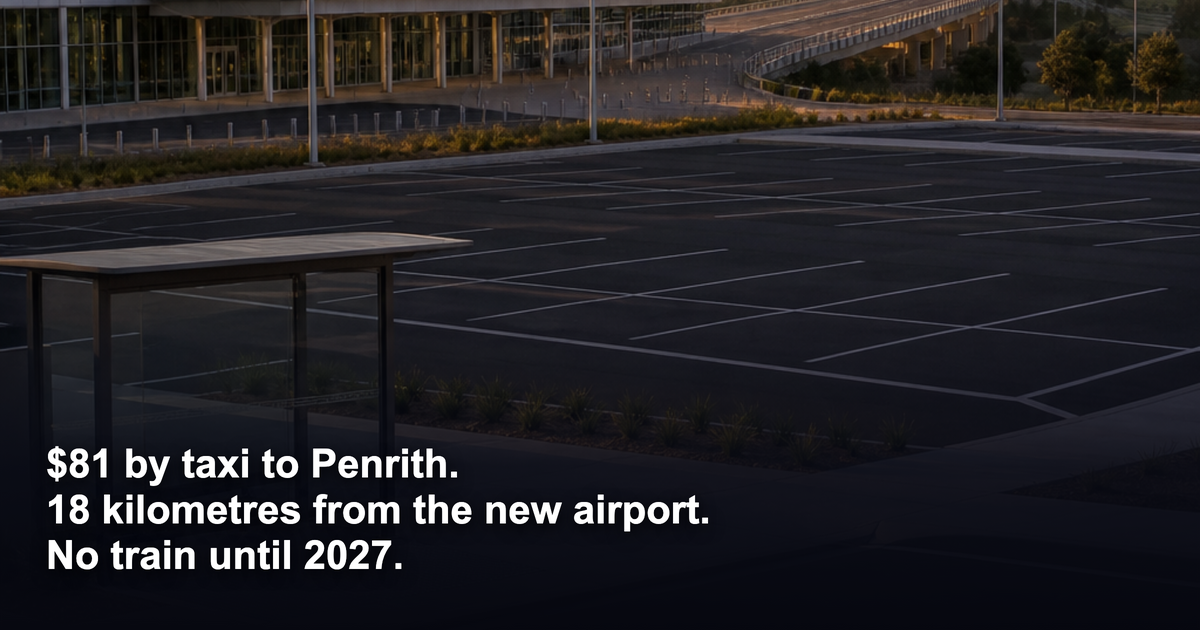
$81 to Penrith, no train until 2027
Western Sydney International Airport opens to commercial flights on October 25. It sits 45 kilometres from the Sydney CBD and 18 kilometres from Penrith, and it will run 24 hours a day.
The ABC published a door-to-door cost breakdown this week. One figure in it should sit in front of anyone being pitched property in the corridor: a taxi from the airport to Penrith CBD is expected to cost about $81. Rideshare, about $60. For a trip of 18 kilometres.
The metro line that is supposed to make the airport easy to reach is not due until 2027. Until then, rail passengers get off at St Marys, about 20 kilometres away, and take a free shuttle bus that runs every 30 minutes and takes roughly twice as long as the metro will.
That is the access story on opening day. It matters more to a property decision than the airport itself.
What actually changed
A second Sydney airport changes three things at once.
Kingsford Smith has a curfew from 11pm to 6am and is congested by slot limits. WSI has neither problem, which is why low-cost carriers want it. Qantas, Jetstar, Air New Zealand, Singapore Airlines, VietJet and Fiji Airways have announced routes. Qatar Airways has signed on for Doha from December 2027. WSI says more than 500,000 people travelled between NSW and Vietnam in 2025, and about 400,000 fly to Fiji each year.
Second, the catchment is large. WSI estimates at least a third of Sydney's population lives within a 45-minute drive, and the new M12 motorway is toll-free. The airport has opened more than 6,000 car spaces, with long-stay parking from $15 a day.
Third, the public transport picture is thin for now. Local buses from Mount Druitt, Penrith, Liverpool, Campbelltown and Leppington take 30 minutes to over an hour, from $5.77 in peak. From Central, the quickest route is train plus a bus from Penrith: about 1 hour 40 minutes for $10.31. The Super Shuttle from the Sydney CBD costs $55 one way or $80 return and takes 45 to 60 minutes. From Parramatta it is $25 one way, $45 return, up to 45 minutes.
So the airport is real, the airlines are real, and the drive-in catchment is real. The rail link is a 2027 promise.
What it means if you have equity to deploy
The pitch you will hear is simple. Airport opens, jobs follow, demand follows, prices follow. Buy within the corridor and ride it.
Some of that will play out for some streets. The mistake is treating distance on a map as the thing that creates value.
Read the ABC figures again as a tenant or an owner-occupier would. Living 18 kilometres from an airport you cannot reach by train, where the taxi home costs $81, is a different proposition from living 15 minutes from it by metro once the line opens. Those are two different suburbs' worth of outcomes, and until 2027 only one of them exists.
The airport also runs around the clock. A 24-hour flight path over a quiet street is a cost to the people living under it, and the market prices that cost whether or not the brochure mentions it. Proximity cuts both ways.
Then there is timing. The savings on airfares, according to the UNSW transport chair quoted by the ABC, depend on jet fuel prices, which are rising during the conflict in the Middle East. The cheapest flights, and the passenger volumes that come with them, may arrive later than the opening-day headlines suggest.
The decision, with numbers
A homeowner with usable equity looking at the corridor faces one question: does this specific property gain from the airport, or does it just sit near it?
Work it through on the ABC's figures.
- Access now: is the property within a reasonable drive of the M12, or does it rely on a bus that takes over an hour?
- Access in 2027: is it near a station on the metro line, or is it near the airport without being near the train?
- The 24-hour cost: is it under the flight path, and what does that do to rents and resale?
- The buyer pool: who else is buying this street, and are they paying a premium today for a rail link that does not yet exist?
The expensive mistake is paying the 2027 price in 2026, on a street that will not be on the line even then.
Two streets, two outcomes
Ripehouse looks at this the way we look at every location decision: street by street, with the full spread of results, including the ones that disappoint.
Airport corridors are a good example of why. Two streets in the same suburb can be having completely different outcomes. One sits ten minutes from a future metro station and off the flight path. The other sits closer to the runway, further from the rail, and backs onto a road that will carry airport freight. Both are "near the airport". Only one of them is an investment.
Our position is that the asset and the street decide the result. Infrastructure headlines are the backdrop. Days on market, vacancy, the mix of owners to renters and the actual access a tenant will pay for are what move the number on your statement. Structure beats timing, and the data beats the brochure.
Want to see how we test a corridor decision like this street by street? Join Jacob's free live webinar.
This article is general information only, not personal financial advice. Figures are from the ABC's reporting of 21 October 2026 and have been rounded down.
If there's a specific street you're weighing up right now, check its Street Score first — it's free, takes ten seconds, and tells you whether that street is pulling the suburb average up or riding on it.
General information only. It does not take your objectives, financial situation or needs into account, and nothing here is legal, financial, taxation or investment advice specific to your circumstances.