News · 20 October 2026 · 4 min read
A licence was all she checked. Up to $138 million is now feared lost at a licensed Sydney firm.
She is 38, lives in Perth with her partner and their four-year-old, and has about $300,000 of usable equity in the home they bought in 2019. She has no investment property. She is a composite illustration, not a real person, built to show a decision thousands of households are...
She had the money ready
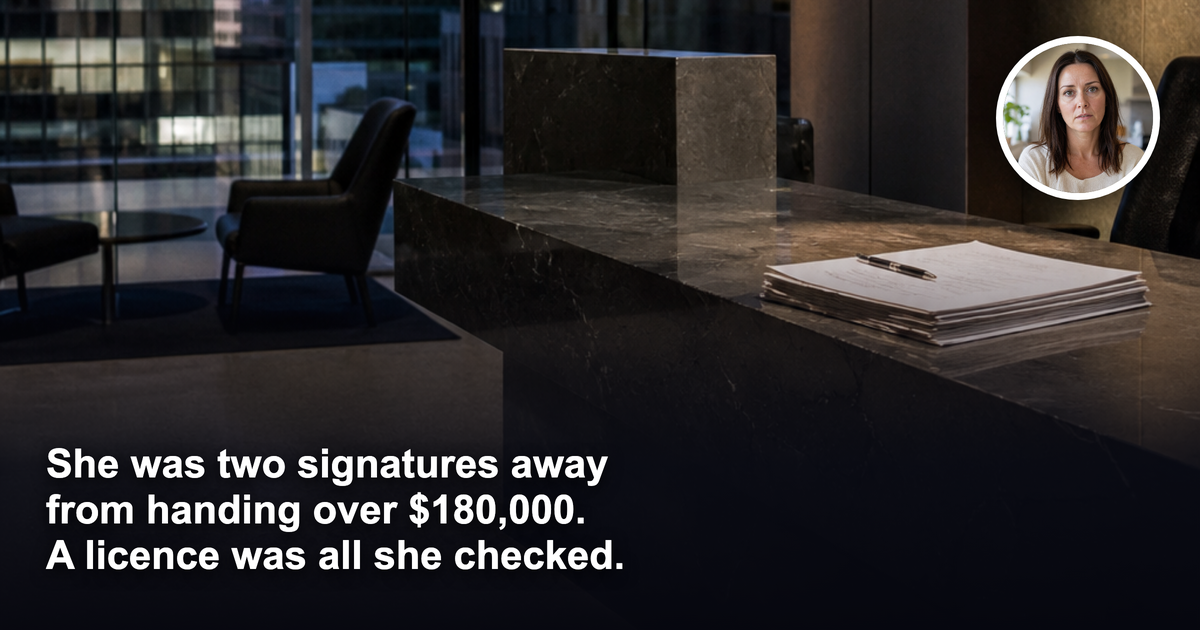
She is 38, lives in Perth with her partner and their four-year-old, and has about $300,000 of usable equity in the home they bought in 2019. She has no investment property. She is a composite illustration, not a real person, built to show a decision thousands of households are making right now.
For the past two months she has been meeting a financial firm that wants to manage her next step. Polished office. Licensed. Australian Financial Services Licence number on every document. The plan was to release $180,000 of equity and hand it over to be invested on her behalf.
She was two signatures away.
Then the ABC reported that a Sydney firm holding an AFSL is being investigated over alleged links to suspected scammers, with up to $138 million feared lost.
She has no connection to that firm. What stopped her was simpler. She realised she had done exactly what those investors did. She had checked for a licence and stopped.
The question
"If a licensed firm can be investigated over alleged links to scammers, what was the licence actually protecting me from? What am I supposed to check that I didn't?"
The answer: a licence is where checking starts
Here is what a licence does. It means a firm has met the regulator's conditions to offer financial services. It sets obligations. It gives you somewhere to complain.
Here is what it does not do. It does not tell you who holds your money. It does not tell you whether the firm earns a payment from the product it is recommending. It does not tell you whether the people behind the firm have ever shown their full results to anyone.
The ABC report describes a firm that held the licence and is now under investigation. The allegations are untested, nobody has been found to have done anything wrong, and the final figure may be lower than $138 million. But the investors now waiting to learn whether their money is gone were given no protection by a licence number printed on the paperwork.
That is the expensive mistake. Treating a licence as the end of due diligence instead of the start.
The three questions she had not asked
- Who holds the money? If the answer is anything other than an account in your name, or a property with your name on the title, you need to know exactly where it sits and who can move it.
- Who pays them? A firm that takes a payment from the developer, the builder or the product it recommends has a reason to recommend it that has nothing to do with you.
- Where are the results? All of them, including the ones that went badly. If a firm can only show you its best clients, you are looking at a highlight reel.
She had asked none of these. Most people do not. Firms pitching to busy households with equity are very good at making the questions feel rude.
What it means for you
Up to $138 million is a lot of individual decisions. Each one was made by someone who had worked for the money, saw a licence, and felt safe.
If you are a homeowner in your thirties or forties with equity sitting there and an income that outruns your net worth, you are the exact person these pitches are built for. You are time-poor. You want someone competent to take it off your hands. That is a reasonable thing to want.
Delegation is fine. Blind delegation is the part that costs you.
Two streets in the same suburb can be having completely different outcomes right now. The same goes for two firms holding the same licence. The paperwork looks identical. What sits underneath it does not.
The Ripehouse reframe
We do not sell property, and we take no developer kickbacks. Across 997 client portfolios since 2021, the median portfolio has grown 19.0 per cent a year on a 5-year rolling basis, against roughly 6.3 per cent for the combined capitals (CoreLogic/Cotality). Past performance is not a guarantee of future results.
We publish those results in full, including the portfolios that underperformed, because a number you can check is worth more than a licence you can only read.
She still wants to invest her $180,000 of equity. She should. The decision that matters is the one she almost skipped: who holds it, who pays them, and whether they will show her everything. The right asset on the right street, chosen on data, beats a polished pitch every time. Structure, not timing.
Want to see how we test a firm, a street and an asset before a dollar moves? Join Jacob's free live webinar.
If there's a specific street you're weighing up right now, check its Street Score first — it's free, takes ten seconds, and tells you whether that street is pulling the suburb average up or riding on it.
General information only. It does not take your objectives, financial situation or needs into account, and nothing here is legal, financial, taxation or investment advice specific to your circumstances.