Market Analysis · 9 June 2026 · 10 min read
The Market the Headlines Missed
The headlines say wait. The data says something more useful. Across listings, sales, rents, vacancy and suburb quality, the 2026 Australian property market is rising, tightening, and rewarding quality — a buyer's year, if you buy like a professional.

Why 2026 is a buyer's year — if you buy like a professional
The public story about Australian property right now is simple.
Rates are high.
Affordability is hard.
Confidence is weak.
Auction clearance rates are soft.
And so, the conclusion writes itself: sit on your hands and wait.
That story is easy to understand. It also appears to be wrong.
This is the problem with public market commentary. It often rewards the loudest headline, not the most useful truth. The media is built to get attention. Fear gets attention. Nuance does not.
Professional investors do not buy from headlines. Family offices do not build wealth from nightly news segments. They look at data, pressure-test the numbers, and move when the gap between public fear and real fundamentals becomes obvious.
That is what we are seeing now.
When we looked under the surface — across listings, transactions, rents, vacancy, suburb quality and council-level activity — the market looked very different from the media narrative.
The market is not collapsing. It is splitting.
The softness is concentrated where prices are highest and supply is heaviest — chiefly Sydney and Melbourne, whose median dwelling values ($1.28 million and $0.81 million) sit at the expensive, over-supplied end of the spectrum. Meanwhile the more affordable, demand-driven capitals and regions — where the national median sits closer to $0.94 million — kept rising. The "market" is not one thing, and treating it as one is the first mistake.
Underneath the headlines, the picture is clear.
The right markets are rising.
Rental demand is tightening.
And capital is moving toward quality.
That creates opportunity for investors who know what they are doing.
And we now have the proof in writing. Cotality's Home Value Index for May 2026 — released in June, a full month of data captured roughly two weeks after the federal budget — lets us test the narrative against reality. The point is not to call the post-budget market to the decimal. It is to show that the fundamentals underneath have not changed.
1. The national market is growing, not shrinking
Start with what actually happened after the budget.
In May 2026 — the first full month of post-budget data — national dwelling values were flat at 0.0%, and up 8.8% over the year (Cotality, formerly CoreLogic). A market that the headlines said should be cracking simply… held.
That is not what a falling market looks like.
A falling market has values dropping across the board, stock piling up, and homes sitting unsold.
This market did the opposite. Underneath that flat national number, most of the country kept rising — and only the two most expensive capitals went backwards.
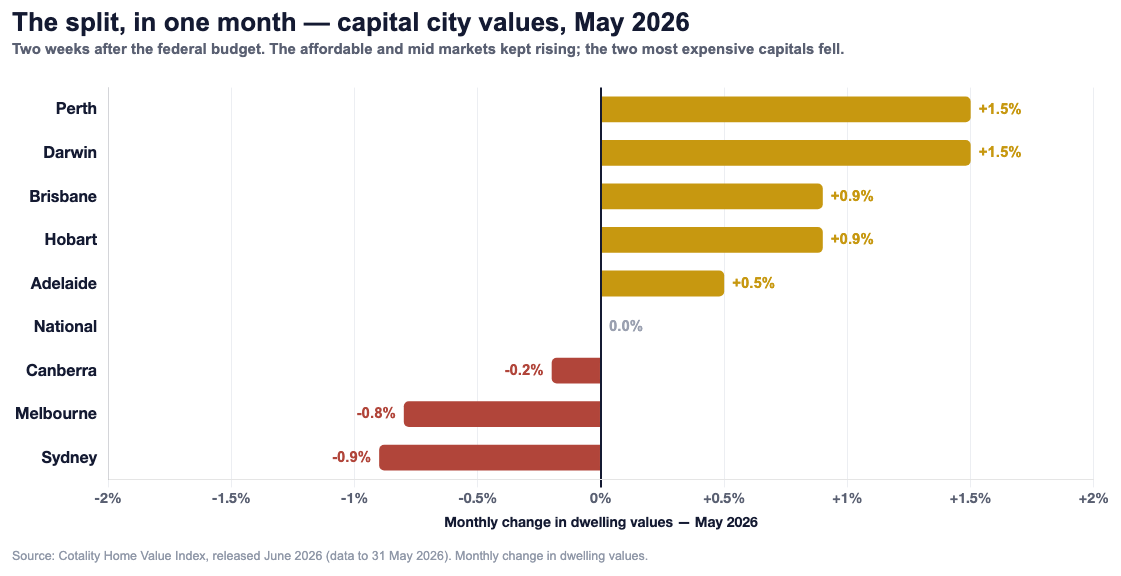
In the month after the budget, Perth and Darwin both rose 1.5%, Brisbane and Hobart 0.9%, and Adelaide 0.5%. Regional Australia rose 0.6%, with regional WA up 1.9%. The only fallers were Sydney (−0.9%), Melbourne (−0.8%) and Canberra (−0.2%).
This is not a guess about where things are heading. It is the first read of the market actually responding to the budget — and it kept climbing almost everywhere.
The annual numbers tell the same story, only louder. Over the year to May, Perth was up 25.8%, Darwin 20.3%, Brisbane 19.1% and Adelaide 12.3%. Cotality's own research director, Tim Lawless, calls it "multi-speed conditions… with Perth and Melbourne at opposite ends of the spectrum."
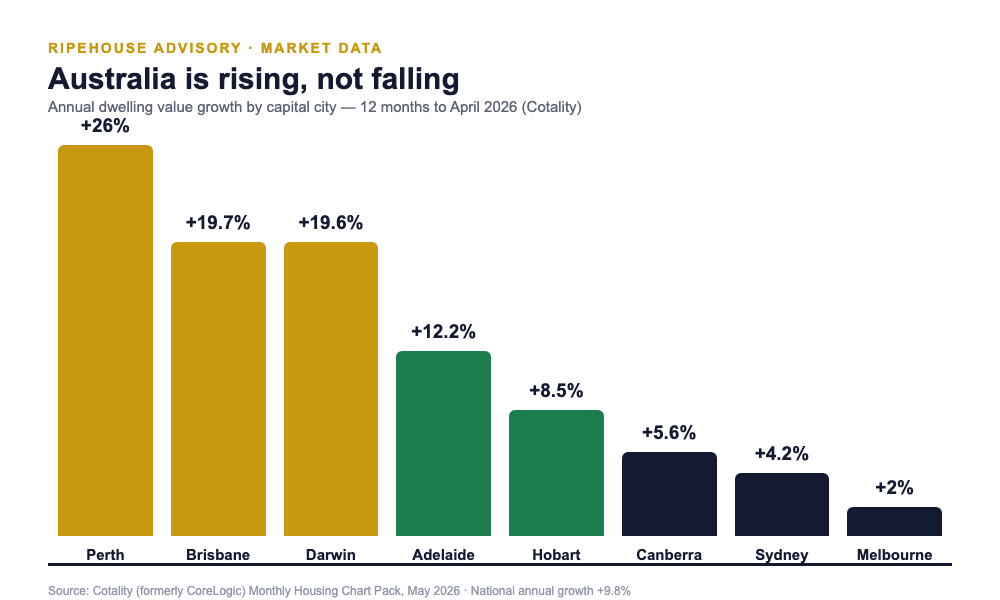
The important point is not just that most of the market is rising. It is that the market is uneven.
The gap between the fastest and slowest capital cities is now massive. That changes the game. You cannot buy "the Australian property market" anymore and expect an average result. You need to buy the right market, the right suburb, the right street, and the right property.
That is exactly why professional guidance matters.
2. The "sales crash" that never happened
One of the easiest mistakes in property is to read a number without understanding where it came from.
A raw look at recent transaction data may suggest sales are down nearly 30% year-on-year. That sounds scary. It sounds like the market has frozen.
But that number is misleading.
Recent settled sales data always takes time to populate. The most recent months are incomplete because many sales have happened but have not yet been recorded. It is like looking at a scoreboard halfway through the first quarter and declaring the final score.
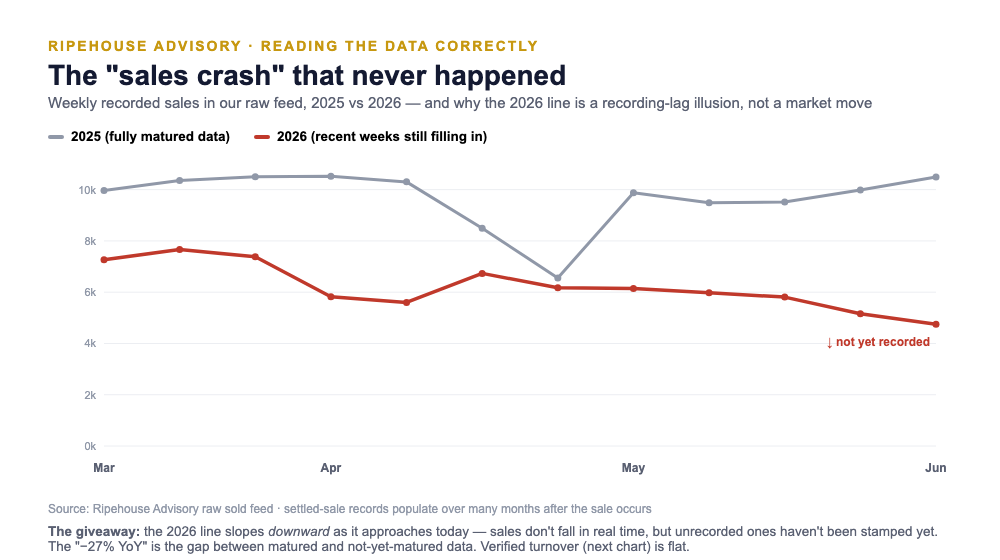
When Ripehouse Advisory tested the data properly, the picture changed.
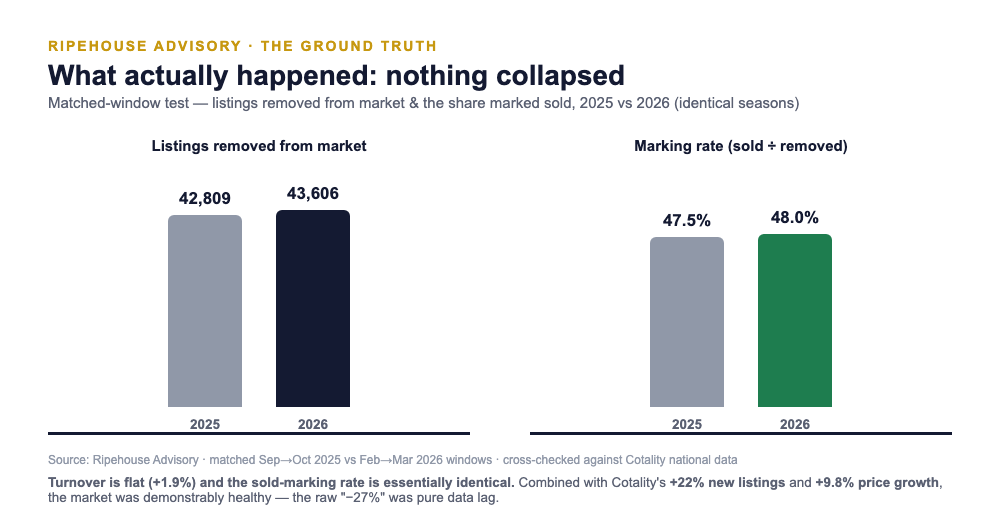
Listing turnover was basically flat. The share of removed listings marked as sold was almost identical year-on-year — 47.5% versus 48.0%. That means the "collapse" was not a real market crash. It was a data lag dressed up as a trend.
This matters.
An amateur investor can lose confidence because of one scary number.
A professional investor asks whether the number is real.
That is the difference between guessing and investing.
3. Quality is holding. Weak stock is fading.
The market is not moving as one big block.
Quality is holding up. Weakness is showing up in lower-quality stock.
Ripehouse Advisory scores suburbs using the R-Score, which looks at investment-grade fundamentals: growth drivers, scarcity, demographics, infrastructure and yield.
When the market is split into five R-Score bands, the pattern is clear.
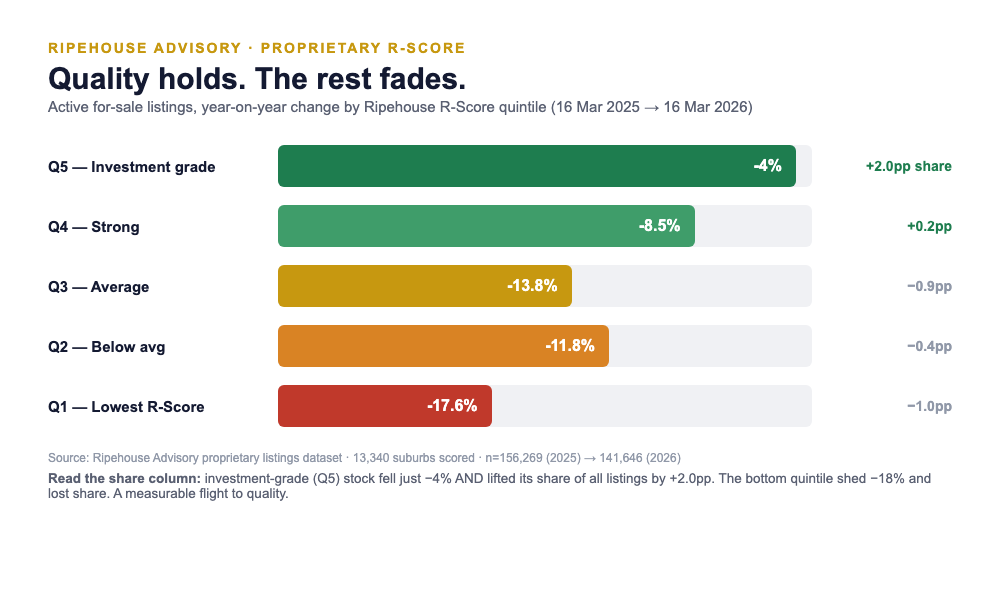
Investment-grade stock was down only 4% in active for-sale listings, while the lowest-rated stock was down almost 18%. The best-rated suburbs also gained share of the total market, while the lowest-rated suburbs lost share.
That is a flight to quality.
When conditions get harder, money does not disappear. It becomes more selective.
Think of it like water running downhill. Capital will always find the strongest channel. In property, that channel is quality: strong locations, broad demand, limited supply, strong incomes, infrastructure, jobs and lifestyle demand.
The average investor often chases the cheaper property because it feels safer.
But cheap is not the same as good value.
A weak suburb at a lower price can still be expensive if the fundamentals are poor. A quality suburb at a higher price can still be good value if demand keeps compounding.
That is where many investors get caught.
They buy what they can afford, not what they should own.
4. Some markets are already pushing ahead
This is not theory.
There are real council areas where activity has grown or held firm while weaker parts of the market softened.
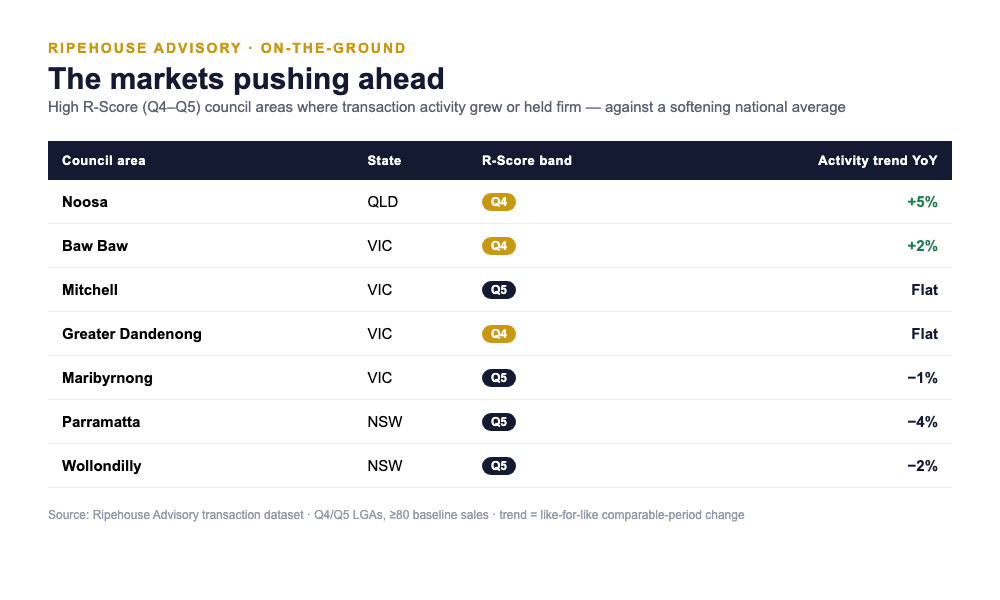
Noosa was up. Baw Baw was up. Mitchell and Greater Dandenong held flat. Parramatta, Sydney's second CBD, barely moved despite broader caution.
These are not random lottery tickets.
They are markets with structural demand.
They have jobs, infrastructure, population growth, lifestyle appeal, or strong long-term economic drivers. They are the types of markets that continue to attract buyers and tenants even when public confidence is shaky.
That is what family offices look for.
They do not ask, "What is the cheapest thing I can buy?"
They ask, "Where will demand still exist in 10 years?"
That is a very different question. It leads to very different assets.
5. The rental story is still powerful
Capital growth is only one half of the investment story.
The other half is rent.
And rents are still moving.
To May 2026, national rents were up 5.9% year-on-year — the largest annual increase in well over a year — the national vacancy rate sat at just 1.5% (back in line with the record lows of 2022–23), and gross rental yields were expanding, with combined-capital yields at their highest since the middle of last year.
That combination matters.
Investors are not just seeing capital growth. They are also seeing better income support.
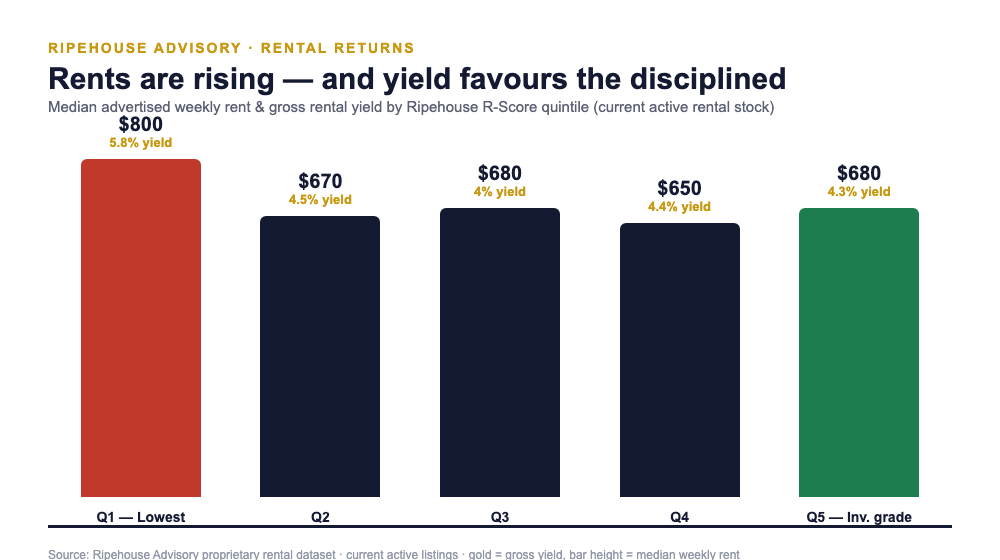
Across every R-Score band, rents rose over the period. Investment-grade markets produced a solid yield while still sitting in a higher-quality part of the market.
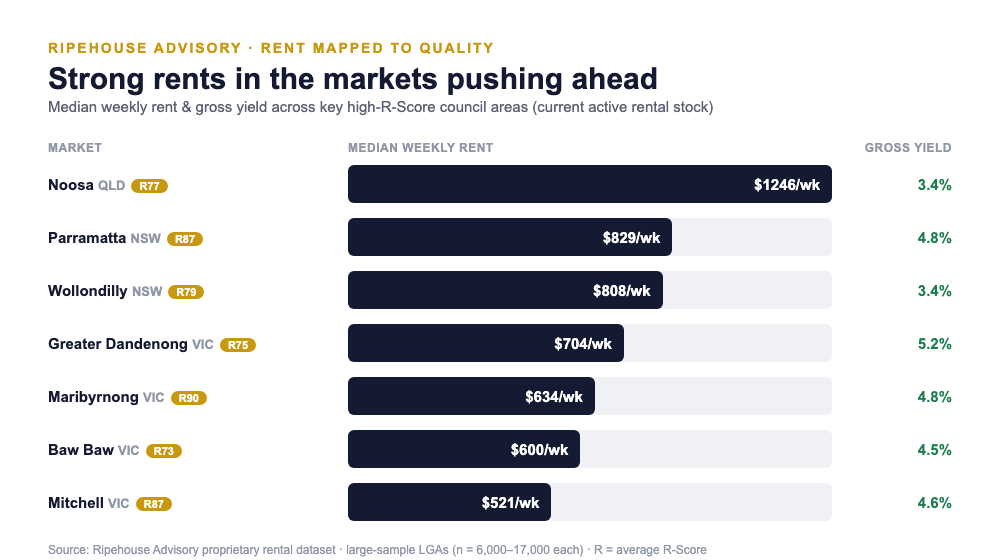
That is the balance serious investors want.
They do not chase yield at any cost. High yield in a weak suburb can be a trap. It can look good on a spreadsheet and then fail in real life through poor tenant quality, weak resale demand, low growth or higher maintenance.
Good investing is not about one number.
It is about the full machine working together: capital growth, rental demand, tenant quality, scarcity, liquidity and long-term demand.
6. Vacancy is still extremely tight
The rental market remains tight, and this is one of the few measures we can read cleanly right up to the most recent month.
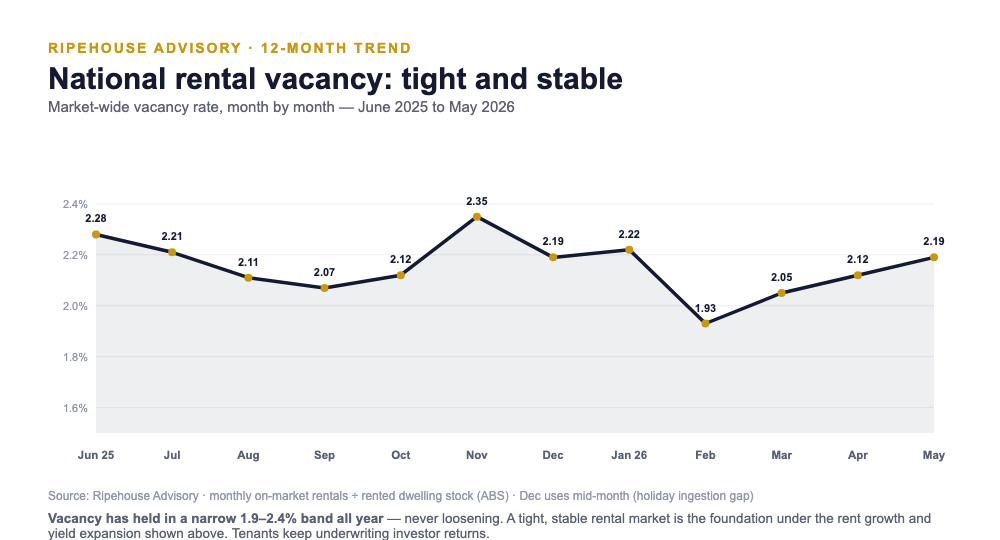
Across the past year, national vacancy held in a tight band between roughly 1.9% and 2.4%, and it has barely moved year-on-year — essentially flat to slightly tighter. The recent months show only a mild, seasonal drift, not a loosening. By any historical standard, a rental market sitting near 2% is tight.
That is important because low vacancy is the engine behind rent growth.
When tenants have few options, rents stay supported. That improves the income side of the investment. It also gives investors more confidence to hold through the cycle.
A strong rental market is like oxygen for a property portfolio. You may not talk about it every day, but without it, the whole system struggles.
Right now, that oxygen is still there.
7. Why waiting may be the bigger risk
Many investors are waiting for the perfect moment.
They want interest rates to settle.
They want headlines to turn positive.
They want confidence to return.
They want certainty.
It is worth being honest about the backdrop. The cash rate is still elevated, and the May budget tightened the rules around property investment — narrowing negative gearing toward new builds and reworking the capital gains discount from later this decade. These are real changes. But they do not alter the core arithmetic of this market: too little housing, strong rental demand, and a widening gap between quality and weak assets. If anything, a tougher policy environment raises the premium on buying the right asset and structuring it properly — which is the opposite of a reason to sit out.
But markets do not reward people for waiting until everything feels safe.
By the time the story feels comfortable, the opportunity is usually smaller.
This is the real risk right now: being paralysed by sentiment. Sentiment can turn quickly — a rate cut, a budget measure, a run of positive headlines — and when it does, the window closes fast. The fundamentals underneath have not changed. Supply is still constrained, rental demand is still strong, and vacancy is still tight. The smart move is to position now, while sentiment is poor, rather than wait for the crowd to feel comfortable and pay more for the privilege.
The data now shows rising values, faster absorption of stock, tight vacancy, rising rents, and a clear shift toward quality assets.
That does not mean every property is a good buy.
It means the right properties may be mispriced because public sentiment is still cautious.
That is the opportunity.
The market is not cheap everywhere. But quality may still be underappreciated relative to its fundamentals.
That is when professional investors pay attention.
8. How family offices buy this market
Family offices do not build wealth by following public emotion.
They use a process.
They separate noise from signal.
They test the data.
They buy fundamentals.
They think in decades, not weeks.
They use experts where expertise matters.
That is the model ordinary investors should study.
Most investors are not short on motivation. They are short on process.
They need help knowing where to buy, what to avoid, how to compare markets, how to assess risk, and how to build a portfolio that can survive different conditions.
That is the role of a professional advisory business.
At Ripehouse Advisory, this is the work.
We do not just ask whether a property looks affordable. We ask whether it belongs in a long-term wealth strategy.
We look at the market.
We look at the suburb.
We look at the street.
We look at the asset.
We look at the numbers.
Then we pressure-test the decision.
That is how serious investors operate.
The bottom line
The headlines are telling investors to be cautious.
The data is saying something more useful.
The market is rising.
Rental demand is strong.
Vacancy is tight.
Quality is outperforming.
And the gap between good and weak assets is getting wider.
This is not a market for guessing.
It is a market for discipline.
The average buyer will keep reacting to headlines. The professional buyer will keep following the evidence.
That is the divide.
And right now, investors need to decide which side of that divide they want to buy into.
For investors still unsure where the split market offers real value, the Ripehouse Advisory webinar is a practical way to pressure-test suburb quality, vacancy and timing before deciding whether to act.
Frequently asked questions
Is the Australian property market actually falling in 2026, or is it just the headlines saying that?
According to the article, it is not a broad fall. National dwelling values were flat in May 2026 and still up 8.8% over the year, with most markets rising and only Sydney, Melbourne and Canberra going backwards.
Why did recent sales data make it look like the market had crashed?
The article says the apparent sales drop was caused by incomplete settled sales data, which lags in recent months. When the data was tested properly, listing turnover was basically flat and the share of removed listings sold was almost unchanged year-on-year.
What does it mean when the article says the market is 'splitting'?
It means Australian property is no longer moving as one market. Higher-priced, more heavily supplied cities like Sydney and Melbourne have been softer, while more affordable and demand-driven capitals and regions have kept rising.
What kind of properties are holding up best right now?
The article says quality stock is holding up better than weaker stock. Suburbs with stronger fundamentals such as growth drivers, scarcity, infrastructure, jobs and lifestyle demand are attracting more buyer interest and are losing less listing stock.
What is the main risk in waiting for the market to feel safer before buying?
The article says the bigger risk may be paralysis from sentiment. If buyers wait for better headlines, they may miss the period when quality assets are still underappreciated and end up paying more once confidence returns.
General information only. It does not take your objectives, financial situation or needs into account, and nothing here is legal, financial, taxation or investment advice specific to your circumstances.