News · 1 October 2026 · 5 min read
The headlines say worst downturn in decades. The Reserve Bank just said she is not the problem.
She is 39. She bought a three-bedroom brick house in 2019, on her own, after her thirties did not go the way she had planned. She owes about $480,000 on it. She has never borrowed a dollar against it since.
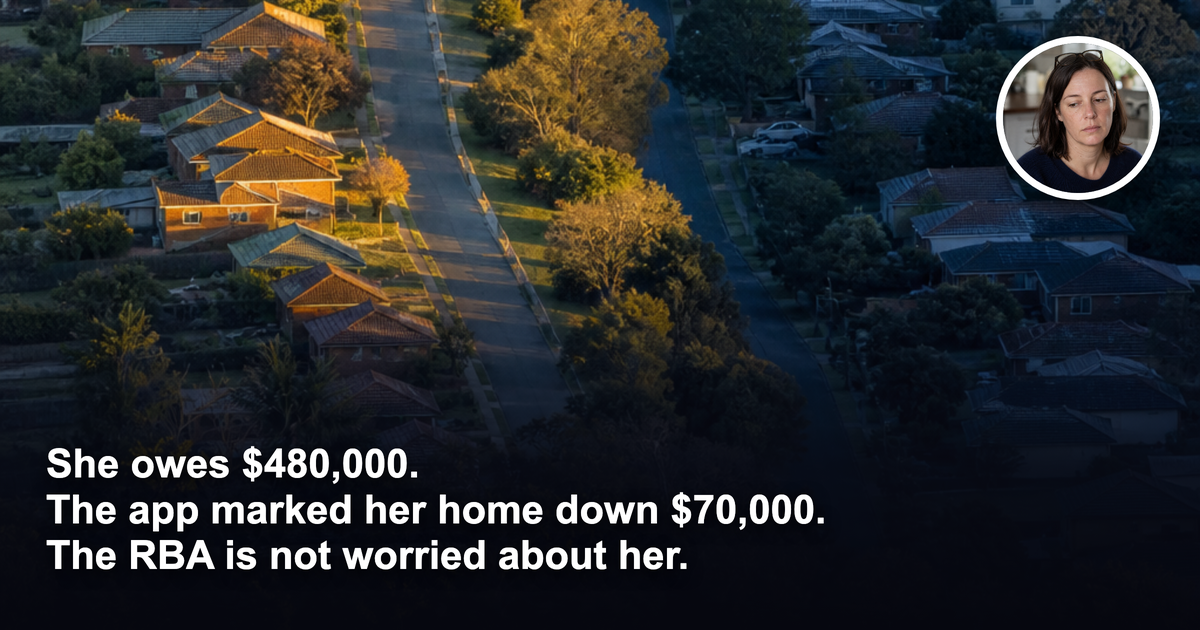
She is 39. She bought a three-bedroom brick house in 2019, on her own, after her thirties did not go the way she had planned. She owes about $480,000 on it. She has never borrowed a dollar against it since.
Every pay cycle she puts what she can into the offset. There is a bit over a year of repayments sitting in there now. She has never told anyone that, because it sounds like bragging and it does not feel like safety.
In March her bank's app put a number on the house. It has moved that number down four times since. The last move took it to roughly $70,000 below where it started.
She stopped opening the app in August.
Then on Tuesday the cash rate went to 4.6 per cent, a 15-year high. Two days later the Reserve Bank released its half-yearly Financial Stability Review. The ABC's summary of it ran under a headline she would not have expected: the bank is relaxed about housing and deeply worried about something else.
*She is a composite, drawn from the questions we receive. The numbers in her story are typical of those questions, not taken from one person.*
### The question she sent us
*"Every news story says this is the worst downturn in decades. My house has dropped $70,000 in six months and rates just went up again. I have equity and I have savings and I am doing nothing with either of them because I am waiting to find out how bad this gets. How bad does the Reserve Bank think it gets?"*
That is the right question, and almost nobody is asking it. They are asking what the headline thinks.
### The answer: the RBA ran the numbers and did not flinch
Here is what the Reserve Bank actually said this week, as reported by the ABC.
At the end of June, less than 2 per cent of variable-rate owner-occupier borrowers had a cash flow shortfall, meaning their income could not cover scheduled repayments and essential spending. The bank expects that to drift to 2 per cent or a little above now that the cash rate has moved to 4.6 per cent. In 2023 and 2024 that figure was close to 5 per cent.
The median borrower holds offset or redraw buffers covering more than a year of repayments at current rates.
Less than 1 per cent of borrowers are in negative equity.
And the line that should be the headline: the RBA estimates that even a 20 per cent fall in house prices would put only around 5 per cent of mortgages into negative equity, because of how far values ran up before this downturn began.
The bank then modelled what it called a very adverse downturn. Unemployment to 6.3 per cent from 4.6. Inflation near 7 per cent. Cash rate another full point higher, to 5.6 per cent. Under that scenario, it estimates about 5 per cent of mortgage borrowers would be at higher risk of default. Similar to 2023. Not a cliff.
So where does the Reserve Bank think the real danger sits? Offshore. It says threats to international financial stability "continue to mount". It names an AI investment boom financed through arrangements it calls opaque and circular, with off-balance-sheet obligations it puts at $US1 trillion to $US1.5 trillion. It warns that risk premia in major equity and credit markets could "move sharply higher" in a disorderly way. That is the bank's worry list. Her street is not on it.
### What she is actually doing
She is treating a valuation app as if it were a margin call.
It is not. Her repayment did not change when the number did. Her buffer did not shrink. Nobody can ask her for the $70,000. The gap between what the app says and what she owes is a ratio on a screen, and it only becomes money on the day she sells.
She is not selling. She is doing something quieter and, over ten years, more expensive. She is doing nothing.
She has equity she has never used and a cash buffer the Reserve Bank would describe as above median, and both are sitting still while she waits for a headline to tell her it is safe. The headline never does that. It moves on to the next thing.
### The mistake almost nobody prices in
The downturn is real. Values have fallen and the ABC is right that it could be the worst in decades. Nobody serious should pretend otherwise.
But the Reserve Bank has just told you, in its own document, that the household sector can absorb it. That shifts the question. If the system is not the risk, then the risk for any individual owner is structural: how much buffer you hold, how your debt is split between fixed and variable, how much equity you draw and in what order, and whether the asset you own is one of the ones falling or one of the ones holding.
That last point matters more than any national figure. Two streets in the same suburb can be having completely different years right now. One is sitting on the market for months with the price cut twice. The other is clearing in a fortnight. The national headline averages them together and tells you nothing about either.
A frozen owner is not waiting for information. She already has the most authoritative information in the country, and it says she is fine. She is waiting for a feeling.
### The Ripehouse reframe
We do not make timing calls. We will not tell you this is the bottom, because nobody knows that, and the people who say they do are selling something.
What we will say is that the Reserve Bank has just described the median Australian borrower as resilient, and a great many people reading this are that borrower. Equity they have never structured. A buffer they have never put to work. Net worth that lags income for no reason other than that nothing has been decided.
That is a structure problem, not a discipline problem. And it is fixable.
We publish our client results in full, including the portfolios that underperformed, because the right asset on the right street, chosen with data rather than headlines, is the thing that beats a downturn. Not the timing of it.
Book a 15-minute Legacy Sequence Diagnostic: ripe.house/4bV7I8u. No pressure. No obligation. Just a clearer picture than you had before.
*This article is general information only and is not personal financial, legal or tax advice. Figures are drawn from the RBA's October 2026 Financial Stability Review as reported by ABC News on 1 October 2026.*
General information only. It does not take your objectives, financial situation or needs into account, and nothing here is legal, financial, taxation or investment advice specific to your circumstances.