News · 30 September 2026 · 5 min read
'Do I wait for the bottom?' She has $400,000 of equity and a headline saying 15 per cent more to fall
She is 44. She and her husband bought the family home in 2014, refinanced twice, and have quietly paid it down to the point where they hold about $400,000 of equity. They have two kids in high school, an offset that is finally doing some work, and a plan they have talked about...
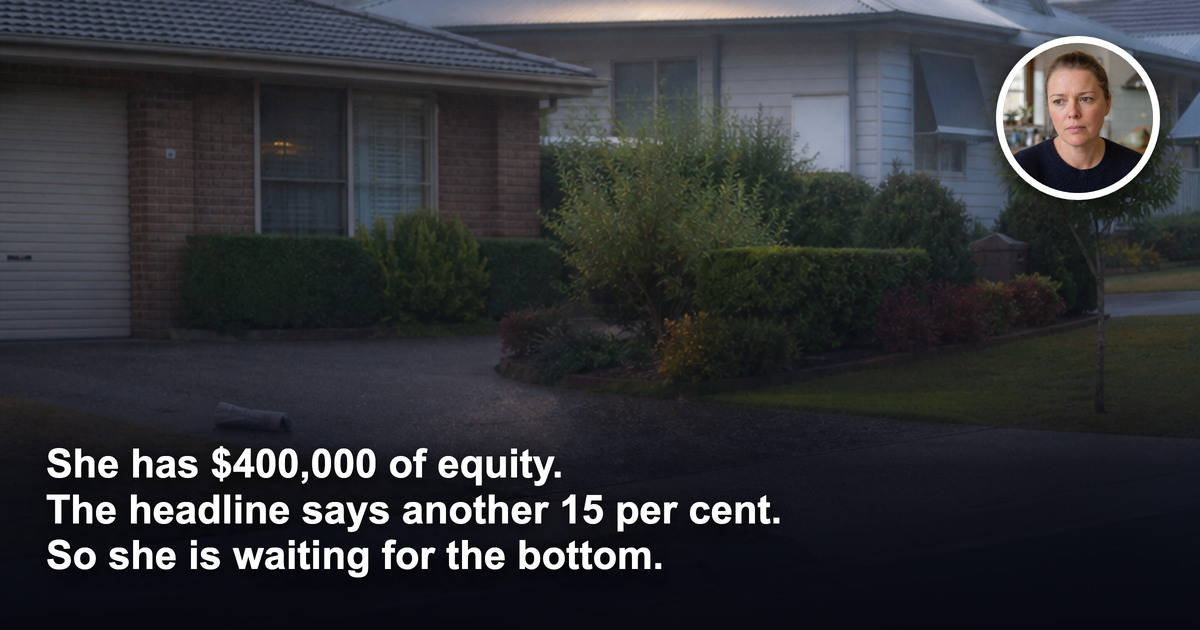
She is 44. She and her husband bought the family home in 2014, refinanced twice, and have quietly paid it down to the point where they hold about $400,000 of equity. They have two kids in high school, an offset that is finally doing some work, and a plan they have talked about for three years: use the equity to buy one investment property before the eldest finishes school.
They had pre-approval. They had a shortlist.
Then on Wednesday morning the ABC reported that national house prices had fallen for a sixth straight month, that Australia was facing its "biggest property downturn in 40 years", and that some experts were forecasting further falls of up to 15 per cent. Higher rates, cuts to property tax breaks, recession risk. All of it in one headline.
She forwarded it to her husband with two words: "We wait."
*She is a composite, drawn from the questions we have received this week. The numbers are hers in spirit, not from any one client file.*
### The question she sent us
*"We have about $400,000 of equity and we were ready to buy. Now they're saying prices could fall another 15 per cent. Surely the smart move is to wait for the bottom and buy then? Why would anyone buy into the biggest downturn in 40 years?"*
It is a fair question. It is also the wrong one, and the gap between those two things is where a lot of people are about to lose years.
### The answer: the headline is not about your street
Start with what the headline actually measures. A national index is an average across every house and unit in the country, in every suburb, on every street, bought at every price point, held by every kind of owner. When that average falls for six months, it means the weighted middle of that enormous distribution moved down.
It does not mean every asset moved down by the same amount. It does not mean the asset you were about to buy moved down at all.
We see this in the data every week. Two streets in the same suburb can be having completely different outcomes: one with stock sitting for months and vendors quietly meeting the market, one where the same three-bedroom home still sells in a fortnight because the buyer pool for that street never left. The national number flattens both of those into one figure and prints it in a headline.
Waiting for "the bottom" of an average is waiting for a moment that, for your specific asset, may never arrive, may have already passed, or may not matter.
### The forecast is not a fact
The "up to 15 per cent" figure belongs to the experts the ABC quoted. It is a forecast. It is not our forecast, and it is not a measurement. Forecasts of this kind exist across a range, and "up to" is the top of the range, which is why it is the number that made the headline.
We are not going to tell you where prices go next. Nobody who is honest will. The last time headlines confidently called a floor or a cliff, plenty of people acted on it and plenty of them were wrong in both directions.
What we will say is this. A person with $400,000 of equity, a stable income and a fifteen-year horizon is not in the same position as a person who bought with a 5 per cent deposit eight months ago. The headline speaks to both of them in the same voice. It should not.
### The expensive mistake nobody prices
Here is what "we wait" actually costs.
If she waits and the average does fall further, she may buy cheaper. Or she may find that the specific streets on her shortlist did not fall at all, because well-located, well-built houses in supply-constrained pockets rarely track the national number on the way down.
If she waits and the market turns, she will be trying to buy when clearance rates and confidence recover, alongside everyone else who was also waiting. That is a crowded doorway.
And in either case, the calendar moves. Every year not invested is a year of rent not collected, debt not paid down and compounding not compounded. She has a defined window before the eldest finishes school. "Wait for the bottom" has no end date.
The mistake is not buying in a downturn. The mistake is letting a national average decide your timing when your outcome will be decided by the asset, the street and the structure of the loan behind it.
### What a downturn actually tests
Six months of falls is not a verdict on property. It is a test of structure.
It tests whether your buffers are real or theoretical. It tests whether your debt is spread or concentrated at one lender. It tests whether the property was chosen because the data said the street was scarce and the rental demand was durable, or because a brochure said the suburb was booming.
In a rising market, every strategy looks good. Highlight reels are cheap when everything goes up. A downturn is when you find out who chose assets and who chose momentum.
This is the reason we publish our results the way we do. Across our client portfolios the median growth has been 19.0 per cent per year on a 5-year rolling basis, against roughly 4.3 per cent nationally over the same period. We publish that as a full distribution, including the portfolios that underperformed, because a downturn is precisely when a single-deal anecdote stops being useful and a measured result across hundreds of portfolios starts.
Past performance is not a guarantee of future results. Benchmark: CoreLogic/Cotality.
### What it means for you
If you are her, the useful question is not "when is the bottom?" It is: does the structure I am about to build hold if the average falls another 15 per cent, and does the asset I am about to choose behave like the average at all?
If the answer to the first is no, the problem was never timing. It was the loan, the buffer or the lender concentration, and those are fixable before you buy.
If you cannot answer the second, you are buying a headline, not a house.
That is a structure problem, not a discipline problem. She did the discipline part for twelve years. What she needs now is not courage. It is a clearer picture of which streets are actually falling and which are only being reported as falling.
This is general information, not personal advice.
15-minute Legacy Sequence Diagnostic: ripe.house/4bV7I8u. No pressure. No obligation. Just a clearer picture than you had before.
General information only. It does not take your objectives, financial situation or needs into account, and nothing here is legal, financial, taxation or investment advice specific to your circumstances.