News · 30 September 2026 · 5 min read
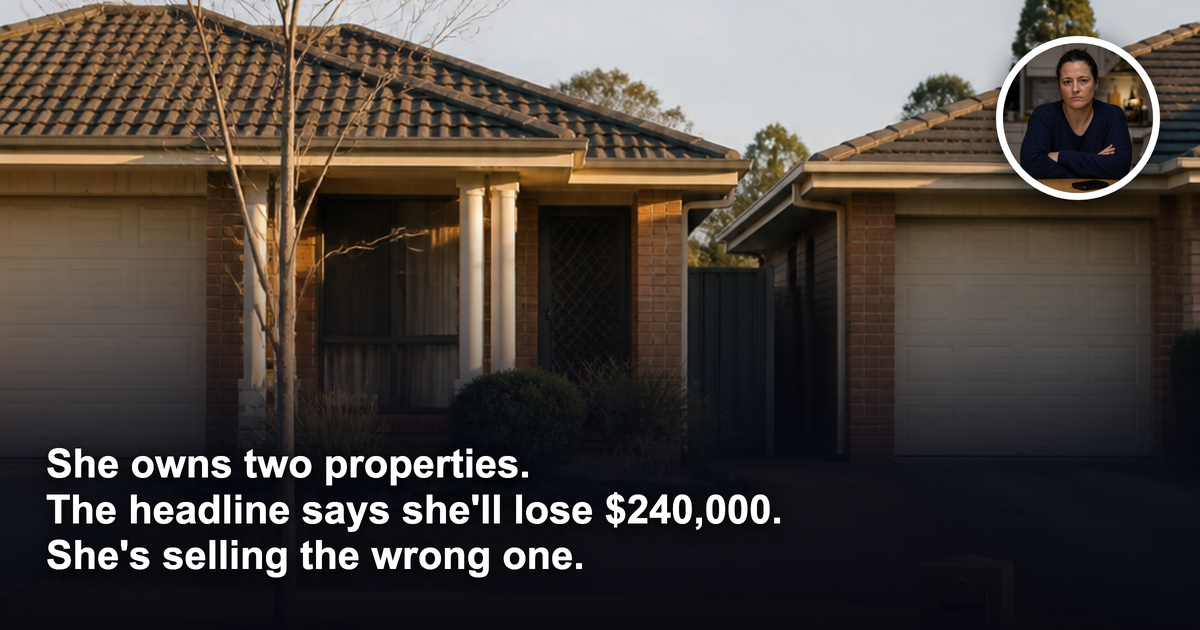
The headline says she will lose $240,000. So she is selling the property that isn't falling
She is 39. She has a home in one capital city and a rental unit in another, bought in 2022 because a friend had done well there. Between them the two are worth about $1.6 million on the last valuations she has.
She is 39. She has a home in one capital city and a rental unit in another, bought in 2022 because a friend had done well there. Between them the two are worth about $1.6 million on the last valuations she has.
On Tuesday night she read the ABC story. Prices down for a sixth straight month. Experts calling it the biggest property downturn in 40 years. Forecasts of further falls of up to 15 per cent.
She opened the calculator on her phone. $1.6 million times 15 per cent. $240,000.
She did not sleep much.
By Wednesday morning she had a plan. Sell one property now, while a buyer will still pay something close to the valuation, and hold the other. Sensible. Decisive. The kind of thing a grown-up does.
The property she picked to sell is the one that has not fallen.
*She is a composite, drawn from the questions we have received this week. The numbers are hers in shape, not in name.*
### The question she sent us
*"If it really is the worst downturn in 40 years and there is another 15 per cent to go, I stand to lose $240,000. I can't stop the market. But I can get out of one property while it is still worth what I paid. The unit is the easy one to sell because it hasn't dropped. Am I mad not to?"*
She is not mad. She is doing exactly what a headline is designed to make a person do. But there are three problems buried in that question, and each one is expensive.
### The answer: the $240,000 does not exist yet, and it may never belong to her
Start with where the number came from.
"Up to 15 per cent" is a forecast. It is the top of a range, offered by experts quoted in a news story, about a national figure. It is not a measurement of anything. It is certainly not a measurement of her house or her unit.
Then she multiplied it by $1.6 million, which is two valuations added together, and treated the result as a bill.
A national average is a blend. It takes markets that are falling hard, markets that are flat and markets that are still edging up, and reports one number for all of them. Nobody owns the average. She owns two specific properties, on two specific streets, in two cities that are not moving together. That is precisely why one has fallen and one has not.
So the $240,000 is a number that belongs to neither property. It is a headline figure wearing her address.
And even if the range plays out in full, a fall in value is not a loss until the day you sell. It changes nothing about her repayments. Her bank cannot ring her and ask for the difference. The only way any of this becomes real money is through a settlement, and she is the one proposing to book it.
### The mistake: selling the asset that is doing its job
Here is what nobody puts in the headline.
In a downturn, the property that holds its value is not the easy one to sell. It is the reason you can afford to keep the other one.
When a portfolio is spread across markets, the whole point is that they do not fall together. One softens, one holds. The one that holds keeps the equity position steady, keeps the lender relaxed and keeps her options open. Sell it, and she has swapped a two-market portfolio for a one-market bet, and she has chosen to bet on the market that is currently falling.
She would pay agent commission and marketing to do it. The stamp duty she paid in 2022 is gone. Any gain on the unit is taxable in the year she sells. Then she would sit on cash, watching the property she kept do the one thing she was afraid of.
That is not protection. That is selling the umbrella because the forecast says rain.
### What this means for you
If you have read the same story and reached for the same calculator, three things are worth doing before you do anything with an agent.
Work out what each property can actually lose before it matters. Not the national forecast. The gap between your loan and a realistic sale price, property by property. For a lot of owners with equity, a 15 per cent fall is uncomfortable and completely survivable. For some it is not, and those people need a plan, not a headline.
Check the cash-flow buffer. Downturns are lost on the monthly number, not the valuation. If the rent covers most of the loan and the shortfall is affordable for two years, the price on a screen is noise.
Look at how the portfolio is spread. Two properties in the same suburb are one bet. Two properties in different cities, in different price bands, on different streets, are the beginning of a structure. Two streets in the same suburb can be having completely different years right now. Two cities almost certainly are.
None of that is advice for her situation or yours. It is the order in which the questions should be asked, which is the opposite of the order the headline asks them in.
### The Ripehouse reframe
Six months of falling prices is uncomfortable. Whether it becomes costly depends almost entirely on how a portfolio was built before the fall started.
That is a structure question, not a timing question.
Nobody times a 40-year downturn. People who own the right asset on the right street, with the debt and buffers arranged so that they never have to sell on someone else's schedule, get to sit through it. People who own the average, or who think they do, sell into it.
We publish our clients' results across a full cycle, including the portfolios that underperformed. Across 997 client portfolios since 2021, the median has grown 19.0 per cent a year on a 5-year rolling basis, against about 4.3 per cent nationally.1 That is not a claim about the next six months. It is a record of what structure did across the last five years, downturns included.
We don't ask you to take our results on faith. We publish them.
If you own property and the headline has you reaching for a calculator, the better first step is a clearer view of what you actually hold, property by property.
15-minute Legacy Sequence Diagnostic: ripe.house/4bV7I8u. No pressure. No obligation. Just a clearer picture than you had before.
---
1 Benchmark: CoreLogic/Cotality national dwelling values. Past performance is not a guarantee of future results. This article is general information, not personal financial, legal or tax advice.
General information only. It does not take your objectives, financial situation or needs into account, and nothing here is legal, financial, taxation or investment advice specific to your circumstances.