News · 31 August 2026 · 4 min read
The bank found a $55,000 gap. Can the deal still work?
A downsizer’s conditional approval hit a $55,000 valuation gap. Here is how to test the evidence, the finance and the exact address before the deadline.
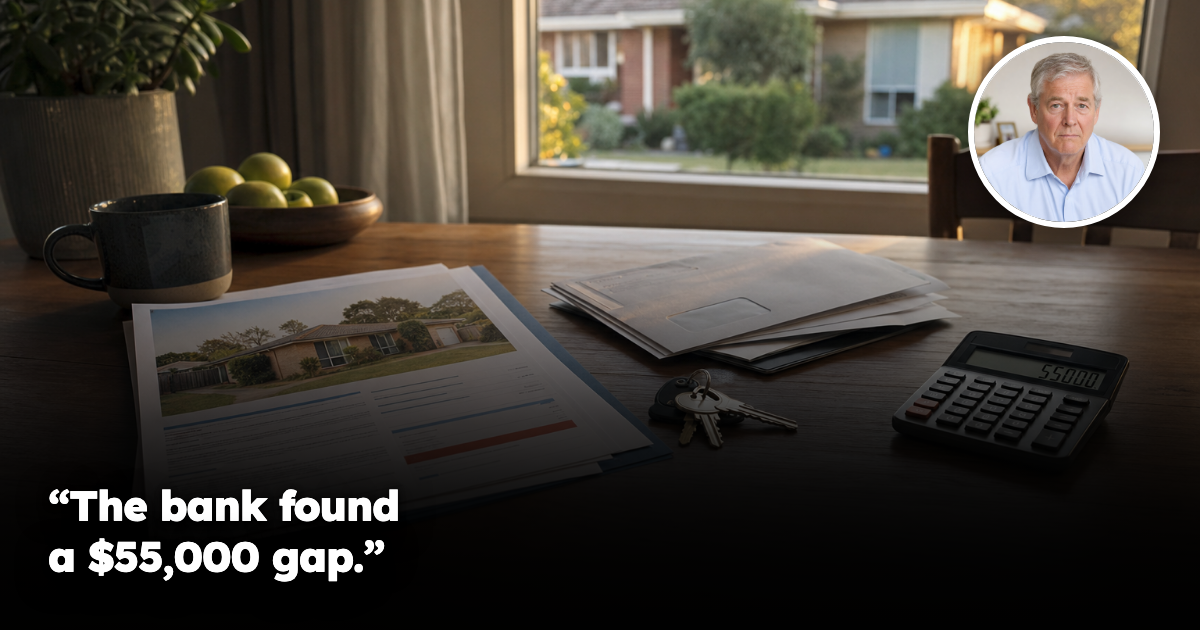
A 68-year-old downsizer thought the hard part was over. He had found a townhouse he could afford, arranged conditional approval and put his existing home on the market. Then the lender’s valuation arrived at $55,000 below the agreed price.
The contract had not changed. The suburb had not changed. But the amount the bank was prepared to lend had.
The question
Can a buyer simply ask another bank to value the property higher, or does a valuation gap mean the purchase is fundamentally too expensive?
The short answer is that a second opinion can help, but it does not turn a weak deal into a strong one. The useful question is not “which valuation do I want?” It is “what evidence would make this address worth the price to a cautious lender and the next buyer?”
Why the gap appears
A lender is assessing the property as security, not just checking whether a buyer loves it. Its valuer usually looks for recent comparable sales, the property’s condition, its layout, local demand and the ease of selling it if the loan ever goes bad.
A buyer, meanwhile, may be paying for a renovation, a preferred school catchment, a quiet position or a seller’s expectations. Those things can be real. They are not always visible in the comparable evidence used for a formal valuation.
The gap is most dangerous when the buyer has treated conditional approval as a promise to fund a particular address. Approval is generally subject to the lender being satisfied with the property and its value. A $55,000 difference can therefore become a cash contribution, a renegotiation, a different loan structure or a reason to walk away, depending on the contract and the buyer’s position.
What he did next
He first checked the numbers rather than arguing with the valuer. The agreed price was $735,000 and the valuation was $680,000. The lender’s maximum loan was calculated against the lower figure, leaving a shortfall that could not be solved by pointing at the seller’s asking price.
He then asked for the valuation evidence to be reviewed. That meant identifying genuinely comparable sales, not simply finding a more expensive home in the same postcode. A renovated end townhouse on a better street is not automatically a comparable for an internal unit beside a busy access road.
The review also exposed the difference between suburb-level confidence and address-level risk. Across the suburb, prices looked healthy. At street level, the relevant pocket had more competing listings, longer selling periods and thinner buyer depth than the suburb headline suggested.
That is where Ripehouse Advisory’s street and suburb data matters. A suburb can show a stable median while two streets behave like different markets. We compare achieved sales, current asking competition, rent, vacancy, days on market and buyer depth around the exact address. If the best nearby sales are exceptional rather than typical, the valuation gap may be a warning about the property—not an administrative mistake.
Can another lender fix it?
Sometimes. Different lenders may use different valuers, instructions and risk settings. A second valuation can reflect a well-supported objection, a recently settled comparable or a feature missed in the first report.
But shopping for a higher number has limits. If the same evidence points to a $680,000 market value, another lender may reach a similar result. A higher valuation can also come with a higher interest rate, stricter conditions or a lower acceptable loan-to-value ratio. The buyer needs to compare the whole finance outcome, not just the headline figure.
The practical sequence is straightforward: ask the lender whether a formal review is available; supply settled, genuinely comparable sales; confirm the exact loan amount and cash required; check the finance and valuation clauses before a deadline passes; and negotiate with the seller while there is still time. Do not assume that a verbal assurance from a broker changes the contract.
What it means for property investors
The lesson is broader than one downsizer’s purchase. Borrowing capacity is only one filter. Security quality is another, and it is highly local.
Before committing, an investor should test whether the address has a deep pool of likely buyers and tenants, whether competing stock is growing, and whether the rent supports the holding cost if the exit takes longer. A property with a modest valuation gap but strong street-level demand may be worth investigating. A property that only makes sense at the seller’s optimistic number deserves much more caution.
The same analysis helps when refinancing or buying an investment property. Recent achieved sales matter more than an online estimate. So do the physical details that separate one side of a suburb from the other: access, noise, slope, parking, outlook, construction and the supply pipeline.
For the 68-year-old, the answer was not to chase a magical valuation. It was to establish the address’s evidence, understand the cash exposure and decide whether the price still worked under a conservative loan. That turns a frightening surprise into a decision.
Property remains an opportunity when the asset is chosen with discipline. The winning combination is the right property, on the right street, bought at a price supported by exact-address data—not a suburb headline or a lender’s first number.
If there's a specific street you're weighing up right now, check its Street Score first — it's free, takes ten seconds, and tells you whether that street is pulling the suburb average up or riding on it.
Frequently asked questions
If a bank values a property below the contract price in Australia, can the buyer still go ahead with the purchase?
Yes, sometimes, but the buyer usually has to cover the shortfall, renegotiate the price, change the loan structure or walk away. A conditional approval is still subject to the lender being satisfied with the property’s value.
Why would a lender’s valuation be lower than the price a buyer agreed to pay?
A lender is assessing the property as security, not the buyer’s reasons for wanting it. Valuers focus on recent comparable sales, condition, layout, local demand and how easy the property would be to sell if the loan defaulted.
Can getting a second bank valuation solve a $55,000 gap?
It can help, but only if there is better evidence to support a higher figure. If the sales evidence still points to the lower value, another lender may reach the same result, possibly with different loan conditions or pricing.
What should a buyer check before the finance deadline if the valuation comes in short?
They should confirm the exact loan amount, the cash required, and whether the finance and valuation clauses still allow time to act. It also helps to ask the lender about a formal review and provide genuinely comparable settled sales.
What is the main risk of relying on suburb-level prices instead of the exact address?
A suburb can look healthy while a specific street or pocket performs more weakly because of competing listings, longer selling periods or thinner buyer depth. The article shows that exact-address data matters more than a suburb headline when judging whether the price works.
General information only. It does not take your objectives, financial situation or needs into account, and nothing here is legal, financial, taxation or investment advice specific to your circumstances.