News · 31 August 2026 · 4 min read
The $64,000 renovation variation that arrived after the walls came down
A homeowner thought her fixed-price renovation was under control. Then a $64,000 variation arrived after demolition.
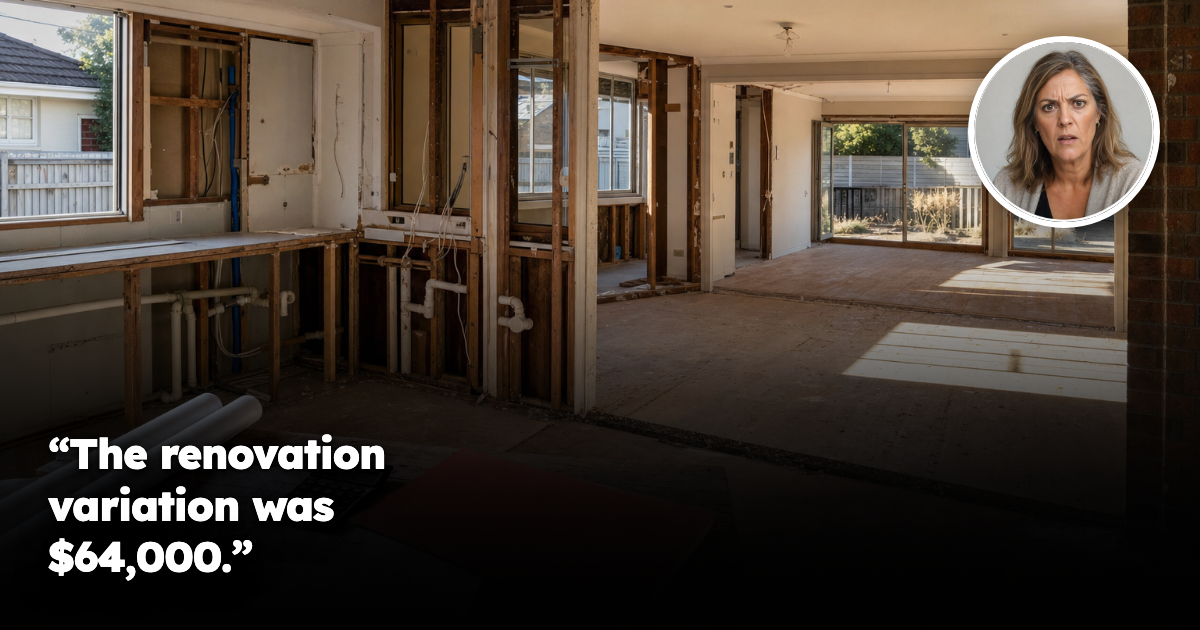
A 55-year-old woman thought the hardest part of her renovation was over when the old walls were removed. Then the builder presented a $64,000 variation and said the original fixed price could not cover what the team had found.
Her question was blunt: can a builder turn a fixed-price renovation into an open cheque once work has started?
The person behind the question
She had planned a substantial extension and internal reconfiguration on a house she had owned for years. The contract was described as fixed price. It covered the visible work, the finishes and the milestones she had budgeted around.
Once demolition exposed the structure, the conversation changed. The builder said sections of the existing framing were not suitable for the new load, drainage had to be rerouted and a compliance issue would require additional work. The proposed variation was $64,000.
She could find the money, but doing so would consume the buffer that protected the project from the next surprise. Refusing could leave an open site, a delayed completion and a dispute about who was responsible for the work already uncovered.
Can a fixed-price contract change?
Yes, but “fixed price” does not mean every unforeseen condition is automatically included, and “unforeseen” does not automatically make every variation legitimate.
The critical questions are whether the extra work was genuinely outside the agreed scope, whether the contract allows it, and whether the change was properly described and accepted before the work was carried out. A variation should identify the work, the price impact and the effect on timing. A vague request to “keep going and we will sort out the cost later” is a dangerous position for an owner.
There is also a difference between a concealed physical condition and a builder correcting an omission, error or poor allowance in the original quote. If the plans, site information or required inspections should reasonably have revealed the issue, the owner needs evidence before accepting that the whole cost belongs to them.
The first move is not to argue about the number. It is to split the claim into a schedule: demolition findings, engineering requirements, statutory compliance, materials, labour, preliminaries and builder margin. Ask for photographs, measurements, the relevant drawing or report and the clause that permits the variation. Separate essential safety or compliance work from upgrades that merely improve the design.
Why the $64,000 matters beyond the renovation
The financial damage is not limited to the invoice. A variation can add holding costs, extend finance, delay rent or force an owner to sell before the finished asset is ready. It can also change the project’s investment case.
That is why Ripehouse Advisory assesses the address, not just the suburb. Street-level achieved sales show what renovated homes on that particular pocket actually attract. Days on market and buyer depth indicate whether the finished property is likely to be liquid. Local rent, vacancy and competing supply help test the fallback if the owner decides to hold it rather than sell.
Two houses in the same suburb can have very different renovation ceilings. A busy road, a narrow frontage, a flood constraint, awkward parking or a weaker tenant catchment can reduce the value created by the same $64,000 of work. Conversely, a quiet street with scarce renovated stock may support more of the spend. The question is not simply “will the renovation add $64,000?” It is “what does this exact street pay for this exact improvement, and how long will the money be trapped?”
What should an owner do before signing?
First, pause non-essential variation work while getting the facts, provided stopping does not create an immediate safety risk or further damage. Keep every email, site photograph, drawing, invoice and inspection report in one file.
Second, obtain an independent building or engineering view of the alleged condition. The builder’s explanation may be correct, but it should not be the only evidence used to approve a material increase.
Third, ask the builder for a revised completion date and a full cash-flow impact. A $64,000 variation that adds six weeks may have a different consequence from one that adds six months.
Fourth, check the contract’s notice and approval process. A signature, text message or payment can have consequences. Before accepting, understand whether the variation changes warranties, approvals, insurance or the original scope.
Finally, compare the revised project with the alternatives: finish, redesign, pause, sell or hold. This is where a renovation becomes an investment decision rather than an emotional contest with a builder.
For context, owners weighing entity changes and builder risk can also read our guide to a builder’s company changing hands during an $86,000 renovation, while the valuation framework in the bank found a $55,000 gap shows why address-level evidence matters before more money is committed.
The right renovation can create an asset that is safer, more useful and more valuable. The protection is disciplined scope control and street-level evidence: the right property, the right improvement and the right numbers can turn a frightening variation into a decision an investor can defend.
If there's a specific street you're weighing up right now, check its Street Score first — it's free, takes ten seconds, and tells you whether that street is pulling the suburb average up or riding on it.
Frequently asked questions
Can a builder turn a fixed-price renovation into a much bigger bill after demolition?
Yes, but not automatically. A fixed-price contract can change if the extra work is genuinely outside the agreed scope and the contract allows a variation, but the change should be properly described and accepted before the work is carried out.
What should an owner ask for when a builder issues a variation after hidden problems are found?
Ask for a breakdown of the claim into demolition findings, engineering requirements, compliance work, materials, labour, preliminaries and builder margin. Also ask for photos, measurements, the relevant report or drawing, and the contract clause that allows the variation.
How can you tell whether the extra work is the owner’s responsibility or the builder’s original mistake?
The key issue is whether the problem was something that should reasonably have been revealed by the plans, site information or required inspections. If it looks like an omission, error or poor allowance in the original quote, the owner should ask for evidence before accepting the full cost.
What are the main risks if you accept a large variation on a renovation in Australia?
The cost is not just the invoice. A larger variation can add holding costs, extend finance, delay rent, or force an owner to sell before the finished property is ready, which can change the project’s investment case.
What should a homeowner do before signing off on a big variation?
Pause non-essential work if it is safe to do so, keep all records together, get an independent building or engineering view, and ask for a revised completion date and cash-flow impact. It is also important to check the contract’s notice and approval process before signing or paying.
General information only. It does not take your objectives, financial situation or needs into account, and nothing here is legal, financial, taxation or investment advice specific to your circumstances.