News · 3 September 2026 · 4 min read
The 44,000-name waitlist question: who pays when the housing promise still misses her street?
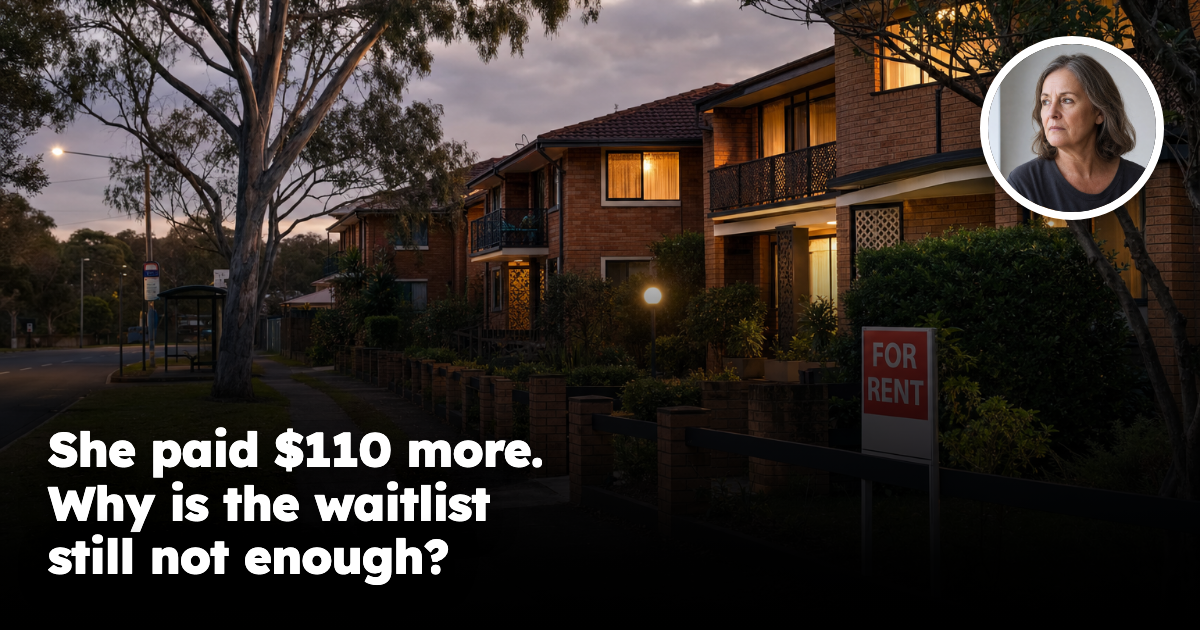
A 62-year-old woman is paying $110 more each week after losing her rental, even as the national housing waitlist falls. The local test is whether suitable supply reaches the exact streets where demand is strongest.
The 44,000-name waitlist question: who pays when the housing promise still misses her street?
When a government says the housing queue is getting shorter, it sounds like relief. For a 62-year-old woman waiting for a stable home, the number that matters is not the national announcement. It is whether a suitable address is actually available before her savings, health and patience run out.
The question
She recently left a private rental after the owner decided to sell. Her new weekly rent is $110 higher, and the available homes within reach are either too far from the people who help her or priced beyond what her budget can absorb.
“If the waitlist is falling, why am I still being told there is nothing suitable?” she asked.
It is a fair question. A smaller queue can coexist with a housing problem that feels worse on one particular street.
The answer
The first trap is treating a national target as if it were a local delivery schedule. Housing targets count dwellings completed across a wide area and over a long period. They do not guarantee that the next completed home is the right size, tenure, location or price for the person currently waiting.
The second trap is treating a waitlist number as a complete measure of need. Some people leave the list because their circumstances change, they find an unsuitable private rental, they move between jurisdictions or they stop responding to the process. That does not necessarily mean their housing stress has disappeared.
The third trap is geography. Two homes in the same suburb can look identical in a suburb-level report while behaving like different assets. A property 300 metres from a frequent bus route, shops and a medical cluster may attract a much deeper tenant pool than another property with the same suburb median but a steep walk, poor lighting or a noisy arterial road.
That is where street-level analysis matters. Ripehouse Advisory’s research looks beyond the suburb label: achieved rents rather than asking rents, genuine vacancy duration, days on market, tenant enquiry depth and competing supply on the same pocket of streets. In one suburb, the best and weakest streets can show a 20–30% difference in effective rental performance after holding costs are considered. A national housing promise cannot see that gap. An investor who checks the address can.
Why the politics becomes personal
The argument is often presented as a choice between public housing and private investment. That is too simple. New social and affordable homes are essential for people who cannot safely compete in the private market. At the same time, private investors provide a large share of the rental homes that exist today. When policy adds demand without enough supply, or builds in the wrong locations, both groups feel the pressure.
For the woman facing the rent increase, the injustice is not merely that a target may be missed. It is that the headline improvement is measured at a distance from the address where she must sleep. A list can fall while the suitable homes near her support network remain unavailable.
For an investor, the lesson is not to dismiss housing policy or avoid property. It is to separate the policy headline from the property decision. Ask what has actually been completed nearby, what type of tenant is looking there, how long comparable homes sit vacant and whether new supply is likely to compete directly with the asset.
That discipline also helps avoid exaggerated fears. A new affordable-housing project is not automatically a discount event. Nor is a shrinking waitlist automatically a rent-growth signal. The outcome depends on design, management, transport, local services, street layout and the depth of demand for that exact kind of home.
Our earlier analysis of a loan term expiring at the wrong moment showed why timing can matter more than a broad market forecast. The same principle applies here: the local clock and the local evidence matter more than a national slogan. A land valuation objection based on the wrong comparison set offers another warning. Broad averages cannot rescue an analysis built on the wrong nearby evidence.
What should property investors measure?
Start with the exact address, then work outward. Compare achieved rent and days vacant for the closest genuinely comparable homes. Check whether tenants are choosing that street or merely accepting it because nothing else is available. Map competing listings, planned completions and transport changes. Then test the downside: how long could the property sit empty if the cheapest competing homes increase by $20 a week?
The strongest property decisions are not made by cheering for a target or arguing against one. They are made by identifying the streets where demand is deep, supply is limited and the asset remains useful to real people through different policy cycles.
For the woman still waiting, a falling queue is welcome only when it becomes a suitable door she can actually open. For investors, the opportunity remains clear: the right property, on the right street, selected with evidence, can serve durable tenant demand while building long-term wealth. Headlines move nationally. Address-level data tells you where the opportunity is.
If there's a specific street you're weighing up right now, check its Street Score first — it's free, takes ten seconds, and tells you whether that street is pulling the suburb average up or riding on it.
Frequently asked questions
Why can the national housing waitlist fall even if someone in Australia is still being told there is no suitable home nearby?
A smaller national queue does not guarantee the next available home is the right size, tenure, location or price for a specific person. Waitlist numbers can also change because people leave the list or their circumstances change, not only because their housing stress has ended.
What is the main local problem highlighted in the article for the 62-year-old renter?
She left a private rental after the owner decided to sell, and her new rent is $110 a week higher. The homes within reach are either too far from her support network or too expensive for her budget.
What should property investors look at instead of relying only on suburb-level housing headlines?
They should start with the exact address and compare achieved rent, days vacant, genuine vacancy duration, tenant enquiry depth and competing supply in the same pocket of streets. The article says the best and weakest streets in one suburb can perform very differently.
Does the article say a new affordable housing project will automatically hurt nearby property values or rents?
No. It says the outcome depends on design, management, transport, local services, street layout and the depth of demand for that exact type of home. A new project is not automatically a discount event.
What is the practical next step for someone assessing a property market affected by housing policy?
Check what has actually been completed nearby, what type of tenant is looking there, how long comparable homes sit vacant and whether new supply is likely to compete directly with the asset. The article argues that local evidence matters more than a national slogan.
General information only. It does not take your objectives, financial situation or needs into account, and nothing here is legal, financial, taxation or investment advice specific to your circumstances.