News · 18 September 2026 · 5 min read
He paid the deposit. Now he is behind $3.08 billion. Who gets paid first when a builder falls over?
A court has given the Bathla Group administrators until September 2027, and the buyers holding pre-sale contracts sit behind $3.08 billion of secured lenders on books that had not even been reconciled. Builder risk is real - and street-level data is the only part of it you can actually check before you sign.
On Friday, the NSW Supreme Court extended the voluntary administration convening period for the Bathla Group to 13 September 2027. One sentence of court procedure. Twelve more months of limbo for the people who can least afford it.
The extension does not mean the administration, or Bathla's construction operations, are funded for twelve months. It does not mean the cranes keep moving. It means the clock that decides who gets paid, and who gets left behind, now runs for another year. And the people at the very back of that queue never signed up to be in it.
The man at the back of the queue
Picture him. Early forties. He did everything the system asked. He saved a deposit, signed an off-the-plan contract on a home that was due to be finished this year, and started planning a life around a completion date.
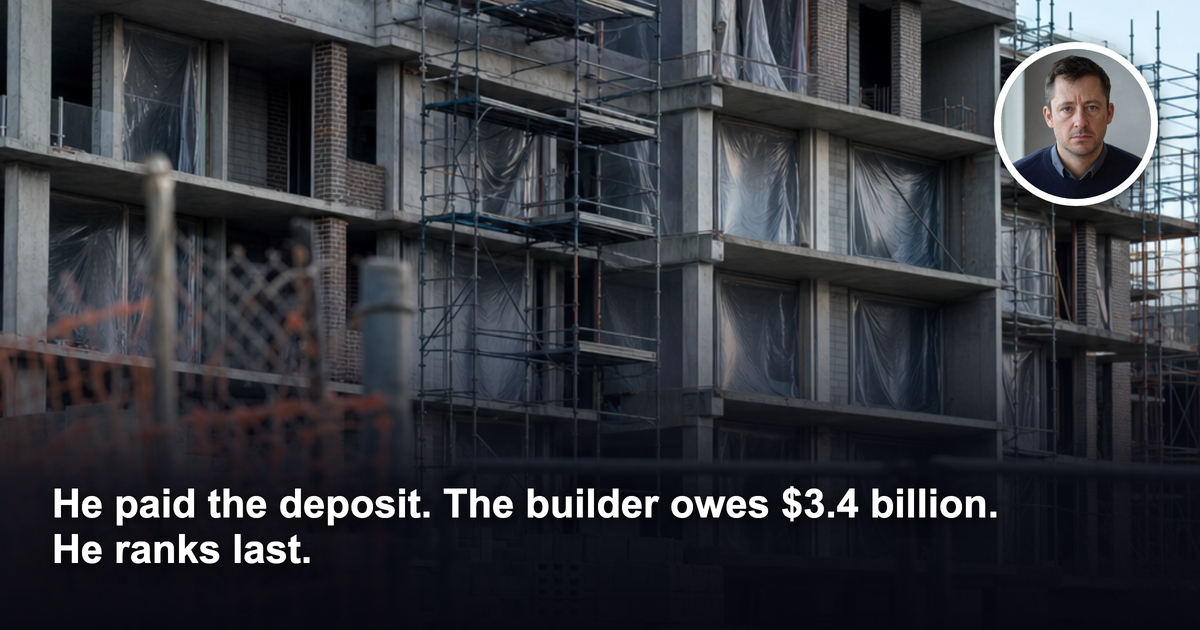
That date is gone. Today he has no title, no key and no home. He cannot move in, and he cannot cleanly walk away. His deposit sits inside an administration where secured lenders are claiming roughly $3.08 billion, the ATO is owed $145 million, private lenders about $48 million, and other unsecured creditors around $110 million. Roughly $3.4 billion in currently known claims, stacked in front of him.
He committed no error. He missed no payment. He simply bought a home from the wrong builder at the wrong time. And for that, he ranks last.
The question he is actually asking
It is not "what happens to Bathla?" He does not care about corporate structure. His question is simpler and harder: do I ever get the home, and if not, do I ever get my money back?
Nobody can answer him yet. And the reasons why should make every Australian who has ever considered buying off the plan sit up straight.
What the administrators actually found
Administrators Teneo have laid out the scale of the problem.
There are roughly 219 current projects carrying about $3.13 billion in debt, against a preliminary total value of around $4.87 billion. On paper, more value than debt. In practice, the paper is the problem.
Bank accounts had not been reconciled for some time. The records may contain around $736 million in overstated inter-company receivables and payables. Key planning, design and construction information is spread across different systems, staff email accounts, network drives and hard-copy records rather than a single central repository, and reviewing the books could take many months. Read that again: the documents that will decide whether he gets a home or a cheque were scattered across inboxes and filing cabinets.
The funding secured so far is $4.7 million, from six lenders. Against $3.4 billion in claims. Longer-term funding is not secured. Teneo's head of financial advisory, Stephen Longley, put it carefully: "We have taken a cautious approach to the time frame to ensure there is sufficient time to progress and complete projects in an orderly way." And more pointedly: "The extension gives us the time needed to progress projects towards completion but that outcome remains dependent on securing further lender support to maintain critical central functions at Bathla."
Translation: even the extension is conditional. The lifeline has a lifeline.
Meanwhile, around $400 million worth of completed property is for sale or under contract, and those proceeds will initially be applied against secured lending. Not to him. Across the projects still under construction, about a quarter of the lots are already subject to pre-sale contracts. That is a quarter of the pipeline made up of households exactly like his: frozen, ranked behind three billion dollars of secured money. There are also about 167 undeveloped sites in the land bank. Roughly 30 per cent will be marketed as-is. The strategy for the other 70 per cent is undetermined.
That is the honest answer to his question. Nobody knows yet. The proceeds flow upward before they flow to him. And the year he just lost may not be the last one.
What it means for you
Here is the uncomfortable part. None of this means property is the problem.
Those 219 projects hold a preliminary value of $4.87 billion against $3.13 billion of debt. The dirt and the dwellings are not worthless. The structure around them failed. The injustice is not that he bought property. It is that he bought a promise, from a counterparty whose own bank accounts were not reconciled, with no way to see that from the outside, and the system now parks him behind every secured dollar while it sorts itself out.
But "no way to see it from the outside" is only half true. You could not have audited Bathla's books. You can absolutely audit the street.
This is what street-level diligence exists for. Before a dollar moves, you can check what the exact stock type actually resells for on that street, and how many days it sits on market. You can check achieved rent against advertised rent, because in oversupplied off-the-plan corridors the gap between what agents advertise and what tenants actually pay is often the first warning light. You can check street-level vacancy, which turns before suburb medians do. You can pull the approved-but-unbuilt pipeline for the surrounding streets, because hundreds of competing lots already approved next door tell you exactly how thin the buyer pool will be on your exit. At Ripehouse we compress this into a street-level R-Score and heatmaps for a reason: suburb averages hide precisely the streets that drag the average down.
Would that have stopped Bathla collapsing? No. But street-level diligence consistently steers buyers away from the exact product where builder risk concentrates: heavily leveraged, high-pipeline, thinly resold stock where the developer's borrowing is the only thing holding prices up. The right asset on the right street, with genuine buyer depth and achieved rent underneath it, survives a builder failing. A contract on a promise does not.
Builder risk is real. It is also diligence-able. You can check who is building, what else is approved around it, and whether the finished product has real demand under it. Headlines punish the people who skipped those checks. Data protects the people who ran them.
Before you sign anything off the plan
He handed over his deposit and got a queue number in return. You do not have to.
Before your next purchase, off the plan or otherwise, get the street-level picture first: the R-Score, the achieved rents, the vacancy on that exact street, the approved supply around it, and the buyer depth waiting on your exit. Talk to Ripehouse Advisory before you commit. Not after the administrators do.
Before you commit to an off-the-plan contract, the real issue is whether the street can support your exit if the builder fails, and a Ripehouse Advisory webinar can help you test achieved rents, vacancy and nearby approved supply before you sign.
Frequently asked questions
If a builder like Bathla Group falls into administration, who gets paid first in NSW?
In this case, secured lenders are ahead of buyers with pre-sale contracts. The article says Bathla has about $3.08 billion in secured lender claims in front of those buyers, so completed sale proceeds will initially go to secured lending first.
What does the Bathla Group administration extension to September 2027 actually mean for buyers?
It means the administration process has more time, but it does not mean the construction work is funded for another year. The article says the extension gives administrators time to try to progress projects, but any outcome still depends on securing further lender support.
Why are Bathla buyers with pre-sale contracts so far behind in the queue?
Because the known claims ahead of them include secured lenders, the ATO, private lenders and other unsecured creditors. The article says the total known claims are around $3.4 billion, which leaves pre-sale buyers last in line.
What warning signs did the administrators find in Bathla's books?
The article says bank accounts had not been reconciled for some time and that records were spread across email accounts, network drives and hard-copy files. It also says there may be about $736 million in overstated inter-company receivables and payables.
What should an Australian buyer check before signing an off-the-plan contract to reduce builder risk?
The article says you can check the street-level picture: actual resale performance, achieved rent versus advertised rent, street vacancy and approved but unbuilt supply nearby. It argues that this kind of diligence helps identify thin buyer depth and heavily leveraged stock before you commit.
General information only. It does not take your objectives, financial situation or needs into account, and nothing here is legal, financial, taxation or investment advice specific to your circumstances.