News · 18 September 2026 · 5 min read
The 125-kilometre line: who gets to object when a mine arrives near your land?
A Queensland bill would let only landholders directly affected and people within 125km object to a new mine, and hand a minister the call on court referral. What that means for anyone whose whole balance sheet sits on one street.
A line has just been drawn across Queensland, and it is 125 kilometres long.
On Tuesday the state's Resources Minister, Dale Last, introduced the Mineral Resources Objections Reform and Other Legislation Amendment Bill 2026. Under the proposed laws, objections to a new mine would generally be restricted to landholders directly affected by the project and to other people living within 125 kilometres of it. Automatic referral of objections to the Land Court would also disappear, replaced by what the bill calls a ministerial referral process — a politician deciding whether an objection is heard in court at all.
The minister's case is efficiency. He argues the changes cut red tape and stop "vexatious" objections from holding up projects. Farmers, environmental groups and lawyers read it differently.
"This is another step of this current government in really hacking at the safety net of laws that protect Queenslanders from bad development," barrister and University of Queensland adjunct professor Chris McGrath told the ABC. "We all benefit from an open process with independent review, and they're really blowing holes in that process."
Dr McGrath's specific objection is that the radius does not describe how a mine actually behaves: the effects of a mine, he says, can travel far beyond its immediate footprint. Dust, water, haulage and heavy-vehicle traffic do not stop at a surveyor's mark.
Notably, the mining industry does not defend the number either. Queensland Resources Council chief executive Janette Hewson called the 125km limit an "arbitrary number", pointing out that the government already uses different radii for different impacts such as groundwater and air emissions. "We think that it should be more of a sliding scale that's actually based on science and data," she said.
So the regulator's own industry body and its loudest critics agree on one thing: the line is arbitrary. The people it lands on are not.
The person on the wrong side of the line
Consider a woman in her late fifties who owns a house and a small parcel of land in inland Queensland. The house and land are worth roughly $680,000, and that figure is not an investment position — it is the entire balance sheet of her household, accumulated over about thirty years.
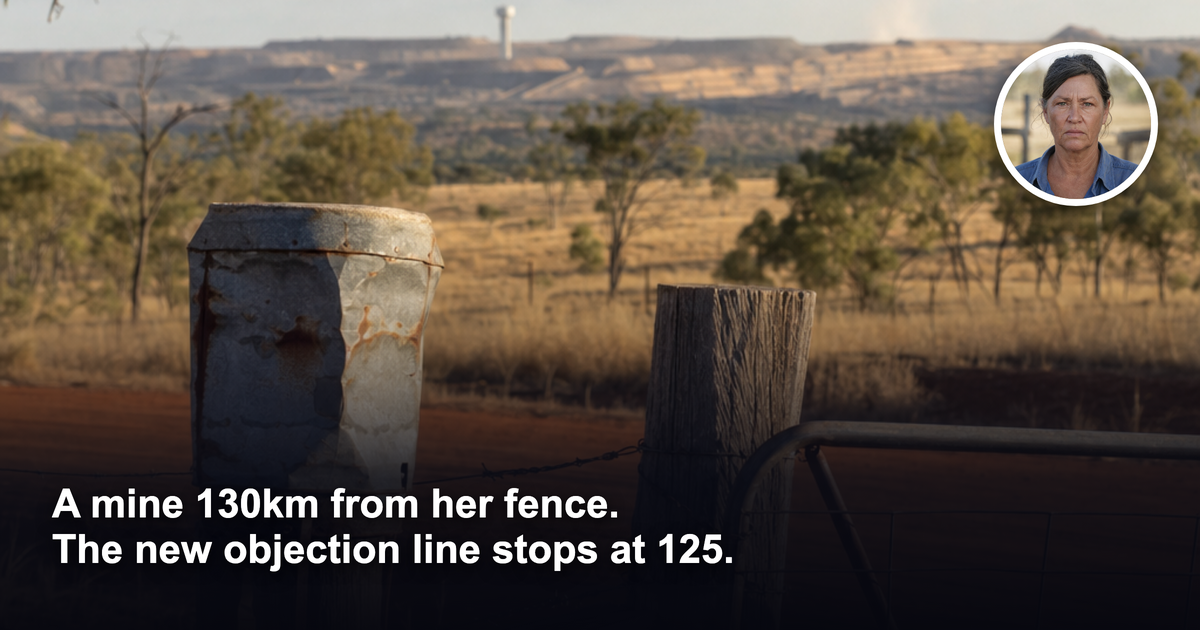
A mine is proposed 130 kilometres from her fence.
Under the bill as introduced, she is not a directly affected landholder, and she lives outside the radius. The haulage that may run past her road, the water table she shares, the buyers who may or may not want a rural-residential block near a new operation in eight years' time — none of that gives her standing. Five kilometres is the difference between a right and a request.
And even for those inside the line, the second change matters more than the first. An objection that once went to the Land Court automatically now goes there only if it is referred. Independent review becomes discretionary.
The question
Here is the question that actually decides her outcome, and it is not a political one:
If you cannot object, what tells you what the asset is worth?
Because the objection process was never really her protection. It was a warning system — a public, documented, adversarial process that surfaced information about a project before it arrived. Remove the automatic referral and you do not just remove a right. You remove a disclosure channel. The information still exists. It simply stops being published on a timetable she can rely on.
The answer, in numbers
This is the part that does not depend on the bill passing or failing, and it is where we spend our time.
A suburb median tells you almost nothing about a property 130 kilometres from a proposed mine. A median blends streets that behave nothing alike. At street and address level, five things decide whether that $680,000 is real:
- Achieved rent versus advertised rent. Advertised rent is an asking price. Achieved rent is what a tenant actually signed. In thin regional markets the gap between the two is the single most reliable early warning that demand is softening — it opens months before the median moves.
- Street-level vacancy. Vacancy mapped street by street, not suburb-wide. A one-off vacant listing is noise; a street where the same stock type sits empty repeatedly is a structural signal.
- Days on market for that exact stock type. Not "houses in the region" — rural-residential blocks of that size, in that price band. Days on market for the precise comparable set is the closest thing to a live liquidity reading.
- Approved-but-unbuilt competing supply. What has already been approved nearby and has not yet been built is future competition that no current listing shows you. It is knowable today and it is routinely ignored.
- Buyer depth on exit. The question nobody asks until they need it: how many buyers were actually transacting in that band, in that location, in the last twelve months? An asset with two plausible buyers is not worth its median.
Tied together — that is what our R-Score does — those five inputs answer a narrower and far more useful question than "is this a good suburb?" They answer: if I needed to leave this street, who would buy it, when, and at what price?
For a single-employer or single-project location, the answer is often uncomfortable. That discomfort is the information. It is better to hold it before you commit capital than to discover it when a hearing you were not entitled to attend is already over.
What it means for you
If you own in a location whose future is decided by one project, one approval or one employer, your exposure is not the headline. It is concentration. You cannot legislate your way out of it and, as this bill demonstrates, you cannot rely on a process to keep telling you about it.
What you can do is buy — and hold — assets whose value does not depend on a discretionary decision going your way. That means streets with genuine buyer depth, multiple demand drivers, achieved rents that hold up when advertised rents slip, and supply pipelines you have actually checked.
This is not an argument against property. It is the argument for property done properly: the right asset, on the right street, chosen on data rather than on a radius somebody drew on a map.
Headlines and arbitrary lines are not a strategy. Street-level evidence is.
Want to know what the data says about your street — or the one you are about to buy on? Talk to Ripehouse Advisory and we will show you the achieved rent, vacancy, days-on-market and buyer-depth picture for the exact address, not the suburb average.
If you own near a proposed mine, the real issue is how to assess concentration risk and buyer depth before the hearing closes the information window, so attending the Ripehouse Advisory webinar can help you see which street-level signals matter before you buy or hold.
Frequently asked questions
Under the proposed Queensland mine objections bill, who would be allowed to object to a new mine?
The bill would generally restrict objections to landholders directly affected by the project and other people living within 125 kilometres of it. People outside that line would not automatically have standing.
What changes would the bill make to how mine objections are heard in Queensland?
Automatic referral of objections to the Land Court would be removed. Instead, a ministerial referral process would decide whether an objection is heard in court at all.
Why are critics saying the 125-kilometre limit is a problem?
Critics say the distance is arbitrary and does not match how mine impacts actually spread. Dust, water, haulage and heavy-vehicle traffic can affect places well beyond the project boundary.
Why does the article say the objection process matters even for property owners who may never object?
The article describes it as a warning system that can reveal information about a project before it arrives. If objections are less likely to be independently reviewed, that information becomes less public and less reliable as a signal.
If you own property near a proposed mine, what market data does the article say matters most?
The article says to look at achieved rent versus advertised rent, street-level vacancy, days on market for the exact stock type, approved-but-unbuilt competing supply, and buyer depth on exit. Together, those inputs show whether the asset is likely to be liquid and supported by real demand.
General information only. It does not take your objectives, financial situation or needs into account, and nothing here is legal, financial, taxation or investment advice specific to your circumstances.