News · 21 August 2026 · 6 min read
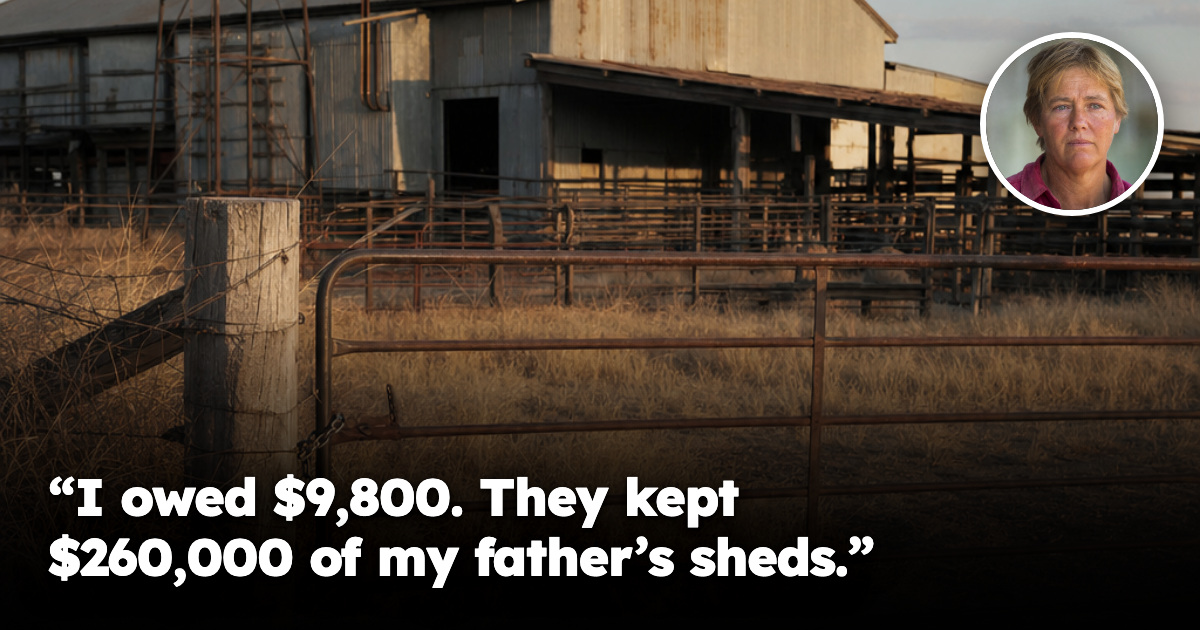
I owed $9,800. They took the land, kept the $260,000 of sheds my father built — and I might get paid one day
A 54-year-old wool classer fell $9,800 behind on a State leasehold block her family had held for thirty-one years. The land was forfeited lawfully — and so were $260,000 of sheds, yards and fencing her father paid for. She keeps a right to be paid for them, but only if a stranger turns up. Here's the machinery nobody explains, and why tenure is a value factor no suburb median will ever show you.
A woman we'll call Denise is 54, a wool classer. Her family has held the same block of State leasehold country for thirty-one years. Her father took the lease up; she took it over when he died.
What happened next is the part nobody is warned about.
Last year the payments fell behind. A bad season, a delayed cheque, a hospital admission that ate three months. The arrears reached $9,800.
She was given notice. It stated the amount, the interest running each day, and a period to fix it. She was nineteen days past that period when she sold enough wool to clear it. By then the lease had been forfeited.
The land went. She expected that. Not the rest.
On the block are a shearing shed, three hay sheds, steel yards, two tanks, nine kilometres of fencing and a bore. Her father paid for all of it. An insurance valuation put the improvements at $260,000.
She was told, in writing and entirely correctly, that she had fourteen days from the forfeiture to apply to remove them — and that otherwise the buildings would belong to the State.
Her question to us was short.
"How can a $9,800 debt take $260,000 of buildings my father paid for? And why is nobody able to tell me when I get paid?"
The answer: because ownership of the land and ownership of the sheds are settled by two completely different rules
Most people assume that if you lose land, you are at least bought out of what you built on it. On State leasehold country that assumption is wrong in a specific, rarely-explained way. It is a very different machine from the one that operates when a council sells freehold land to recover overdue rates, where the owner at least keeps whatever is left after the debt is paid.
Forfeiture is total, and instant on registration. Three things happen at once: the lease ends, the former lessee is divested of any interest in it, and — the phrase that does the damage — the land becomes free of any encumbrance. Every registered interest over that lease is wiped, not just hers. Anyone occupying must vacate immediately, and a person who stays is treated as unlawfully occupying State land.
The buildings are dealt with separately — and the clock is fourteen days. A former lessee may apply, in writing, to remove their improvements. But the drafting is precise, and the precision is the story:
- Removal is permitted only with written approval, and only within a time someone else states.
- The improvements are forfeited to the State if approval is not given — or if it is given and the work is not finished in time.
A right to recover your own property that depends on another party's written approval is not a right; it is a permission. And for a shearing shed on a concrete pad, a bore and nine kilometres of fencing, "remove it" is not a real option — removal costs exceed salvage value, which is why almost nobody applies.
Then the part that answers her second question. She does keep a right to be paid for the improvements. It survives the forfeiture. But read what triggers it:
If the State receives payment from an incoming lessee or buyer for the improvements, the State must pay that amount to the previous lessee.
That is not a debt the State owes her. It is a pass-through, payable only if and when somebody else takes up that country and pays for those sheds. If nobody applies for five years, she is owed nothing for five years. If the next lessee negotiates a lower figure, that is her figure. She is a creditor of a transaction that has not happened, on terms she will never be in the room for.
There is a second cut. If the person entitled cannot be found, or does not collect within six years of the State receiving the money, the amount is forfeited to the State — a second forfeiture, of money everyone agrees was hers. Readers who followed the case where a council acquired a house over $18,600 and paid nothing will recognise the shape: a small debt, a lawful process, and a result nobody would have predicted from the size of the arrears.
Costs can also keep coming after the asset is gone. For a period after forfeiture the former lessee can be given a notice to repair a structure, remove one, or remediate the land — and must give notice before entering land that is no longer theirs. If they don't do the work, the State can, and recover the cost as a debt, expressly including transport, dump fees, storage and costs of sale.
So the sequence is: lose the land, lose the buildings, wait unknown years for an unknown amount that depends on a stranger, and stay exposed to a bill for tidying up what you no longer own.
Denise is precise about fault. Nobody misbehaved. The notice was served correctly and the period is more generous than most debt enforcement. The rules exist for defensible reasons — State land is held for everyone, and derelict buildings on public land are a genuine safety and cost problem. Every officer she dealt with applied the law exactly as written. That is the point. This was not a failure. It was the system working normally, and almost nobody knows what normal looks like.
What this means if you own or are buying property
The lesson is not "avoid leasehold" — plenty of leasehold assets are excellent investments. It is that tenure is a value factor, invisible in any suburb-level number.
This is the gap we spend our time in. Two holdings can share a postcode, a median, a growth rate and a school catchment and be entirely different assets — one freehold with a clean title, one held on terms where a missed payment triggers a machine that does not stop at the fence line. A median has never once read a tenure schedule. It is the same blind spot that lets a buyer inherit a tribunal order about a tree they have never seen — the obligation was public, searchable and free to find, and nobody looked.
It is the same effect we measure inside suburbs, where the spread in effective yield between the best and worst street in one suburb routinely runs 20–30% once you use achieved rents, real vacancy duration and true days-on-market instead of the headline average. The data is not poor. The unit of measurement is wrong. Suburb averages describe a postcode; money is made and lost at the level of the street, the parcel and, as Denise found, the instrument the land is held under.
Which is the reassuring part, and why this should make you more confident rather than less. Every rule that cost her those sheds was published, in force, and readable years before it became urgent. The notice period, the fourteen days, the approval requirement, the incoming-lessee condition, the six-year cut-off — none of it hidden, none invented on the day, none needing a lawyer to find. It needed somebody to look.
That is what separates a risk from a threat. A threat happens to you. A risk you can read is a line item — something you price, negotiate against, or walk past in favour of the asset next door. Investors who lose money in property are almost never the ones who researched too hard.
Denise cleared the $9,800 nineteen days late. She is still waiting to hear whether anyone will take up that country — because that is the day she finds out what her father's sheds were worth.
If there's a specific street you're weighing up right now, check its Street Score first — it's free, takes ten seconds, and tells you whether that street is pulling the suburb average up or riding on it.
Frequently asked questions
What happens when a State leasehold block is forfeited in Australia?
On forfeiture, the lease ends immediately, the former lessee loses any interest in it, and the land becomes free of any encumbrance. Anyone still occupying it must vacate, because the land is treated as State land.
Do sheds, fencing and other improvements on a State leasehold block automatically stay with the former owner?
No. Improvements are dealt with separately, and the former lessee must apply in writing to remove them within the stated time. If approval is not given, or the work is not completed in time, the improvements are forfeited to the State.
If the State takes the improvements, does the former lessee get paid straight away?
Not necessarily. The former lessee only gets paid if the State later receives money from an incoming lessee or buyer for those improvements. Until that happens, the payment is only a possible future entitlement.
How long does someone have to claim payment for forfeited improvements?
If the State receives payment for the improvements, the person entitled must collect it within six years. If they cannot be found or do not collect in that period, the money is forfeited to the State.
Can the former leaseholder still be charged costs after the land has been forfeited?
Yes. The State can still issue notices to repair, remove structures or remediate the land, and recover the costs as a debt. The article says those costs can include transport, dump fees, storage and costs of sale.
General information only. It does not take your objectives, financial situation or needs into account, and nothing here is legal, financial, taxation or investment advice specific to your circumstances.