News · 2 October 2026 · 4 min read
She waited three years for the all-clear on rates. It arrived with a 'probably'.
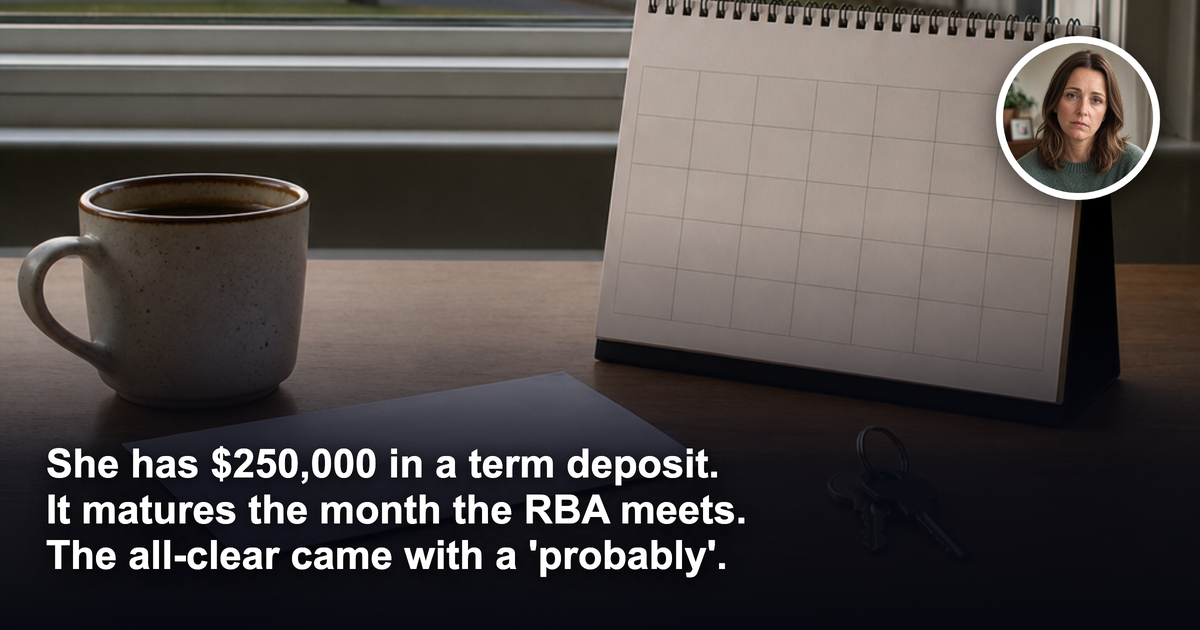
She is 42. Her mother died in early 2024 and, once the estate settled, left her a little over $250,000.
She is 42. Her mother died in early 2024 and, once the estate settled, left her a little over $250,000.
She did the sensible thing. She put it in a six-month term deposit while she worked out what to do with it.
That deposit has now been rolled over three times.
She is a composite, drawn from the questions we have received this year, but the pattern is hers in every detail that matters. Each time the money matured she asked herself the same question. Are the rate rises over yet? Each time, the honest answer was that nobody knew. So she rolled it over and waited for someone who did.
This week someone very senior said something. The chief executive of Commonwealth Bank, the country's largest home lender, said publicly that the Reserve Bank's rate hikes are probably finished (ABC News, 2 October 2026).
Her deposit matures in November. The Reserve Bank meets in November.
The question she sent us
"The CBA boss says the rate rises are probably over. Is this the all-clear I have been waiting for? Do I put the $250,000 into a rental now, before everyone else reads the same headline?"
The answer: the all-clear does not exist
Read past the headline and one word is doing all the work. Probably.
He also said it depends on the inflation data due late this month, ahead of the Reserve Bank's November meeting. So the person running the biggest mortgage book in Australia has offered a view, attached a condition to it, and named the date on which the condition gets tested.
That is a careful and honest way to talk about rates. It is also exactly what she did not want to hear. She wanted a sentence with no conditions in it. Nobody can give her that sentence. Not him, and not us.
For three years she has been outsourcing her decision to a forecast. She waited for a forecaster to sound confident. When one finally did, the confidence arrived with a caveat and a calendar.
The expensive mistake almost nobody notices
The cost of waiting never shows up on a statement. The term deposit paid interest. The balance went up a little each time. It felt like progress.
What did not happen, in all that time, was a decision. And a decision deferred three times for the same reason has stopped being caution and become a habit.
The mistake we see most often after a headline like this one is a swap. Three years of "wait until the rises stop" becomes "buy before everyone else does." Same reasoning, opposite direction, still resting on someone else's prediction. If she buys now because a bank boss sounded calm, she will sell later because a different one sounded worried.
What the next four weeks are actually for
There is a dated checkpoint ahead of her now, and that is more useful than any forecast. This is how we would use it.
- Test the purchase at today's rate plus a stress margin. If the numbers only work at a rate lower than the one on offer now, the numbers do not work.
- Decide the buffer before the deposit. Part of that $250,000 stays in reserve for vacancies, repairs and rate moves. The purchase is sized to what is left, never the reverse.
- Write down, today, what the late-October inflation data would need to show for her to proceed, and what it would need to show for her to wait. The rule is written before the number is published, so the number cannot be argued with afterwards.
- Choose the asset and the street first. If the checkpoint says go, she should be buying one specific property that already passed on its own data, rather than starting a search in a hurry.
None of those steps require knowing what the Reserve Bank will do. All of them survive if the CBA boss turns out to be wrong.
What it means for you
If you have equity in your home and have been holding off an investment purchase until rates "settle", this week gave you a date, and a date is more useful than the certainty you were never going to get.
Run your serviceability against today's rate plus a margin. Set your buffer. Decide in advance what the inflation print has to say. Then stop re-reading headlines, because none of them will ever contain the sentence you are waiting for.
The Ripehouse reframe
Rates set the price of money. They do not pick the street.
Two streets in the same suburb can be having completely different outcomes in the same rate environment. One has stock sitting, the other has none. The buyer who waits for the national rate story to resolve still ends up buying one house on one street, and the rate story will not tell her which one.
Our clients' portfolios have grown at a median of +19.0 per cent per year on a 5-year rolling basis, against roughly 4.3 per cent nationally (benchmark: CoreLogic/Cotality). We publish those results, including the portfolios that underperformed. Past performance is not a guarantee of future results. What that record does show is that none of it came from calling the top of a rate cycle. It came from structure: the right asset, on the right street, chosen on data and held through the noise.
She has four weeks and a checkpoint. That is enough to make a decision properly, for the first time in three years.
Want to see how we would test a decision like hers street by street, against today's rate rather than a forecast? Join Jacob's free live webinar.
General information only. It does not take your objectives, financial situation or needs into account, and nothing here is legal, financial, taxation or investment advice specific to your circumstances.