News · 2 October 2026 · 5 min read
Her agent wants to list her $620,000 rental as 'must sell'. Is a forced sale really her only move?
She is 37. She bought a four-bedroom house in Melbourne's outer south-east in 2022 for $620,000, her first investment property, with a loan secured against the equity in the home she shares with her partner.
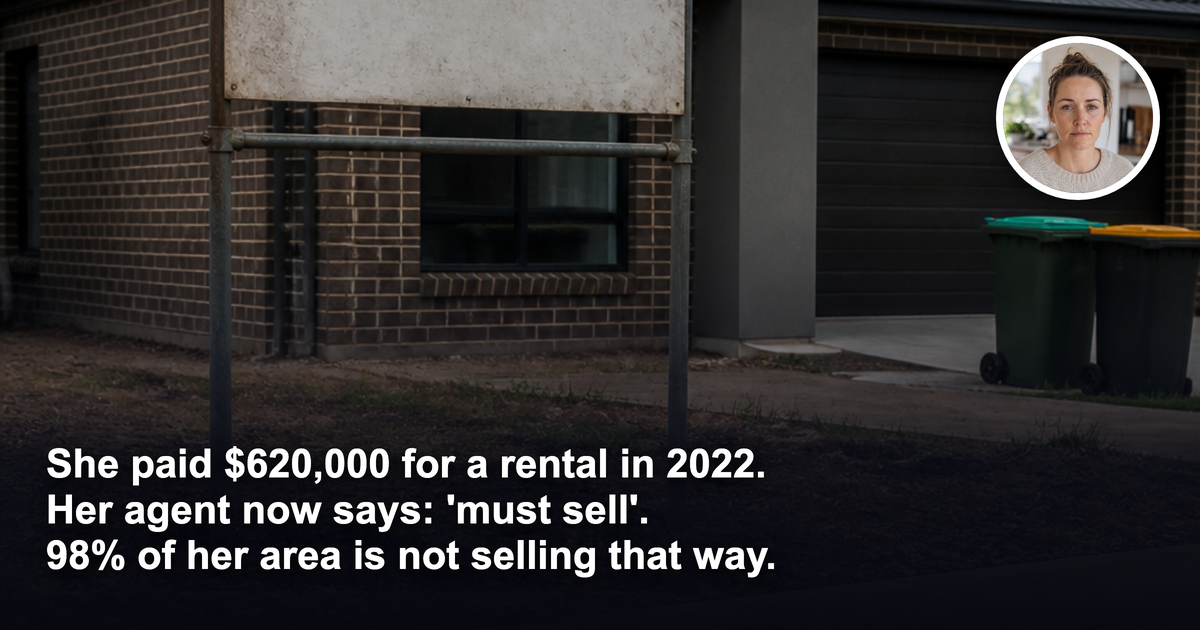
She is 37. She bought a four-bedroom house in Melbourne's outer south-east in 2022 for $620,000, her first investment property, with a loan secured against the equity in the home she shares with her partner.
The plan was simple. Tenant in, rent covers most of the loan, hold for ten years.
Then the rates started going up. Then the Victorian land tax bill arrived. Then the rent review came back lower than the number she had budgeted. This week her property manager, who also sells, suggested she "get ahead of it" and list before spring finishes. The draft ad used two words she had only ever seen on other people's houses: must sell.
She is a composite, drawn from the questions we have received from Victorian owners in the past fortnight. The situation is not.
The question she sent us
"My agent says the market is only going one way and I should sell now, even at a loss, before more people do. He says half his listings have had price cuts. If everyone around me is selling in distress, am I mad to hold?"
The answer: the distress is real, and it is still rare
Start with the number in the headline.
Domain's August data, reported by The Sydney Morning Herald this morning, shows the Melbourne council areas with the highest share of distressed listings: Melbourne City Council at 2.4 per cent, Dandenong at 2.2 per cent and Casey South at 2.2 per cent, with parts of Stonnington also above 2 per cent. A distressed listing is one where the ad says the vendor is "motivated", wants an "urgent sale", flags a price drop or states they "must sell".
Read that again. In the worst-affected pockets of the city, roughly 97 to 98 per cent of sellers are not advertising distress.
And over the past year, with three rate rises inside the reporting window and a fourth handed down on Tuesday, most areas saw the share of distressed listings fall slightly, according to the same report.
So the picture in the ad copy and the picture in the data are different. One agent in Casey told the SMH he had cut the price on more than half of his listings and was surprised the distressed share was so low. Prices are being cut widely. Very few owners are being forced to the exit.
Who is actually selling under pressure
The SMH piece is useful because the agents describe who the forced sellers are.
In the CBD and Docklands, they are mostly investors who believed they had bought the bottom, watched unit prices fall further, and are now willing to take a loss to stop the bleeding. In Dandenong, the agent says most of the pressured sellers are owner-occupiers downsizing under cost-of-living strain, while houses in the $600,000 to $650,000 bracket are still selling to first home buyers. In Casey, sellers are rattled by rates, land tax, changes to negative gearing and capital gains tax, and one agent says he cannot see growth for five years.
One vendor spent heavily on a renovation and found the price roughly where it started after five years.
Look at what those stories have in common. A thin buffer and a single asset carrying the whole plan, bought on a prediction about the market rather than on the owner's own capacity to hold through a bad stretch.
AMP's Shane Oliver put it plainly to the SMH: distressed listings have stayed low because households have been able to get by, often by working more hours, but with unemployment at 4.6 per cent and rising, he thinks we are getting closer to the tipping point.
What it means for you
If you own one investment property and the question keeping you awake is "should I sell before it gets worse", the honest first step is to work out whether you are actually at risk of being forced, or whether you are being nudged.
Forced means the cash-flow gap cannot be covered from income, savings or redraw for the next two years, and there is no lever left to pull.
Nudged means it hurts, and someone with a commission on the line has told you it will hurt more.
Those are different situations and they deserve different answers. A loss on sale is permanent. Agent fees are permanent. Buying back into the same market later, with stamp duty, is permanent. A tough cash-flow year is temporary if the structure underneath it holds.
For the composite owner above, the expensive mistake is listing a house in a price bracket that is still selling, in a council area where 97.8 per cent of vendors are not advertising distress, because a two-word label told her everyone else was.
For buyers with equity and a buffer, the same report raises a different question. Agents say buyers are offering well below asking and placing offers on several properties at once to see which vendor blinks first. That is a market where terms are negotiable. Whether it is a market to buy into depends entirely on the street, the asset type and your own capacity to hold, and no headline can tell you that.
The Ripehouse reframe: forced sales are a structure problem
Two houses on the same street in Cranbourne can be having completely different years. One owner has a buffer, a sensible loan split and a rent that was set with some room in it. The other borrowed to the limit on a forecast and is now writing "must sell" in an ad.
The structure decided that outcome long before the market moved.
This is also why we publish our full client distribution, including the portfolios that underperformed. Forced sales are the part of the story that highlight reels leave out, and you cannot plan for a downside you refuse to look at.
The right asset, on the right street, bought with a structure that survives four rate rises, beats a headline every time. Timing the bottom is a hope. Structure is a decision.
If you are weighing whether to hold, sell or buy into a market where some agents have cut prices on more than half their listings, join Jacob's free live webinar and see how we test a decision like this street by street before anyone signs anything.
General information only. It does not take your objectives, financial situation or needs into account, and nothing here is legal, financial, taxation or investment advice specific to your circumstances.