News · 3 October 2026 · 5 min read
He renovated for five years and the house is worth what he paid. Should he sell before Dandenong turns?
He is 44. He and his wife bought a three-bedroom brick house in Dandenong five years ago for about $650,000, the bracket a local agent now describes as the part of the market that still moves. They put in a kitchen. They put in a second bathroom. They did it the slow way,...
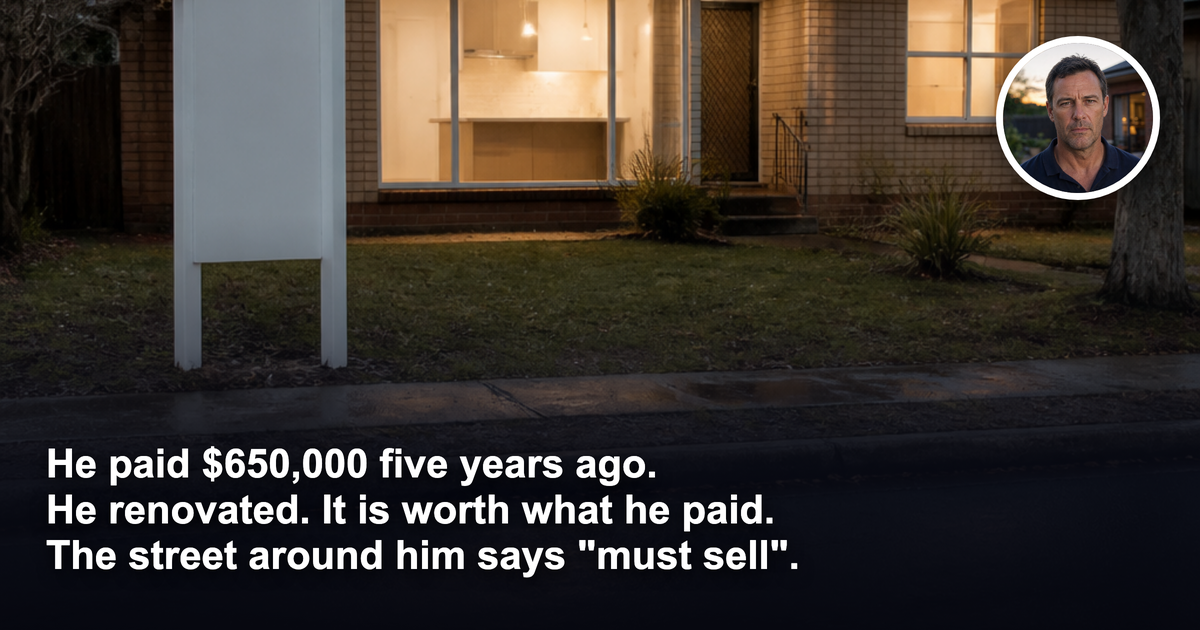
He is 44. He and his wife bought a three-bedroom brick house in Dandenong five years ago for about $650,000, the bracket a local agent now describes as the part of the market that still moves. They put in a kitchen. They put in a second bathroom. They did it the slow way, paying as they went, with a plan to keep the house as their first rental when they upsize next year.
Last month he asked an agent what it would fetch. The answer was roughly what he paid.
Then came Tuesday's rate rise, on top of the three handed down during the period covered by the Sydney Morning Herald's 3 October report on Melbourne's distressed sellers.
He is a composite, drawn from the questions we receive. The numbers around him are real.
The question he sent us
"We've held this house five years and renovated it and it's worth what we paid. There are 'must sell' listings two streets away and buyers are putting offers on three houses at once to see who folds first. Do we sell now before the whole suburb goes that way?"
The answer: the whole suburb is not going that way
Start with the number in the headline. Domain's August data, reported in the Herald, put Melbourne City Council at the top of the distressed-listing table with 2.4 per cent of listings flagged as motivated, urgent, price-dropped or must sell. Dandenong and Casey South were next at 2.2 per cent. Parts of Stonnington also made the list.
Read that again. In the most distressed pocket in Melbourne, more than 97 in every 100 listings are not distressed.
And the share of distressed listings in most areas fell slightly over the past year, according to the same report. That happened while prices fell and rates rose three times.
The experts quoted are honest about what is coming. AMP's Shane Oliver says households have coped so far, but the longer rates stay at these levels the closer we get to a tipping point, and he expects distressed listings to rise. Unemployment is 4.6 per cent, the highest in a few years, and appears to be climbing. Nobody should pretend the pressure is easing.
But a rising count of forced sellers is a different thing from a suburb-wide collapse. It is a small, visible group making a lot of noise. The noise is the problem.
What the "must sell" sign actually does
One Dandenong agent told the Herald that properties in the $600,000 to $650,000 bracket are still selling, mostly to first home buyers who plan to live in them, while the top end of the suburb is struggling. In Casey, an agent reports price cuts on more than half his listings. A Melbourne CBD agent says buyers are making offers on several properties at once and waiting to see which vendor comes back first at the price they want.
Hold those three facts together and the mechanics of a forced sale become clear.
A buyer with four offers out does not need your house. They need one house. The vendor who signals weakest gets the call. The words "must sell" in a listing are a written instruction to every buyer in the suburb: start low, this one will fold.
So the man in our inbox would be taking a property that sits in the bracket still clearing to first home buyers, and voluntarily relabelling it as the weakest offer in the street. The renovation he paid for over five years would be priced by someone shopping for the most frightened vendor.
That is the expensive mistake. He has not lost his renovation money yet. A house worth what he paid, after five years that included a Melbourne downturn and four rate rises, is a boring result rather than a disaster. Boring is survivable. A sale into a lowball market is the only step in this story that turns boring into a loss.
Why the forced sellers are forced
Look at who the agents say is selling under pressure.
Investors in the CBD and Docklands who believed they bought at the bottom and are now willing to take a loss to avoid a bigger one. Owner-occupiers in Dandenong downsizing because the cost of living and the rate rises ran ahead of their income. Recent buyers in Casey who went in expecting short-term profit and met flat growth, Victorian land tax and changes to negative gearing and capital gains tax instead.
None of them were undone by the market alone. Melbourne prices have fallen for everyone. The ones listing as "must sell" are the ones whose loan, buffer and timeline could not absorb the fall. The structure gave way before the asset did.
Most forced sales are decided on the day the loan is set up, long before the market turns.
What this means for you
If you are holding, the question to answer this week is how many months you could carry the property if rates rise again and the tenant leaves. Write the number down. If it is twelve months or more, the distressed-listing table is other people's problem. If it is three, you have a structure problem, and a structure problem is fixable before it becomes a listing.
If you are buying, the pockets in this report are not a sale rack. An agent in Casey says he cannot see growth there for five years. One in Dandenong says buyers are lowballing and vendors are refusing to list at all. A low price in a street where nothing is clearing is a low price for a reason. Two streets in the same suburb can be having completely different years right now, and a council-level table in a newspaper cannot tell you which is which.
The Ripehouse reframe
We do not ask clients to pick the bottom. Nobody in this report who tried to pick the bottom is happy.
We ask a different question: can this loan, on this asset, in this street, hold through a bad three years without the owner ever having to type the words "must sell"? If the answer is yes, a headline about distressed suburbs is weather. If the answer is no, no bargain price fixes it.
The right asset on the right street, carried by a structure built for the downturn, beats every headline in this story.
Our client portfolios have grown at a median of 19.0 per cent a year on a 5-year rolling basis, against roughly 6.3 per cent for the combined capitals (benchmark: CoreLogic/Cotality), and we publish the full distribution, including the portfolios that underperformed. Past performance is not a guarantee of future results.
Want to see how a decision like this is stress-tested street by street before you commit to it? Join Jacob's free live webinar, If I Were Buying an Investment Property in Australia Today.
General information only. It does not take your objectives, financial situation or needs into account, and nothing here is legal, financial, taxation or investment advice specific to your circumstances.