News · 30 September 2026 · 5 min read
She sold, banked $260,000 and waited for the all-clear. Inflation just sent her the bill
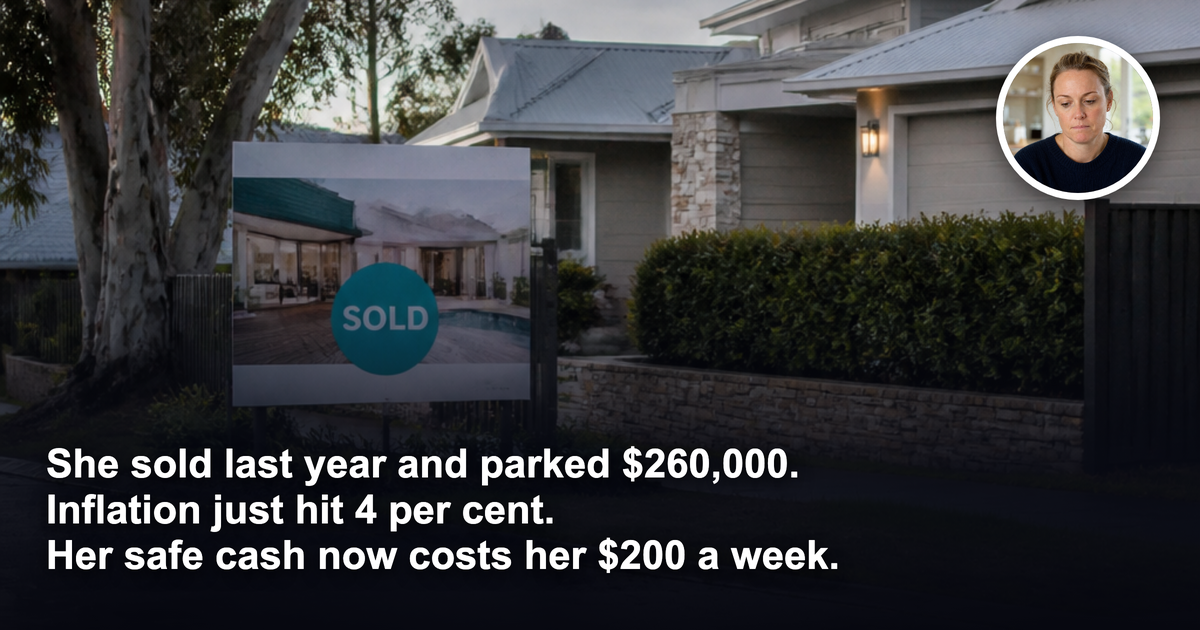
She is 43. She sold her one investment property in the middle of last year, cleared the loan, and walked away with about $260,000.
She is 43. She sold her one investment property in the middle of last year, cleared the loan, and walked away with about $260,000.
She did not blow it. She did not put it into anything she did not understand. She put it in the bank, told herself she would get back in "when things settle", and got on with her life.
It felt like the grown-up decision. Most of the people around her told her it was.
This morning the Australian Bureau of Statistics published its monthly inflation indicator. Headline inflation rose to 4.0 per cent in the year to August, up from 3.5 per cent in July. The ABS says the jump was mostly fuel.
She read that on her phone before work and felt the same thing a lot of you felt. Not panic. Something duller. The sense that the ground had shifted under a decision she thought was finished.
*She is a composite, drawn from the questions we receive. The numbers are hers in the sense that they are the numbers we keep seeing.*
### The question she sent us
*"I sold last year so I wouldn't get caught out. The money is safe in the bank. Now inflation is going the wrong way again and everyone is saying rates might not come down. Did I do the wrong thing by waiting? And what do I do now?"*
Two separate questions hiding in there. Take them in order.
### The answer: the cash is not safe. It is just not moving.
Here is the part nobody puts in the headline.
Inflation is not only a rates story. It is a purchasing-power story, and purchasing power is what her $260,000 actually is.
At 4 per cent, if that rate held for a year, $260,000 of cash buys about $10,400 less than it did. Call it $200 a week. Whatever interest her savings account pays claws some of that back, and then tax takes a slice of the interest. She can do her own sums on the net. Very few people who run them like the answer.
So the "safe" decision has a running cost. It always did. Inflation at 3.5 per cent was already charging her. This morning the rate on that quiet levy went up, and it went up without anyone asking her permission.
She has not lost $10,400. She has not lost anything you could point to. That is exactly why it is dangerous. A property that falls in value shows up on a valuation. Cash that goes backwards never shows up anywhere. It just buys a little less house every month, and nobody sends you a statement for that.
### The expensive mistake is not that she sold
Plenty of people should sell a property. Wrong street, wrong asset, wrong debt structure, wrong time in their life. Selling is not the sin.
The sin is what she did next: she treated "wait" as a neutral position. It is not. Waiting is a position with a cost, and the cost is set by a number she does not control and cannot predict. This morning that number moved against her.
And there is a second cost she has not priced. Every headline like today's changes how the banks think about her, too. Lenders do not assess you at the rate you will pay. They assess you at a rate above it, with a buffer, against your living costs. When the cost of filling the car, insuring a house and paying council rates drifts up, the borrowing capacity of a person on a fixed income drifts down. She is not just watching her cash shrink. She is watching the door she plans to walk back through get narrower.
We are not going to tell you what the Reserve Bank will do. We do not know, and neither does anyone posting confident predictions today. That is the whole point. Her plan depended on knowing.
### What it means for you
If you are sitting on equity or cash and waiting for a clean signal, hear this plainly: there is no clean signal. There is only the cost of waiting, and this morning it went up.
If you already hold property with debt, the lesson is different. Do not read today's number and reach for the sell button. Read it and recheck your buffers. How many weeks of holding costs could you cover if fuel, insurance and rates kept drifting the way they have? If the honest answer is "not many", that is a structure problem, not a discipline problem, and it is fixable. It is fixable long before it becomes a forced sale.
And if you are the friend telling someone to "just wait and see", understand what you are actually recommending. You are recommending they pay about $200 a week, on $260,000, for the comfort of doing nothing.
### The Ripehouse reframe
One month's CPI print should not decide anything about a portfolio. Neither should one rate decision. We judge outcomes over five-year rolling periods because that is the only frame in which structure shows up and noise disappears.
On that frame, our clients' portfolios have grown at a median of +19.0 per cent a year, against roughly 4.3 per cent nationally.* That gap is not timing. Nobody at Ripehouse called the bottom in 2021 or the inflation print this morning. The gap is asset selection, street selection and debt structure, done deliberately and then left alone.
Because here is what the headline never says: two streets in the same suburb can be having completely different outcomes in the same month. The national inflation number is identical for both. The result is not. The people who are not going backwards this year did not out-guess the ABS. They bought the right asset on the right street with debt built to survive a year like this one, and they did not have to be right about August.
We don't ask you to take our results on faith. We publish them, including the portfolios that underperformed.
She did not do the wrong thing by selling. She did the wrong thing by stopping. The fix is not to rush. The fix is to replace a decision that depends on a forecast with a structure that does not.
15-minute Legacy Sequence Diagnostic: ripe.house/4bV7I8u. No pressure. No obligation. Just a clearer picture than you had before.
*Median portfolio growth per year, 5-year rolling basis, across Ripehouse client portfolios. National benchmark: CoreLogic/Cotality. Past performance is not a guarantee of future results. General information only, not personal financial advice.
General information only. It does not take your objectives, financial situation or needs into account, and nothing here is legal, financial, taxation or investment advice specific to your circumstances.