News · 2 October 2026 · 4 min read
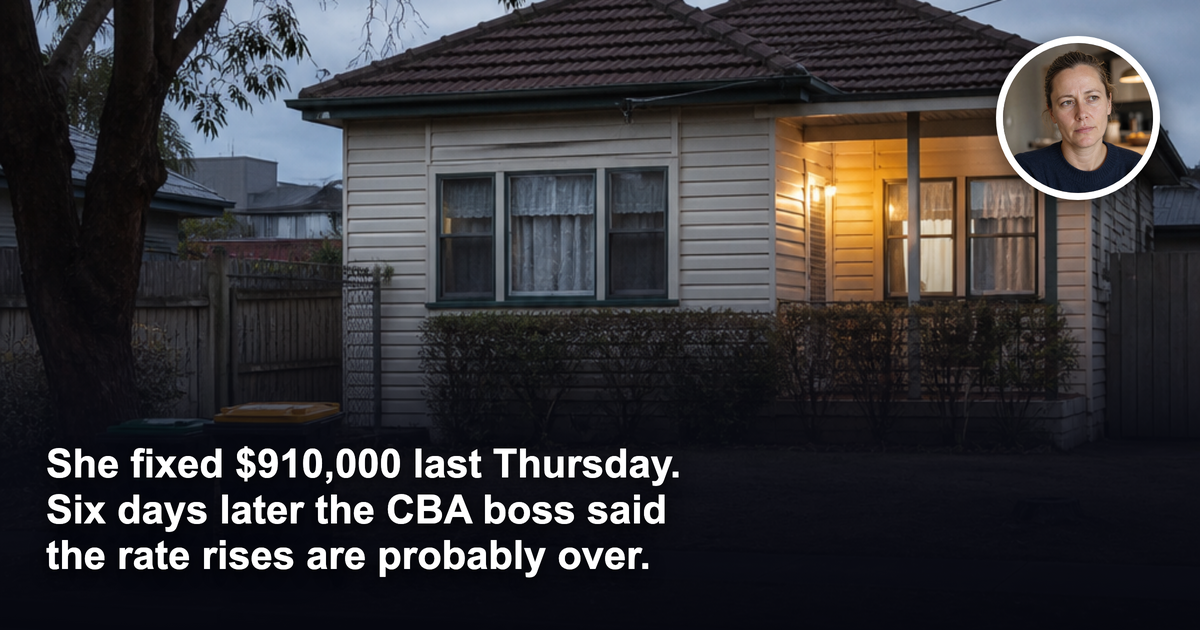
She fixed $910,000 last Thursday. Six days later the CBA boss said the rate rises are probably over
She is 41. She owns her home in Adelaide's inner south and a three-bedroom rental in Geelong she bought in 2023. Across the two loans she owes about $910,000, and until last Thursday every dollar of it was on a variable rate.
She is 41. She owns her home in Adelaide's inner south and a three-bedroom rental in Geelong she bought in 2023. Across the two loans she owes about $910,000, and until last Thursday every dollar of it was on a variable rate.
The September rate rise landed on both loans in the same week. She did the sums on her phone at the kitchen bench, rang her broker, and locked the lot into a three-year fixed rate. She told us she slept properly for the first time in a month.
Six days later Matt Comyn, the chief executive of the Commonwealth Bank, sat down with the ABC's Alan Kohler and said his bank believes the September rise was the last one.
She is a composite, drawn from the questions that arrived in our inbox this week. The question itself is the one we keep being asked.
The question she sent us
"I fixed $910,000 last Thursday because I couldn't take another rise. Now the CBA boss says they're done. Did I just lock in the top? Should I pay the break fee and go back to variable?"
The answer: read the whole sentence
Here is what Comyn actually said to the ABC. "We believe that's the last [rate rise], but certainly I think the last meeting of this calendar year is live."
Two clauses. The headline took the first one and left the second on the floor.
"Live" is central bank language for a meeting at which the board might move. Comyn was explicit about what would decide it: the quarterly inflation data due at the end of this month. If that print runs hot, his "probably" becomes a November rise. If it comes in soft, the cycle is over and the conversation turns to when cuts begin.
So the man running the country's largest mortgage book has told you, in one sentence, that he does not know. He has a view. He has hedged it. That is the honest position, and it is a long way from "rates are done".
Which means nobody can yet answer "did I lock in the top?", including him.
What the last cycle did
Comyn offered a comparison worth holding onto. When rates last peaked, in 2023, national house prices fell 8.2 per cent. Current forecasts, he said, are for a drop of about 10 per cent this time.
He also said he expects prices to weaken through the rest of this year, then pick up as rates come down next year, helped by what he called a structural undersupply of housing.
Hold those two numbers side by side. An 8.2 per cent fall in 2023 was followed by a recovery strong enough that most people have forgotten it happened. Comyn's words: "I seem to remember considerably less focus on house prices during that time."
People who held good assets through the 2023 peak came out the other side. The damage fell on people who made permanent decisions in the loud months.
The expensive mistake nobody is naming
She has not made a mistake by fixing. Plenty of investors fix part of their debt for certainty and never regret it.
The expensive move would be a second permanent decision to undo the first. Breaking a fixed loan six days in, on the strength of one hedged sentence, means paying a break cost to buy back exposure to a November meeting the CBA boss himself calls live.
Comyn said something else in that interview that matters more to her than the rate call. CBA has seen an increase in the proportion of customers needing financial assistance or struggling to meet repayments. Spending is down among people exposed to higher borrowing costs. Savings are down.
Those are buffer problems. They show up when a household has no room for rates to go the wrong way, whatever anyone predicted.
What this means for you
If you have investment debt and you are refreshing the news for the November decision, you are asking the wrong person for the wrong thing.
The useful questions this month are about structure:
- How many months of repayments could each loan survive with no rent coming in?
- What share of your debt is variable, and what does one more rise do to the monthly figure?
- If prices fall the forecast 10 per cent, does any loan reach the point where your bank wants a conversation?
- Which of your properties would you buy again at today's price?
None of those answers change on inflation day. All of them decide whether a November rise is a nuisance or a crisis.
The Ripehouse reframe
Comyn put a number on why this matters: housing is about 57 per cent of household wealth in Australia. A 10 per cent national fall is a headline. What happens on your street is your balance sheet.
Two streets in the same suburb are having completely different years right now. One has stock sitting for months and landlords competing on rent. The other absorbs turnover within weeks. The national figure averages them together and tells you nothing about which one you own.
Structure beats timing. It did in 2023 and it will again. The right asset on the right street, with a buffer sized for the bad case, makes the November decision interesting rather than frightening.
She fixed. That is done. Her next decision should be about the buffer under those two loans and whether the Geelong house sits on a street that can carry a soft year. Nothing Matt Comyn says before November changes either answer.
Want to see how we test a decision like this street by street before a rate meeting rather than after? Join Jacob's free live webinar.
General information only. It does not take your objectives, financial situation or needs into account, and nothing here is legal, financial, taxation or investment advice specific to your circumstances.