News · 29 September 2026 · 5 min read
She owns her home outright. The bank just told her she can borrow $480,000.
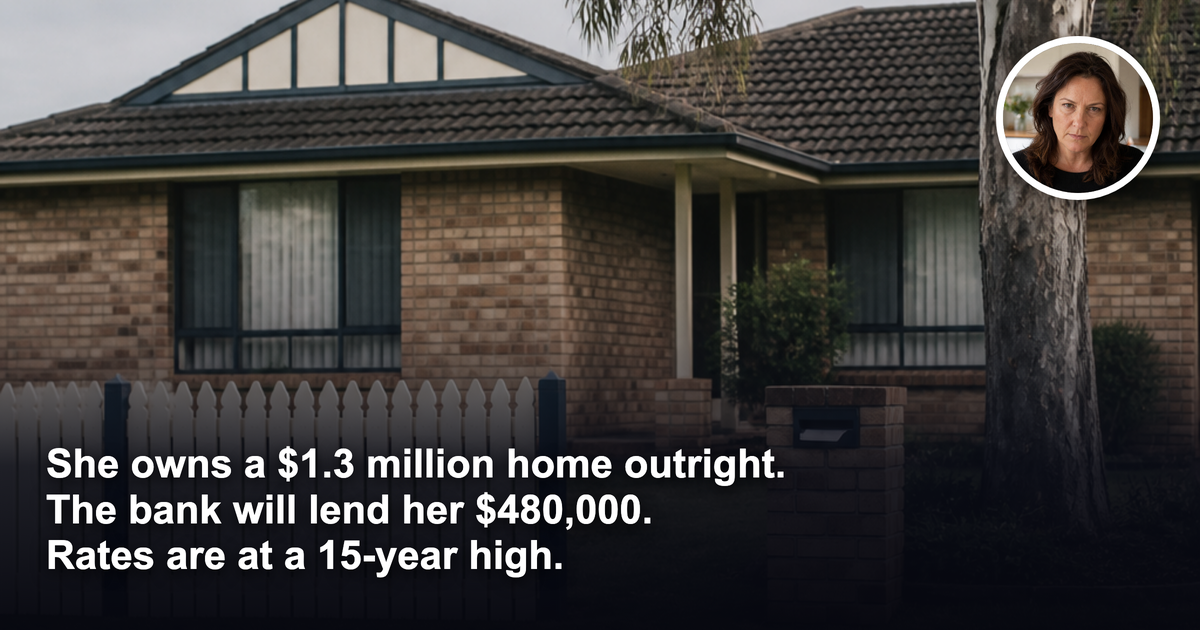
She is 46. She made the last payment on her home in March. She kept the letter from the bank, the one that says the mortgage is discharged, on the fridge for a fortnight because it felt like a trophy.
She is 46. She made the last payment on her home in March. She kept the letter from the bank, the one that says the mortgage is discharged, on the fridge for a fortnight because it felt like a trophy.
Her plan was simple and, on paper, conservative. Own the home. Then use it to buy one investment property. Then maybe a second. Twenty years of not going on the trip, not upgrading the car, not moving to the bigger place.
This week she sat in a bank branch with a payslip, a rates notice and a house worth about $1.3 million with nothing owing on it. The lender came back with a borrowing figure of roughly $480,000.
She read it twice. Then she asked whether they had left off a digit.
*She is a composite, drawn from the questions we have received this month. The figures are illustrative of that composite, not a single client.*
### The question she sent us
*"I own my house. Not mostly. Completely. I have a good job and no other debt. The bank has just told me I can borrow $480,000, which buys almost nothing where I live. Rates went to 4.6 per cent this week and I feel like I've been punished for being careful. What did I get wrong?"*
She got nothing wrong. She just believed something almost everyone believes, and that the last two decades of easy credit never forced anyone to test.
### The answer: equity is not capacity
Here is the part that never makes the headline.
**Banks do not lend against what you own. They lend against what you earn.**
Her house is collateral. It is what the bank takes if things go wrong. It is not what the bank uses to decide how much she can borrow in the first place. That decision runs on income, minus living expenses, minus every other commitment, assessed at an interest rate higher than the one she would actually pay, so the bank knows she survives the next rise as well as this one.
At 4.6 per cent, the highest cash rate in 15 years according to ABC reporting on 29 September, that assessment rate is higher than it has been for most of her adult life. Every dollar of her income now supports fewer dollars of debt than it did a year ago. Nothing about her changed. The denominator did.
Her house did not stop counting. It never counted the way she thought.
The RBA's own framing, as the ABC reported it, is that it hopes the pain "will all be worth it". For a household with a mortgage, that pain arrives as a bigger repayment. For a household with no mortgage and a plan to start investing, it arrives as a smaller number in a branch meeting. It is the same squeeze, wearing different clothes.
### The expensive mistake, in two versions
We see two reactions to that $480,000, and both cost money.
The first is to treat it as a budget. Take the number, find the biggest thing it stretches to, buy that. Usually a unit in a postcode chosen because it is what $480,000 buys, not because anyone looked at what that street has been doing. That is how people end up owning the one asset in the suburb that goes sideways for a decade.
The second is to wait. Rates went up, so capacity went down, so wait for rates to come down and capacity to come back. That is a bet on timing dressed up as patience. Nobody, including the RBA by its own admission, knows how long "worth it" takes. We make no forecast. We simply point out that a plan whose first step is "wait for the cash rate" is not a plan. It is a hope with a spreadsheet.
### What actually moves the number
This is what nobody told her in the branch.
Borrowing capacity is not a fixed verdict on a person. It is the output of a structure, and structures can be changed.
Lenders count a portion of expected rent as income. Which means the property she buys changes how much she can borrow to buy it. A high-yield asset in a street with low vacancy and short days on market does more work for her serviceability than a low-yield one in a prettier suburb. Two streets in the same suburb can be producing completely different outcomes on exactly the measures a lender cares about.
The order of purchases matters. Which lender sits on which property matters. How the debt is split, whether an offset is doing anything, whether the loan is held in her name or somewhere else. None of that is personal advice, and none of it is exotic. It is simply the difference between walking into a branch with a payslip and walking in with a structure.
She spent twenty years building a very strong wall. Nobody told her the bank measures the gate.
### The Ripehouse reframe
A 15-year high in the cash rate is a stress test. It is testing every portfolio in the country right now, including the ones that were built on the assumption that rates only go one way.
We publish how our clients' portfolios have gone through that test. Across 997 client portfolios since 2021, median portfolio growth has run at +19.0 per cent per year on a 5-year rolling basis, against roughly 6.3 per cent for the combined capitals over the same kind of period.1 We publish the underperformers too. We don't ask you to take our results on faith.
The portfolios that hold at 4.6 per cent are not the ones that guessed the rate. They are the ones built on the right asset, in the right street, with debt arranged so that a rise is uncomfortable rather than fatal.
If you own your home, have real equity and have just discovered the bank's number is smaller than your effort, that is not a discipline problem. It is a structure problem. And it is fixable.
15-minute Legacy Sequence Diagnostic: ripe.house/4bV7I8u. No pressure. No obligation. Just a clearer picture than you had before.
1 Benchmark: CoreLogic/Cotality combined-capitals dwelling values. Past performance is not a guarantee of future results. This article is general information, not personal financial, credit or tax advice.
General information only. It does not take your objectives, financial situation or needs into account, and nothing here is legal, financial, taxation or investment advice specific to your circumstances.