News · 13 October 2026 · 4 min read
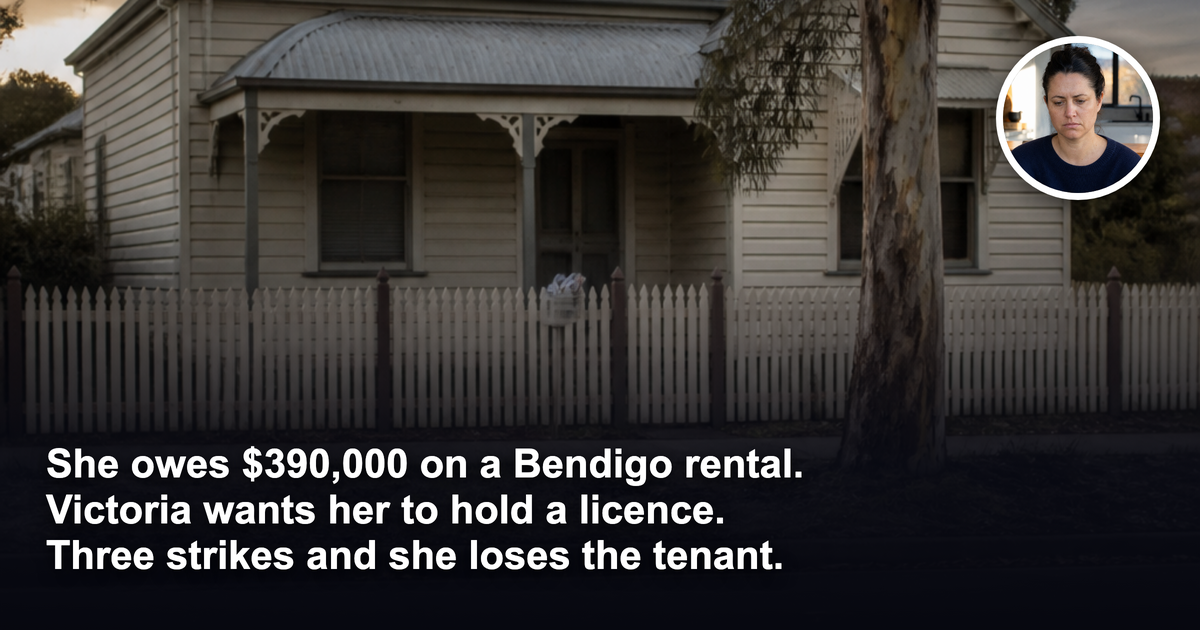
She owes $390,000 on a Bendigo rental. Victoria is proposing three strikes could end her right to let it
She is 39. She and her partner own their home in Canberra, and in 2021 they used some of its equity to buy a three-bedroom weatherboard in Bendigo for about $480,000. They owe about $390,000 on it. The rent is around $430 a week.
She manages the house herself, from 700 kilometres away
She is 39. She and her partner own their home in Canberra, and in 2021 they used some of its equity to buy a three-bedroom weatherboard in Bendigo for about $480,000. They owe about $390,000 on it. The rent is around $430 a week.
She manages it herself. She found the tenant on a listing site, wrote the lease from a template, and does the inspections when they drive down to see her partner's family twice a year. She has never paid a property manager a cent, and she is a little proud of that.
She is a composite illustration, not a real person. The situation is common enough that she could be any of several thousand interstate owners.
On 13 October, realestate.com.au reported that Victoria is proposing mandatory licences for landlords, with a three-strike rule that could stop an investor from renting out their property at all.
She read it on her phone at the kitchen bench.
The question
"I have never had a complaint. But I have also never had anyone check. If Victoria brings in a licence and I get three strikes for things I did not know were breaches, do I lose the right to rent out a house I still owe $390,000 on?"
The answer: the proposal is a proposal, and the loan is not
Start with what is actually on the table. It is a proposed plan. It is not law. The realestate.com.au report describes mandatory licensing and a three-strike rule. It does not settle what a strike is, who decides, or when any of it starts. Anyone telling you the detail today is guessing, and we are not going to guess.
So take the shape of it, and leave the detail alone.
The shape is this. A government is proposing that the right to collect rent becomes a licence, and that a licence can be taken away. That is new. Until now, the worst outcome of a compliance failure in Victoria was a fine, a tribunal order, a repair bill. The proposal adds a different kind of outcome: a house you own, with a loan you still owe, that you are no longer allowed to let.
The bank does not care about your licence. The repayments arrive on the same day either way.
That is the part worth sitting with. For an owner carrying $390,000 of debt, the fine is the small cost. The large cost is the risk that a third strike turns a rental into a vacant house with a mortgage attached.
Why self-managing from interstate is the exposure
Two owners can hold identical houses on the same Bendigo street. One uses a licensed property manager who logs every repair request, every smoke alarm check, every entry notice, every rent review, with dates. The other does it from Canberra with a template lease and a good memory.
Under a fine-based system, both carry roughly the same risk. The self-manager saves the management fee and wears the odd mistake.
Under a licence-and-strikes system, the arithmetic changes. The question becomes whether you can prove you did the right thing, on the day someone alleges you did not. A strike that cannot be contested is a strike. Three of them, on the proposal as reported, and the tenant goes.
Nobody is saying self-managers are bad landlords. Many are better than the agencies they refuse to pay. But a licence regime rewards paperwork, and paperwork is exactly what a time-poor owner 700 kilometres away does least.
What it means for you
If you hold Victorian property, or you are deciding between states right now, three things follow.
- State compliance risk is now part of the yield. A Victorian house and a Queensland house at the same rent are no longer the same investment if one carries a licence that can be revoked. Price that in before the headline yield.
- Delegation is worth more than it was last year. The management fee used to buy convenience. Under a strike regime it buys evidence, and evidence is what keeps the licence.
- Do not sell on a proposal. The expensive mistake here is the reflex one: listing a Bendigo house in a soft market because of a rule that has not been written. Selling costs are real and immediate. The licence does not exist yet.
The Ripehouse reframe
Headlines move faster than markets, and policy moves slower than both.
The owner who gets through a change like this is the one whose portfolio was built on structure: the right asset, on the right street, held under documented professional management, with the compliance trail already there before anyone asked for it. For that owner a licence is a form to fill in.
The owner who gets hurt is the one holding the right house with no paper trail, who finds out what a strike is by receiving one.
Street still matters more than state. Two streets in the same Bendigo suburb can be having completely different outcomes on vacancy and days on market, and a rule that applies to the whole state does not change that. What a rule like this changes is how much of the outcome depends on who is managing the house.
She has not done anything wrong. She has done it alone. Under the proposal as reported, that distinction is about to cost something, and the sensible move is to close the gap now, while it is cheap.
Want to see how we test a decision like this, state by state and street by street, before the rules change? Join Jacob's free live webinar.
If there's a specific street you're weighing up right now, check its Street Score first — it's free, takes ten seconds, and tells you whether that street is pulling the suburb average up or riding on it.
General information only. It does not take your objectives, financial situation or needs into account, and nothing here is legal, financial, taxation or investment advice specific to your circumstances.