News · 13 October 2026 · 4 min read
A 30 per cent trust tax is before parliament. Whose name goes on your next investment property?
Thirty per cent.
The number
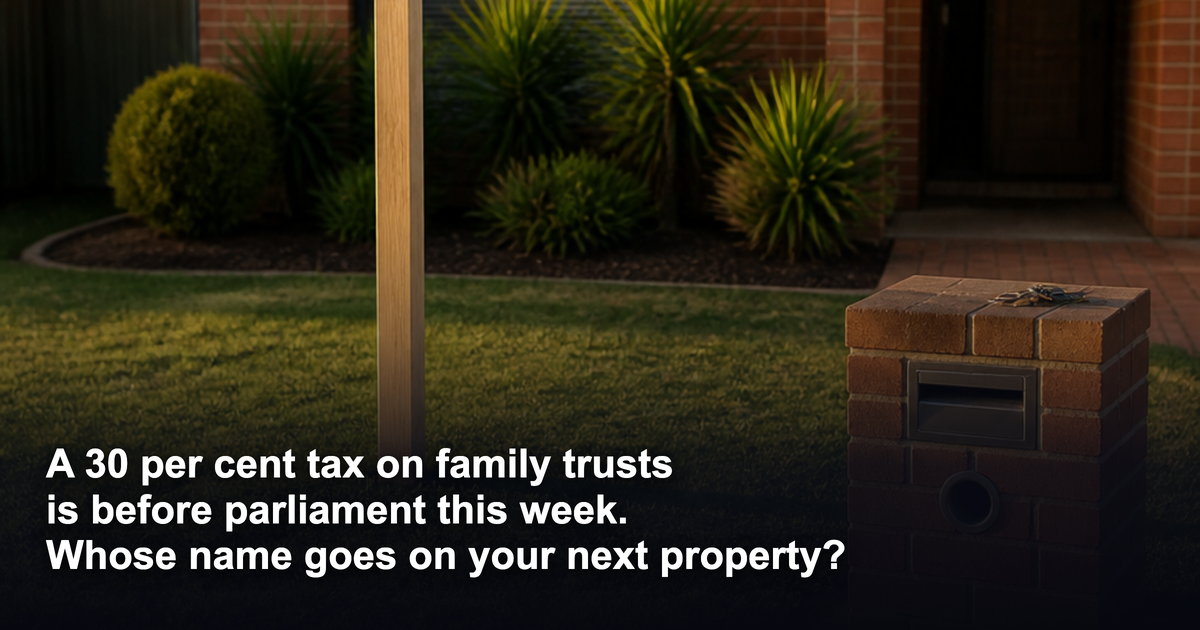
Thirty per cent.
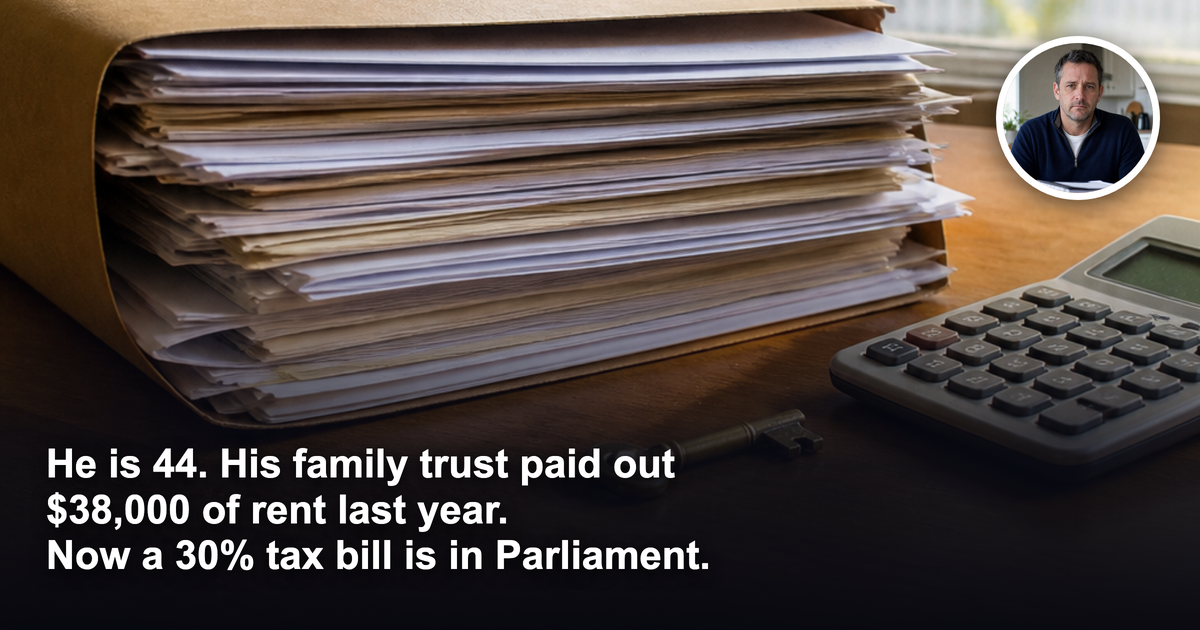
That is the minimum tax rate the Treasurer was preparing to put before parliament on Wednesday for distributions from discretionary trusts, according to the ABC.
The bill was being introduced this week. It has not passed. The final text, any thresholds and the start date all still need to be read in the legislation itself before anyone treats them as settled.
But the decision it touches is live today, because a lot of households with equity are sitting on a plan to sign the next contract in the name of a family trust.
What changed, and why it matters
A discretionary trust, in the form most property investors use, lets the trustee decide each year which beneficiary receives the income. Rent and capital gains could be directed to whoever in the family was on the lowest marginal rate that year.
That flexibility was the main reason an accountant would put a rental property into a trust in the first place.
A 30 per cent floor on those distributions, if it passes in the reported form, takes most of that flexibility away. Income streamed to a beneficiary on a low rate would no longer be taxed at that low rate. It would be taxed at 30 per cent at least.
The asset protection and estate planning arguments for a trust do not disappear. The tax arbitrage, which was the part most people were really paying for, is the part under threat.
What it means if you have equity to deploy
If you own your home, have usable equity, and were about to buy your next property, there are broadly four ways to hold it: your own name, joint names, a company, or a discretionary trust.
Until this week, the trust was often the default answer for households on higher incomes. Now it is a calculation, and the inputs to that calculation are not confirmed yet.
Three practical consequences follow.
- If you already hold property in a trust, nothing has changed to the property. The rent is the same. The loan is the same. The tenant is the same. What may change is how much of the income reaches you after tax.
- If you were about to buy in a trust, the structure decision deserves a pause. The purchase decision can keep running alongside it. A good asset on a good street does not stop being one because the holding entity is under review.
- If you were thinking about pulling property out of an existing trust, do not do it on the strength of a headline. Moving a property between entities usually triggers stamp duty and capital gains tax. That is real money paid in exchange for certainty that does not exist yet.
The decision, and the trade-offs
Here is the honest version of the choice.
Your own name. Simplest, cheapest to set up, and the income lands on your marginal rate. Land tax thresholds vary by state and apply per owner, which matters once you hold more than one property.
Joint names. Splits income and gains between two people, with the same simplicity. Less flexible than a trust once incomes diverge.
A company. A flat rate on income, but capital gains are treated differently for a company than for an individual, and that difference is often where the money is on a long hold.
A discretionary trust. Asset protection, control over who receives what, and, if this bill passes as reported, a 30 per cent minimum on distributions.
The expensive mistake is to make this choice in a hurry in either direction. Setting up a trust this week to beat a bill that has not passed. Or collapsing one next week on an assumption about a start date nobody has read.
This article is general information, not tax or financial advice. The right holding structure depends on your income, your state and your family, and that is a conversation for your accountant before you sign anything.
The part nobody puts in the headline
The tax rules around who holds the asset have changed before and will change again. Negative gearing, capital gains discounts, land tax surcharges, foreign buyer levies. Every one of them was announced as the thing that would end property investing. None of them did.
What survived every change was the quality of the asset underneath the structure.
Two streets in the same suburb can be having completely different outcomes right now. One has days on market stretching out and the same three houses relisted every fortnight. The other has none for sale and a rental vacancy close to zero. A 30 per cent trust rate applies to both. Only one of them is building wealth.
That is the Ripehouse position, and it has been for years. Structure beats timing. The right asset, the right street and the data beat the headline. Our clients' portfolios have grown at a median of 19.0 per cent per year on a 5-year rolling basis, against about 6.3 per cent for the combined capitals over the same period (benchmark: CoreLogic/Cotality). We publish that figure including the portfolios that underperformed. Past performance is not a guarantee of future results.
The household with equity who treats this week as a reason to get the street right, and lets the accountant settle the entity question once the bill is actually law, will be fine.
The household who stops buying because of the headline, or rushes a structure to beat it, pays for that decision for a decade.
If you want to see how we test whether a street can carry the asset regardless of whose name is on the title, join Jacob's free live webinar.
If there's a specific street you're weighing up right now, check its Street Score first — it's free, takes ten seconds, and tells you whether that street is pulling the suburb average up or riding on it.
General information only. It does not take your objectives, financial situation or needs into account, and nothing here is legal, financial, taxation or investment advice specific to your circumstances.