News · 13 October 2026 · 4 min read
His rentals sit in a family trust his accountant built. Now there is a 30% tax bill in Parliament
He is 44. He and his partner have three kids under twelve, a mortgage on the family home in Newcastle, and two rental houses they bought in 2019 and 2022.
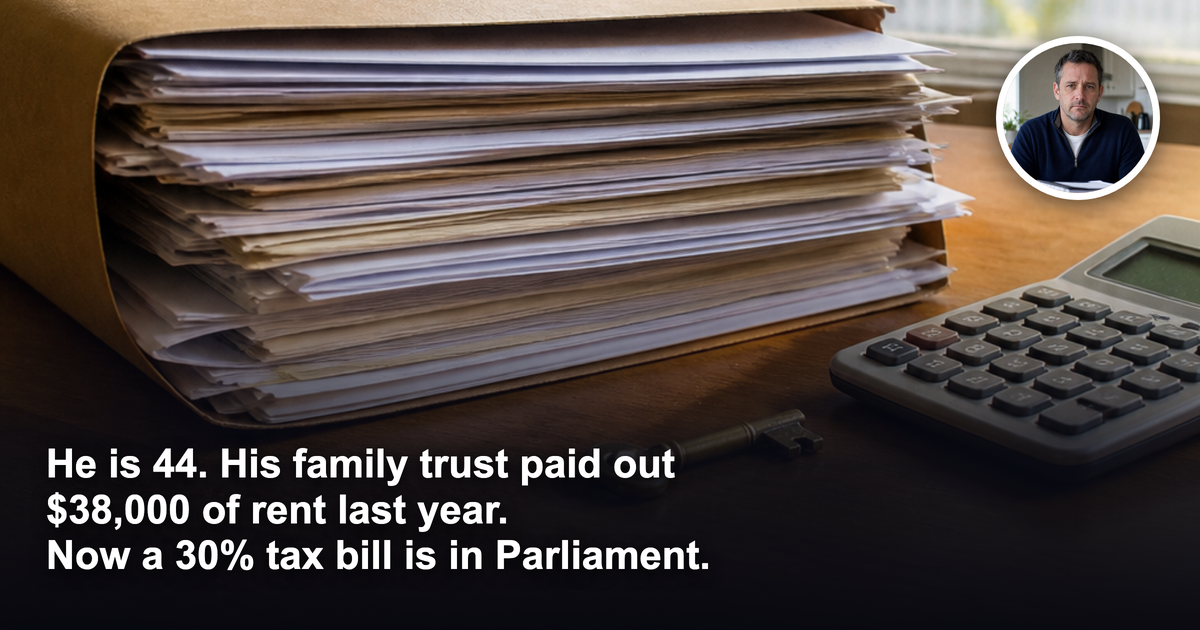
He is 44. He and his partner have three kids under twelve, a mortgage on the family home in Newcastle, and two rental houses they bought in 2019 and 2022.
Both houses sit inside a discretionary family trust. He did not dream that up. An accountant drew it on a whiteboard, explained that the trust could distribute rental income to whichever family member paid the least tax, and sent him an invoice. He signed. His partner works part time, so last year the trust paid her about $38,000 of net rent and the family kept more of it than they would have otherwise.
He is a composite illustration, not a real person. But the structure he is sitting in is very real, and so is what happens to it on Wednesday.
The question
"Our rentals are in a family trust because our accountant told us to. Now there is a 30 per cent tax on trusts coming through Parliament. Do we pull the properties out, and what does that even cost? We set this up properly. Why are we the ones being punished?"
The answer: the bill is real, the final shape is not
According to the ABC, Treasurer Jim Chalmers is unveiling legislation this week for a 30 per cent minimum tax on discretionary trusts. The government expects it to raise $4.5 billion in its first year.
The tax is aimed at the structures that let an owner shift income between family members, holding companies and others. That is the exact feature his accountant sold him. It is also the feature the Treasurer calls a vehicle for reducing tax bills.
Two things matter before anyone panics.
First, this is a bill, and bills change. The Greens hold the votes in the Senate and have called for an inquiry. Their complaint is that the draft is too soft. They want an exemption for money paid from trusts to charities, non-profits and private schools knocked out of the legislation. The government has said it will cap that exempt amount each year, but the cap has not been set. Labor backbenchers are pushing from the other direction on behalf of small business. The wording he will eventually be taxed under does not exist yet.
Second, the government has already carved out family farms, charitable trusts and deceased estates. Investment property trusts are not on that list. If you hold rentals in a discretionary trust, assume you are in scope until the final bill says otherwise.
The number that is actually about him
The ABC reports that about 350,000 active small businesses, roughly one in six, used discretionary trusts in 2022-23. Treasury analysis suggests 140,000 of those would not need to pay the new tax. The rest are expected to pay, or restructure.
Nobody has published the equivalent count for property investors. But he is in the second group by default, and the restructure path is where the cost lives.
Here is the sentence from the report that should stop him. People who move their affairs out of a trust and into a company may have to pay state and territory stamp duty in the process. The government has flagged assistance to restructure, but the detail is thin.
So the choice in front of him is a 30 per cent floor on income the trust earns, or a transfer of two houses he already owns, with duty on each, to escape it.
And according to UNSW tax academic Dale Boccabella, quoted in the same report, a company structure may still deliver much of the same discretion and much of the same tax reduction. In other words, he could pay to move and end up somewhere the next bill also targets.
What this means for you
If you hold property in a family trust, or your accountant has suggested one for your next purchase, three plain points.
- Do nothing in a hurry. A structure change made against a draft bill is an expensive bet on wording that has not been written.
- Get the duty number. Ask what it would cost to move each property out of the trust in your state, before anyone proposes moving it.
- Get qualified tax and legal advice on your own position. This article is general information. It is not advice for your trust.
The expensive mistake in this story is the one made in 2019. He chose his ownership structure for a tax outcome and never asked what it would cost to unwind.
The Ripehouse reframe
Every headline this week is about the rate. 30 per cent. Who pays, who is exempt, whether private school fees slip through.
The rate is a policy setting. Policy settings move. His houses do not.
What decides whether this family comes out ahead over the next twenty years is which two houses they own, on which two streets, and whether those streets are growing while the argument in Canberra runs its course. Two streets in the same Newcastle suburb can be having completely different years. A trust does not fix a weak street. A company does not either.
The right asset, bought in a structure that can survive a change of government and a change of tax law, beats a clever structure wrapped around an average house. Structure first, then the street, then the timing. In that order.
Want to see how we test a hold decision like this against the street, before the structure? Join Jacob's free live webinar, "If I Were Buying an Investment Property in Australia Today".
If there's a specific street you're weighing up right now, check its Street Score first — it's free, takes ten seconds, and tells you whether that street is pulling the suburb average up or riding on it.
General information only. It does not take your objectives, financial situation or needs into account, and nothing here is legal, financial, taxation or investment advice specific to your circumstances.