News · 29 September 2026 · 5 min read
She kept the house in the split and planned to rent it out. Then the Budget changed the maths
She is 41. The separation settled in autumn. She kept the house, a three-bedroom brick place on a quiet street she has lived on for eleven years, with about $310,000 of equity in it and a mortgage she can carry on one income, just.
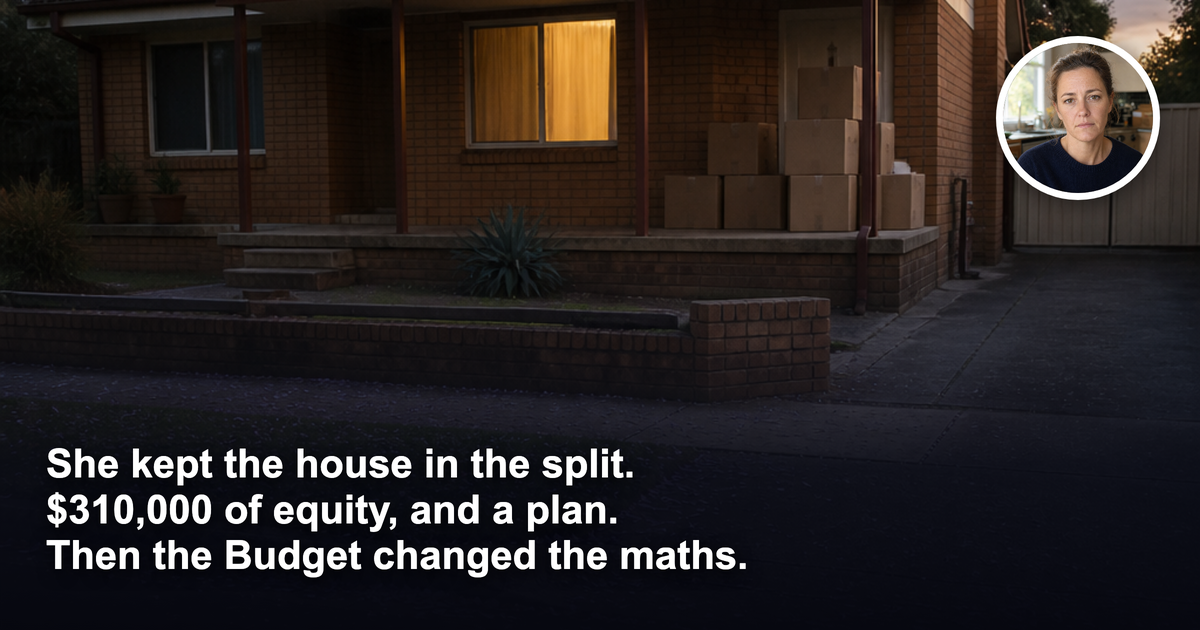
She is 41. The separation settled in autumn. She kept the house, a three-bedroom brick place on a quiet street she has lived on for eleven years, with about $310,000 of equity in it and a mortgage she can carry on one income, just.
Her plan was simple and, honestly, sensible. Move into a smaller rental near the kids' school. Put the house into the rental pool. Let a tenant help carry the loan while she rebuilds. In five or six years, decide.
She had a property manager lined up. She had a rent appraisal. She had a spreadsheet.
Then the Budget landed, and the argument started about whether it makes owning a rental less rewarding after tax. Property Update put the contradiction bluntly this week: Australia needs property investors, so why is the Budget making rental investment less attractive?
She read that headline and closed the spreadsheet.
*She is a composite, drawn from the questions we have received since the Budget. The situation is real. The person is not one identifiable client.*
### The question she sent us
*"I was about to become a landlord because it was the only way I could see to keep the house and keep moving. Now everyone is saying the Budget punishes rental investors. Have I missed the window? Should I just sell and be done with it?"*
That last sentence is the expensive one. Sit with it for a second.
### The answer: the window did not close, the question moved
Here is the thing nobody puts in the headline. The Budget did not decide whether her house is a good investment. It changed which question decides that.
Before, most people ran the numbers on two things: what rent it would fetch, and what the suburb might do. Gross yield and growth. That was always a thin way to look at a rental, but for a long time it was thin enough to get away with.
The Property Update piece makes the point that the settings on rental investment have shifted, and that the shift bites after tax. We are not going to quote specific measures or dollar impacts here. The detail belongs with the official Budget papers and with her accountant, not in a Facebook article. This is general information only. Speak to your accountant before you act on any of it.
But the direction is enough to change her decision, because it changes what she needs to compare.
The question is no longer "should I rent this out?"
The question is "is the way I own this, and the way the debt sits against it, still right under the new settings?"
Those are different questions. The first one has a yes or no answer. The second one has a structure answer.
### The mistake that costs the most
Selling a house you do not need to sell, because of a headline about tax, is the most expensive response available.
She would pay agent commission. She would pay marketing. She would give up the stamp duty already sunk into the place. She would then be renting, on one income, with cash in the bank earning less than she is paying to live, and no asset working for her in the background.
And she would have done it to avoid an after-tax change she has not yet had anyone quantify for her own circumstances.
That is not caution. That is panic wearing caution's clothes.
### What it means for you
If you own a home with equity and were thinking about a first or next investment property, the Budget has not told you to stop. It has told you to stop being casual.
The after-tax return is now the return. Gross yield is a starting number, not a decision.
How you own an asset, in whose name, against which loan, with what split of debt, moves the outcome more than most people are comfortable admitting. Two owners can hold identical houses on the same street and end up with materially different after-tax results because one of them thought about structure before settlement and one thought about it at tax time.
And it is worth saying plainly: the people who suffer most from a policy shift are the ones who bought on a hunch and a headline. A poorly chosen asset in a soft street was a poor investment before the Budget. The Budget just made it harder to hide.
### The Ripehouse reframe
We would tell her the same thing we tell everyone who arrives with a screenshot and a knot in their stomach.
Policy settings move. They have moved before and they will move again. We make no claim about whether these ones will be reversed. Nobody honest can.
What does not move is this: the right asset, on the right street, held in the right structure, beats a headline over time. Two streets in the same suburb can be having completely different years right now, one with tenants queuing and one with signs that have faded in the sun. The suburb name on the news tells you nothing about which one you own.
Her house is not automatically a good rental because she already owns it. It is not automatically a bad one because the tax settings tightened. It needs to be assessed like any other asset: the street, the demand, the days on market, the vacancy around it, and then the ownership and debt arranged to suit her position, not a generic one.
That is what we do. We do not sell property. We build portfolios through structure and delegation, and we publish the results, including the portfolios that underperformed. Across 997 client portfolios since 2021, the median portfolio has grown at +19.0 per cent a year on a 5-year rolling basis, against roughly 4.3 per cent nationally.* Past performance is not a guarantee of future results.
Being behind on this, or scared by it, is a structure problem, not a discipline problem. It is fixable.
If you are standing where she is, with equity, a plan and a headline that just knocked the wind out of it, take the 15-minute Legacy Sequence Diagnostic: ripe.house/4bV7I8u. No pressure. No obligation. Just a clearer picture than you had before.
*Benchmark: CoreLogic/Cotality national dwelling values. General information only; not personal financial, tax or legal advice.*
General information only. It does not take your objectives, financial situation or needs into account, and nothing here is legal, financial, taxation or investment advice specific to your circumstances.