News · 11 October 2026 · 4 min read
She is settling a $640,000 house in a growth corridor. Nobody checked how hot the street gets.
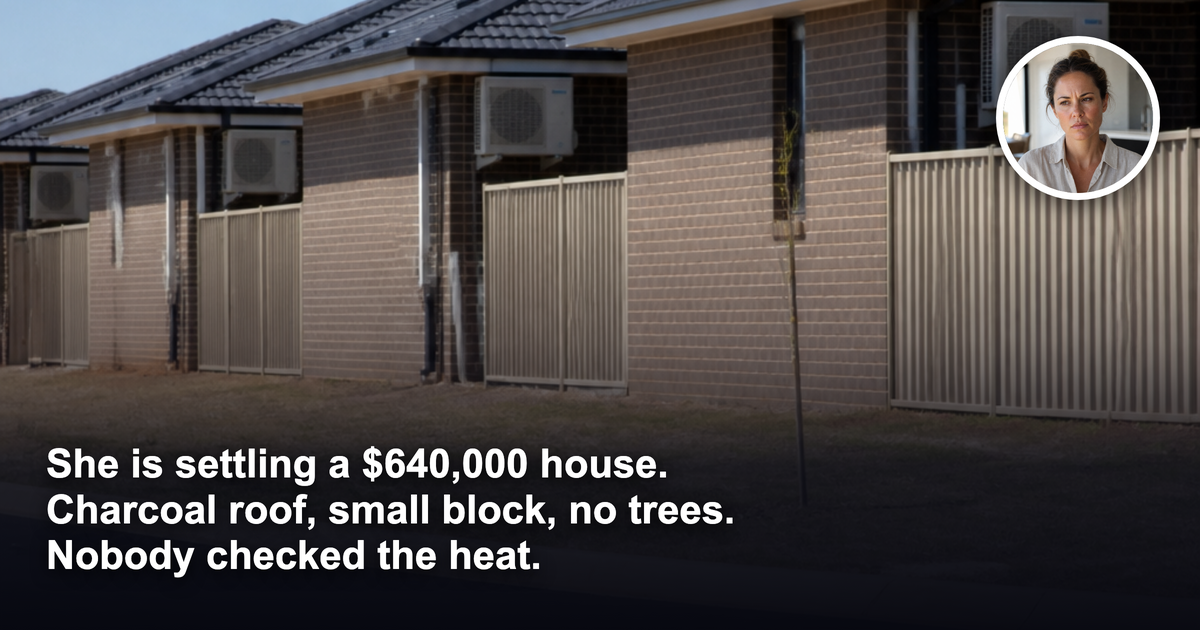
She is 34 and settles on a $640,000 four-bedroom house-and-land package in a Queensland growth corridor in a few weeks. She and her partner drew about $120,000 of equity from their Brisbane home to do it.
She is 34 and settles on a $640,000 four-bedroom house-and-land package in a Queensland growth corridor in a few weeks. She and her partner drew about $120,000 of equity from their Brisbane home to do it.
The sales brochure led with population growth, a new train station and a school under construction. It did not mention the roof. The roof is charcoal. The block is 400 square metres. The nearest tree is in a park two streets away.
She is a composite illustration, not a real person. The street she is buying into is being built right now, many times over, across south-east and north Queensland.
The question
"Everyone says this corridor is the growth story. I have a tenant lined up for December. Why would heat change anything about whether this is a good investment?"
The answer: the state only just noticed
On 11 October the ABC reported that planners, architects and conservationists are worried Queensland's fast-growing urban centres are not being planned for extreme heat.
A few facts from that report deserve a slow read.
Heatwaves are Australia's deadliest natural hazard. The Queensland Government's own heatwave risk assessment says they cause more deaths than every other natural hazard combined. Queensland's yearly average temperature has warmed by 1.5 degrees since records began in 1910.
The Minister for State Development, Jarrod Bleijie, said in a statement that the State Planning Policy had not been reviewed since 2016, and that it previously did not mention heat at all.
Read that again. The document that shapes how Queensland's suburbs get laid out has not changed since 2016, and heat was not in it.
A new draft policy is now open for consultation and names the reduction of urban heat islands as a key priority. That is a draft. It is a proposal, and it will not retrofit a single estate that has already been approved.
Nicole Bennetts of the Planning Institute of Australia described the mechanism plainly. Concrete, roofs and walls trap heat. An air temperature of 35 degrees can feel like 40 or more in a dense urban environment after repeated hot days. Flood and bushfire can be mapped. Heat is invisible, so it gets missed.
Crystal Falknau from the North Queensland Conservation Council pointed to the small brick houses "built to be lived in with air conditioning". Lose power, or lose the budget to run the unit, and she calls them a brick oven.
Architect James Davidson made the point that should matter most to anyone buying new. What is built today will still be standing in 20, 30, 40 or 50 years.
What it means for you
Her tenant will not read the planning policy. Her tenant will read the power bill in February.
Nothing in the ABC report says heat lowers prices, and we will not claim it does. What the report does say is that the physical design of an estate decides how it performs through the hottest weeks of the year, and that the people who set the rules are only now writing heat into them.
For an investor, that adds questions to the due diligence.
- Which way does the house face, and where do the afternoon windows sit?
- What colour is the roof, and how much of the block is roof, driveway and fence?
- Is there any canopy on the street, or any plan for it?
- Can the house be kept liveable without the air conditioner running flat out?
- When the whole estate switches on at 4pm, is the local grid built for it?
None of those appear in a growth forecast. All of them show up in tenant turnover and in the day a lease comes up for renewal in the middle of a heatwave.
The expensive mistake
The mistake is buying an estate by its brochure.
A corridor can be growing fast and a specific street inside it can still be a poor hold. Two streets in the same suburb can be having completely different outcomes. One has wider lots, lighter roofs and a line of established trees. The other is a row of charcoal roofs on 400 square metre blocks with the fence a metre from the wall.
Volume operators sell the suburb. The suburb is the headline. The street and the house are what you own.
The Ripehouse reframe
We do not pick a corridor and buy whatever is left in it. We test the asset and the street, and we publish the results, including the portfolios that underperformed.
Heat is one more input in that test, alongside flood overlays, vacancy and days on market. It separates the houses built for the climate they will live in from the ones built for the climate of 2016.
She still has a few weeks before settlement. The right asset on the right street, chosen on data, beats a headline. Structure beats timing.
Want to see how we test a decision like this street by street? Join Jacob's free live webinar, "If I Were Buying an Investment Property in Australia Today".
General information only. It does not take your objectives, financial situation or needs into account, and nothing here is legal, financial, taxation or investment advice specific to your circumstances.