News · 1 September 2026 · 4 min read
She had $64,000 saved. Why did the lender still say no?
A buyer with $64,000 saved was declined after the lender assessed her full serviceability and the property’s security risk. Here is what the deposit missed.
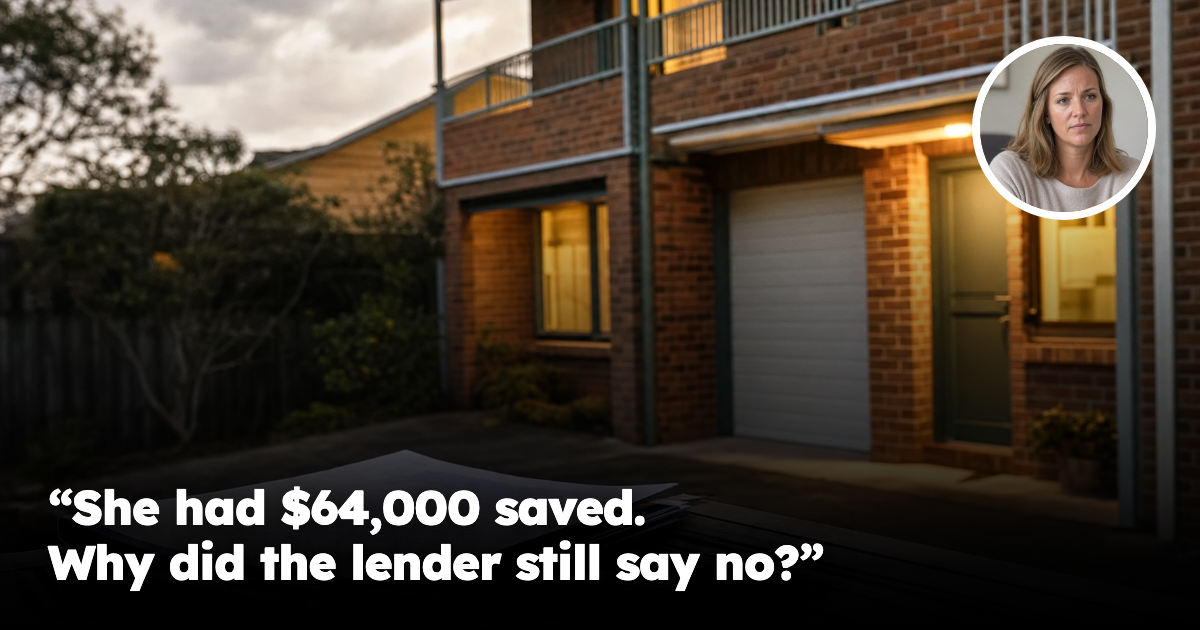
She had $64,000 saved. Why did the lender still say no?
A 37-year-old woman had done what every first-time investor is told to do: she saved $64,000, kept her spending under control and found a modest property that appeared to stack up on paper.
Then the lender said no.
The rejection felt personal. The deposit was real. The property was not a luxury purchase. The expected rent looked reasonable. So what had the bank seen that she had missed?
The question behind the rejection
“If I have the deposit, stable repayments and a property people actually want to rent, why can’t I borrow?”
The uncomfortable answer is that a deposit is only one part of a credit decision. The lender is also testing whether the application survives a higher assessment rate, existing debts, living-cost assumptions, loan term, income variability and the value of the security if the market turns.
That can create a sharp gap between what a buyer thinks they can afford and what a lender is prepared to approve.
In this case, the initial borrowing estimate treated the $64,000 as the headline fact. The full application exposed several smaller pressures: a credit-card limit that was rarely used but still counted, a car loan with years remaining, and a rent estimate that was more optimistic than the evidence for comparable homes on the same streets.
None of those items alone explained the decline. Together, they pushed the application outside the lender’s comfort zone.
Is the bank rejecting the person or the property?
It can be both, but the distinction matters.
A lender may approve a different borrower for the same address, or approve the same borrower against a different address. That is because security risk is not evenly distributed across a suburb.
Two homes can share a postcode and a school catchment yet attract very different buyers and tenants. One may sit near a noisy arterial road, have limited parking and face a wall of competing listings. Another may be a few streets away, have better access to transport and attract a deeper pool of renters.
RHA’s street-level screening looks beyond a suburb-wide median. For a candidate like this, the useful questions include: how many comparable homes actually leased nearby, how long did they sit on the market, what was the achieved rent rather than the advertised rent, and how many similar properties are competing for the same tenant today?
That evidence can change the conversation with a lender. It cannot override serviceability rules, but it can prevent a buyer from wasting a borrowing limit on a weak asset.
The deposit may be smaller than it looks
$64,000 sounds substantial until the full purchase budget is written down.
Stamp duty, conveyancing, inspections, lender fees and a cash buffer all compete with the deposit. If the buyer is targeting a $500,000 property, a 12.8 per cent deposit is not the same as 12.8 per cent available for the purchase. A lender may also apply mortgage insurance, a different valuation or a more conservative view of rent.
The answer is not automatically to save for years longer. Waiting can help, but it can also leave the buyer exposed to changing prices, rents and lending policy. The better first move is to separate the problem into three tests:
1. Can the household service the loan under the lender’s assessment rules? 2. Is the cash position strong after every transaction cost and a realistic reserve? 3. Is the property itself liquid enough to protect the strategy if refinancing or resale becomes necessary?
If the first answer is no, changing suburbs will not magically fix the application. If the second is no, a lower purchase price or longer preparation period may be needed. If the third is no, the buyer may be trying to solve a finance problem by buying an asset with too narrow an audience.
What should a rejected borrower do next?
First, obtain the actual reason for the decline rather than relying on a generic “policy” explanation. Ask which input changed the result: serviceability, debt-to-income exposure, valuation, rental assessment, credit limits or documentation.
Second, have the file tested with more than one lender pathway. Policies differ, but shopping for a softer answer without fixing the underlying weakness can create more enquiries and no better outcome.
Third, rebuild the borrowing model using achieved rents and exact-address evidence. A suburb-level rent estimate can hide a meaningful difference between a quiet, well-presented pocket and a street where comparable homes sit vacant longer.
Finally, keep the deposit intact until the approval, valuation and property checks are complete. A buyer who empties the account to win an auction may remove the buffer that made the investment resilient in the first place.
The opportunity in the “no”
The rejection was frustrating, but it also exposed a useful distinction: being financeable is not the same as being investable.
The strongest property investment decisions join the two. They test the borrower’s cash flow, the lender’s rules and the exact street’s demand before emotion takes over. The right asset on the right street, supported by street-level data rather than a suburb headline, can make a smaller borrowing capacity work harder — and keep the strategy alive when credit conditions tighten.
For a broader view of where demand, supply and long-term value are lining up, download Ripehouse Advisory’s Top Five Investment Markets ebook, or book a discovery call.
If there's a specific street you're weighing up right now, check its Street Score first — it's free, takes ten seconds, and tells you whether that street is pulling the suburb average up or riding on it.
Frequently asked questions
Why can a lender decline someone who has saved a deposit for an investment property?
A deposit is only one part of the decision. In this article, the lender also assessed serviceability, existing debts, living-cost assumptions, loan term, income variability and the property’s security risk.
What was missing from the buyer’s $64,000 savings when the lender looked at the full application?
The $64,000 was not available just for the deposit. Costs such as stamp duty, conveyancing, inspections, lender fees and a cash buffer also had to be covered, which reduced the amount available for the purchase.
How can a property be seen as a security risk even if it looks fine on paper?
A lender may look at how easy the property would be to rent or sell if needed. Street-level factors such as competing listings, noise, parking, transport access and the actual demand for comparable homes can all affect that assessment.
What details should a rejected borrower ask for after a loan decline in Australia?
They should ask which input changed the result, such as serviceability, debt-to-income exposure, valuation, rental assessment, credit limits or documentation. That helps show whether the issue was the borrower, the property, or both.
Why does the article say being financeable is not the same as being investable?
A borrower can meet some lending criteria but still choose a weak asset. The article says the strongest decisions test the borrower’s cash flow, the lender’s rules and the exact street’s demand before buying.
General information only. It does not take your objectives, financial situation or needs into account, and nothing here is legal, financial, taxation or investment advice specific to your circumstances.