News · 29 September 2026 · 5 min read
She cut back four times this year. The fourth rate hike took all of it back
She is 38. Two kids in primary school, a mortgage of about $750,000 on a house she and her husband bought before either of them had heard of a rate cycle. Both work. The household income is good. On paper, they are fine.
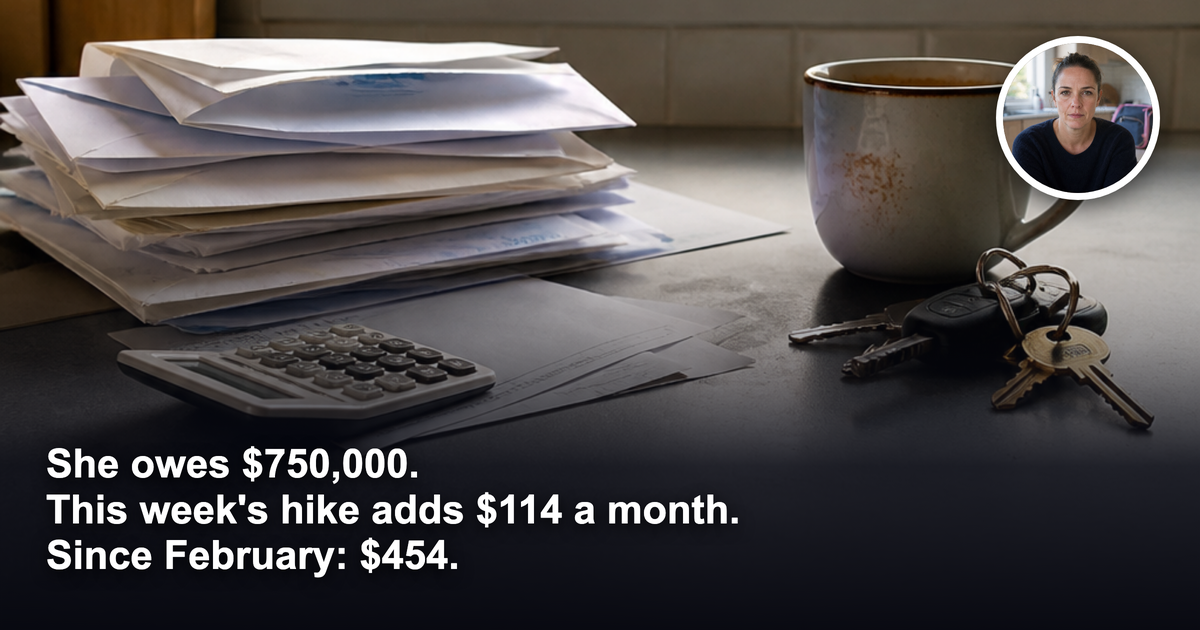
She is 38. Two kids in primary school, a mortgage of about $750,000 on a house she and her husband bought before either of them had heard of a rate cycle. Both work. The household income is good. On paper, they are fine.
This is a composite, drawn from the questions we have received since Tuesday's decision. The details are shared by more people than you would think.
In February, when the Reserve Bank started raising rates, she did what sensible people do. She cut. The winter holiday went. Then the second car. Then the private health cover got downgraded, and the extra repayments she had been quietly making stopped.
Each cut bought her a few months of breathing room. Each hike took it back.
On Tuesday the cash rate went to 4.6 per cent, the highest in almost 15 years and the fourth rise in this cycle. On a $750,000 loan that is another $114 a month, and $454 a month in total since February, according to the ABC.
She has run out of things to cancel.
### The question she sent us
*"We earn well. We have done everything right. We have cut and cut and we are still going backwards. How much more do they expect us to squeeze, and at what point does 'being careful' stop working?"*
That last sentence is the one that matters, because she has already found the answer and does not like it.
### The answer: cutting has a floor, and she has hit it
Here is what nobody puts in the headline.
There is a hard limit on how much any household can save by spending less. You can cancel the holiday once. You can sell the second car once. After that, the next $114 has to come out of groceries, school, or the mortgage buffer itself.
A rate rise has no such limit. It can arrive again in November. And again after that. Nobody knows, and anyone telling you they do is guessing.
So a household that answers every hike with another cut is fighting an opponent with unlimited moves, using a strategy with about four.
That is not a discipline problem. She has more discipline than most. It is a structure problem, and structure problems are fixable in a way that discipline problems are not.
### What the hardship data quietly says
The ABC piece carries a detail that cuts against the mood.
Calls and chats to the National Debt Helpline reached 187,905 in the year to August, up 11.76 per cent. Mortgage stress is now the number one reason people ring. That is real, and it is getting worse for people already on the edge.
But Experian's data, quoted in the same story, shows mortgage hardship at 0.92 per cent in June, six basis points lower than a year earlier. Personal loan hardship went the other way, up to 2.14 per cent.
Read those two facts together. The stress is showing up first in the households with the weakest structure: unsecured debt, no buffer, no room. Households with a home loan and some equity are, on average, holding.
Holding is not the same as coping well. Our composite is holding. She is also miserable, and she has stopped building anything.
### The difference between the households that are coping and the ones that are cutting
We have watched hundreds of households go through this cycle. The ones taking it best are not the frugal ones. They tend to share a few dull features.
Their cash sits against the loan, in an offset, rather than in a savings account earning less than the mortgage costs.
Their buffer was sized for a rate that started with a five, not for the rate on the day they signed.
Their debt is split so that a rise on one loan does not put pressure on the whole position at once.
And if they own an investment property, they bought the right asset on the right street, so the rent is doing part of the lifting. Two streets in the same suburb can be having completely different outcomes right now, and the difference shows up in vacancy and in days on market before it ever shows up in a headline.
None of that is exciting. All of it was decided before February.
### What it means for you
If the last four hikes have cost you $454 a month and your response has been to spend less, you have almost certainly done the right thing for the short term.
But ask yourself the question our composite eventually asked: what is my plan for the fifth?
If the honest answer is "cut again", the plan has already failed. You just have not felt it yet.
The better question is not "should I wait until rates fall". It is "is my structure strong enough to hold at 4.6 per cent, and would it hold at the next one". Buffers, offset balances, how the loans are split, and the order in which any future purchase happens. Those are the levers that do not run out.
### The Ripehouse reframe
Headlines are about the cash rate. Wealth is about the asset, the street and the structure that carries them through a cycle.
Across 997 client portfolios since 2021, our clients have seen a median portfolio growth of 19.0 per cent a year on a 5-year rolling basis, against about 4.3 per cent nationally.* That result was not produced by calling the top or the bottom of anything. It was produced by buying the right asset on the right street, with a structure built for the rate that might arrive, not the one on the day.
We don't ask you to take our results on faith. We publish them, including the portfolios that underperformed.
If you are four hikes in and running out of things to cancel, that is worth 15 minutes.
Book a 15-minute Legacy Sequence Diagnostic: ripe.house/4bV7I8u. No pressure. No obligation. Just a clearer picture than you had before.
*National benchmark: CoreLogic/Cotality. Past performance is not a guarantee of future results. This article is general information only and is not personal financial advice.
General information only. It does not take your objectives, financial situation or needs into account, and nothing here is legal, financial, taxation or investment advice specific to your circumstances.