News · 4 October 2026 · 4 min read
She budgeted on relief arriving by Christmas. The Treasurer just said it is not coming
She is 39. She owns her home in Brisbane's north with her partner, and in 2024 they used some equity to buy a three-bedroom rental in a regional centre two hours away. Two loans, two incomes, a toddler in daycare, and a spreadsheet that balanced.
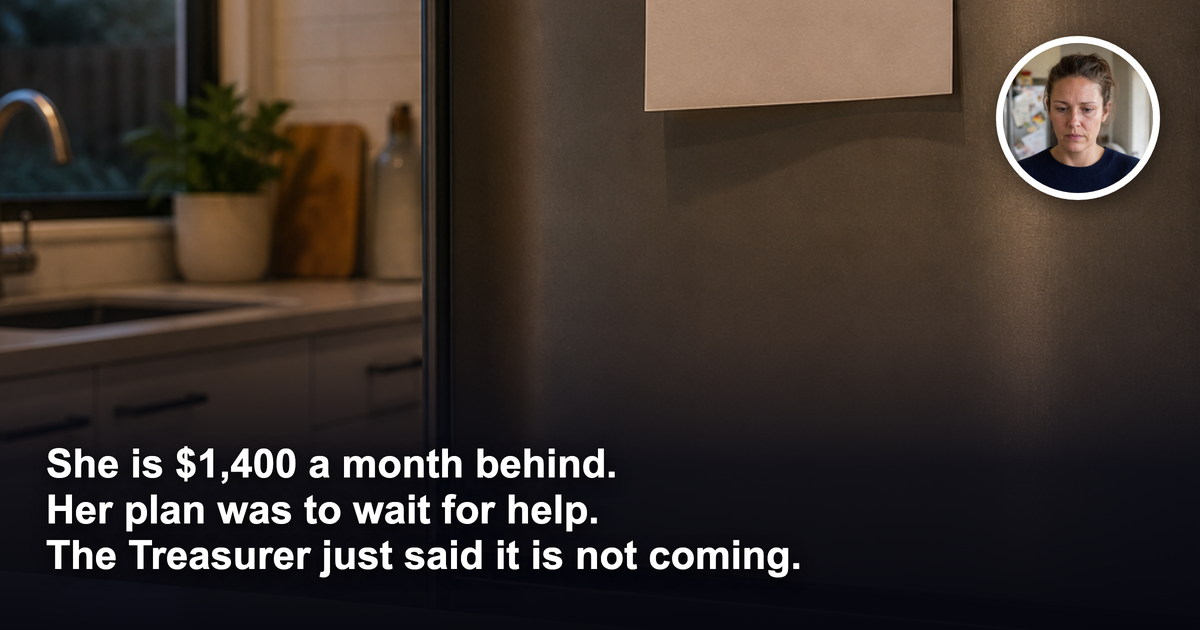
She is 39. She owns her home in Brisbane's north with her partner, and in 2024 they used some equity to buy a three-bedroom rental in a regional centre two hours away. Two loans, two incomes, a toddler in daycare, and a spreadsheet that balanced.
It does not balance any more.
Between the rate rises since then and a rent that has moved far less than her repayments, she is about $1,400 a month worse off across the two loans than she was when she signed. She has covered it from savings and by cutting what she can. Her plan, written in pen on the fridge, was to hold until help arrived. A rate cut. A bit of relief in the budget. Something.
She is a composite illustration, not a real person. The situation is common enough that it does not need a name.
The question
"Every month I'm topping up two loans and telling myself this is temporary. Now the Treasurer says there won't be relief this year. Was I wrong to count on things easing, and what do I do if they don't?"
The answer: the help she budgeted for was never a line item
On Sunday, Treasurer Jim Chalmers told the ABC's Insiders program that the mid-year budget update, due in mid-December, will feature a savings package. In his words, one of the primary influencers on the update will be the need to find more savings. He described the government as looking to run a "tight ship" and downplayed the prospect of more cost-of-living relief, days after the Prime Minister had hinted that help was on the way.
He also said the government is not actively considering another fuel excise discount.
The same week, according to the ABC, the Reserve Bank raised the cash rate to a 15-year high. And the Treasurer warned that the cost of servicing the government's trillion-dollar debt will rise by billions as cheaper borrowing rolls off and bond yields climb overseas. "The pressure will still come to Australia, unfortunately," he said.
Read that as a household and the message is plain. The government is tightening its own budget. It is telling you it will be more expensive to borrow, and it is not promising to send money your way.
None of that is a forecast. Nobody knows where rates go next, and we are not going to pretend otherwise. But she did not budget on a forecast. She budgeted on hope, and hope has just been priced.
What this means for you
If you hold an investment property, or you are about to, there is one question that matters more than any headline this week.
Does your structure work on today's settings, with no help coming?
Run the numbers at the rate you are paying now. Assume rent does what rent is doing on your street now, not what the national average says. Assume no relief, no cut, no rebate. If the result is a shortfall you can carry for three years without selling anything, you have a position. If it only works when something changes, you have a bet.
The expensive mistake is the one she nearly made. Carrying a shortfall month after month, draining the buffer, waiting for a rescue that was never written down anywhere. By the time she decides to act, the buffer is gone, the choice is forced, and forced sellers get forced prices.
The part nobody puts in the headline
Her problem is being described as a rates problem. It is a structure problem.
The two loans were set up to lean on each other. The rental was chosen because it was affordable on the day, in a town she had visited twice. There was no stress test at a higher rate. There was no look at whether the street had rental demand deep enough to lift rents when costs rose. There was no plan for the year nothing goes right.
Two streets in the same suburb can be having completely different outcomes right now. One has tenants queuing and days on market in single digits. The other has three identical houses listed and a landlord dropping the asking rent every fortnight. The national rate is the same for both. The owner's experience is not.
That is why we keep saying the same thing in good years and tight ones. The right asset, on the right street, chosen with data, beats timing. Policy settings move. A sound structure absorbs them.
The Ripehouse reframe
A portfolio built to hold was designed for tight conditions, so they should cause no panic when they arrive.
Our clients' portfolios have grown at a median of +19.0% per year on a 5-year rolling basis, against roughly 4.3% nationally, and we publish the full distribution, including the portfolios that underperformed. Past performance is not a guarantee of future results, and this period will test every structure in the country. That is exactly why the structure, and the street, deserve more attention than the Treasurer's next sentence.
Benchmark: CoreLogic/Cotality.
Being behind on cash flow in a year like this is a structure problem, not a discipline problem, and it is fixable. The first step is to stop waiting for a line in a budget update and start testing your own position against the market as it is.
Want to see how we stress-test a decision like this street by street, on today's settings rather than hoped-for ones? Join Jacob's free live webinar.
General information only. It does not take your objectives, financial situation or needs into account, and nothing here is legal, financial, taxation or investment advice specific to your circumstances.