News · 27 August 2026 · 4 min read
She was asked for another $90 a week. Why the rent increase exposed the street-level risk
A $90 weekly rent increase became a $4,680 annual decision — and a reminder that rental value is set at street level, not by suburb averages.
She was asked for another $90 a week. Why the rent increase exposed the street-level risk
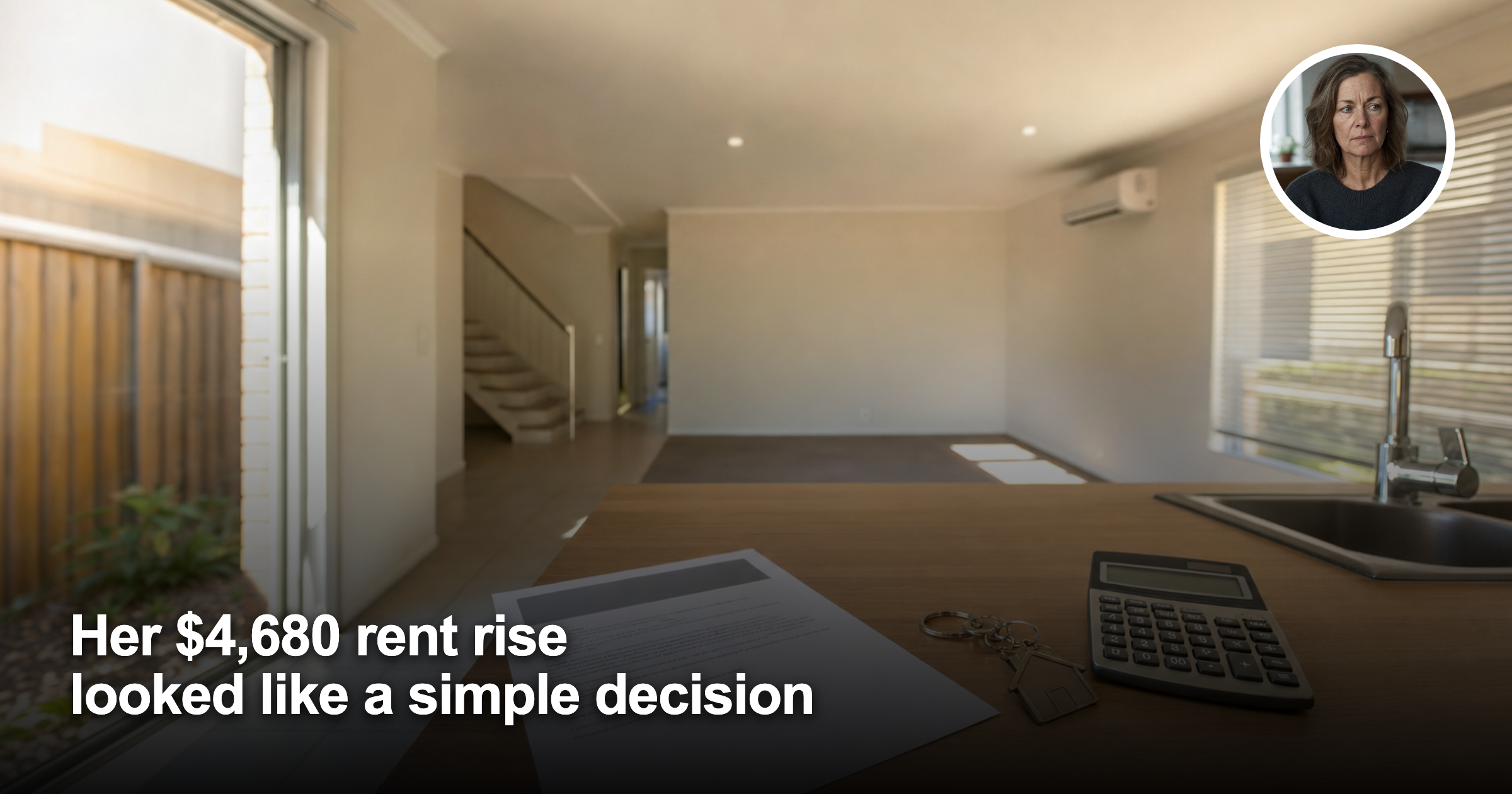
A 63-year-old woman had planned her next year around a familiar address. Then a letter arrived asking for another $90 a week.
That sounds like a weekly problem. It was actually a $4,680 annual decision.
She had lived near her adult children for long enough to know the value of the location: the bus route, the quiet side street, the shops she could reach without driving and the neighbours who knew her. Moving would mean removal costs, a new bond, time spent applying and the risk of trading a known home for a cheaper one with a hidden problem.
Her question was simple: “If the owner can ask for more, how do I know whether staying is sensible or whether I’m just paying to avoid the pain of moving?”
The answer is not simply “accept” or “leave”
The first step is to turn the increase into a yearly number. A $90 weekly rise is $4,680 over 12 months. It should be compared with the complete cost of changing homes, not just the advertised rent on the next listing.
That means adding the new bond requirement, moving and connection costs, application time, transport changes, storage if the move is awkward and the value of losing a workable routine. It also means checking whether the cheaper property is actually cheaper after its commute, heating, parking, maintenance and likely future increases are considered.
The second step is to test the new rent against genuinely comparable homes. “Same suburb” is not a comparison. A home on a busy arterial road, beside a construction site or at the end of a steep walk can sit under the same suburb median as a quiet, convenient property while attracting a very different tenant pool.
This is where street-level data matters. Ripehouse Advisory looks beyond suburb averages to achieved rent, vacancy duration, days on market, applicant depth and the supply pipeline around the actual address. Two homes 600 metres apart can share a postcode and headline median while showing a 20–30 per cent difference in effective rental performance once vacancy and achieved, rather than advertised, rent are included.
For a tenant, that distinction explains why one property feels “expensive” but remains fiercely competitive, while another appears like a bargain and sits vacant. For an owner, it explains why a rent increase that looks obvious on a spreadsheet can damage the asset if it pushes out a reliable tenant and leaves the home exposed to a longer vacancy or a weaker applicant pool.
Can the owner simply charge whatever the market will bear?
No single headline answers that question across Australia. Rent-review timing, notice requirements and limits differ by state and territory, and the signed agreement matters. The practical question is whether the proposed figure is supportable against comparable achieved rents and whether the process has been followed.
The tenant should keep the notice, check the agreement, compare several nearby properties and ask for the basis of the increase in writing. If the amount looks disconnected from comparable homes, the relevant tenancy authority or tribunal pathway may be worth investigating before a deadline passes.
That is not an instruction to fight every increase. A reasonable increase can be cheaper than moving. But accepting automatically can also be expensive, especially when the increase is being used to compensate for a property that has a narrow applicant pool or an address-level drawback.
What should an owner measure before raising rent?
An owner should begin with achieved rents, not the highest optimistic listing. Then measure how long comparable homes actually take to secure a suitable tenant, how many applications are credible, and whether new supply is about to arrive nearby.
The best rent is not always the maximum number for one week. It is the price that protects income across the full holding period. A $90 increase that creates six weeks of vacancy can erase more than a year of apparent upside. A stable tenant who pays on time and cares for the home is part of the asset’s performance, even if that value does not appear in a suburb report.
This is why the address matters. A suburb-level vacancy rate can hide a street where applicants compete heavily and another where properties repeatedly re-list. Investors who treat both streets as identical may price their decision from the wrong average.
For more on how lease structure can affect both sides, see our analysis of the two-year lease question. The wider lesson is the same: certainty has a price, and that price should be measured rather than assumed.
The decision she made
She compared the $4,680 annual increase with the real cost of moving. She checked four comparable homes, found that two were cheaper but materially less convenient, and asked for the increase to be reconsidered using the nearby achieved-rent evidence. The owner did not have to accept her preferred number. But the conversation moved from fear to evidence.
That is the useful discipline for both sides. A tenant should not treat every rent increase as proof that moving is the only rational response. An owner should not treat every vacant week as a tenant’s fault. The right number sits where the address, the condition, the applicant depth and the cost of churn meet.
Property remains a powerful long-term investment when it is selected and managed at that level of detail. The winning approach is not to avoid every uncomfortable headline; it is to identify the right asset, on the right street, and price its real demand with better data than the market average.
If there's a specific street you're weighing up right now, check its Street Score first — it's free, takes ten seconds, and tells you whether that street is pulling the suburb average up or riding on it.
Frequently asked questions
Why does a $90 a week rent increase matter so much in practical terms?
A $90 weekly increase adds up to $4,680 over 12 months. The article says that should be weighed against the full cost of moving, not just the higher rent on its own.
What should a tenant compare before deciding whether to accept a rent increase or move?
They should compare the annual rent rise with the real cost of changing homes, including bond, moving costs, connection costs, application time and any loss of routine. They should also check whether cheaper listings are still cheaper once commute, parking, heating and likely future increases are considered.
Why are suburb median rents not enough to judge whether a rent increase is fair?
The article says rental value is set at street level, not by suburb averages. Two homes in the same suburb can perform very differently depending on factors like traffic, nearby construction, access and applicant demand.
What should an owner look at before raising rent on an investment property?
An owner should focus on achieved rents, how long comparable homes take to lease, the depth of applicants and any new supply coming nearby. The article says pushing for the highest weekly number can backfire if it causes vacancy or drives away a reliable tenant.
Can a tenant challenge a rent increase in Australia if it seems too high?
The article says rent-review timing, notice requirements and limits vary by state and territory, and the lease matters. A tenant should keep the notice, check the agreement, compare nearby homes and ask for the increase basis in writing; if it looks disconnected from comparable achieved rents, the relevant tenancy authority or tribunal pathway may be worth investigating.
General information only. It does not take your objectives, financial situation or needs into account, and nothing here is legal, financial, taxation or investment advice specific to your circumstances.