News · 28 August 2026 · 5 min read
His $300,000 build just got a $21,000 shock. Is renovating still worth it?
A 66-year-old empty-nester faces a $21,000 shock on a $300,000 build and asks whether renovating still makes property sense.
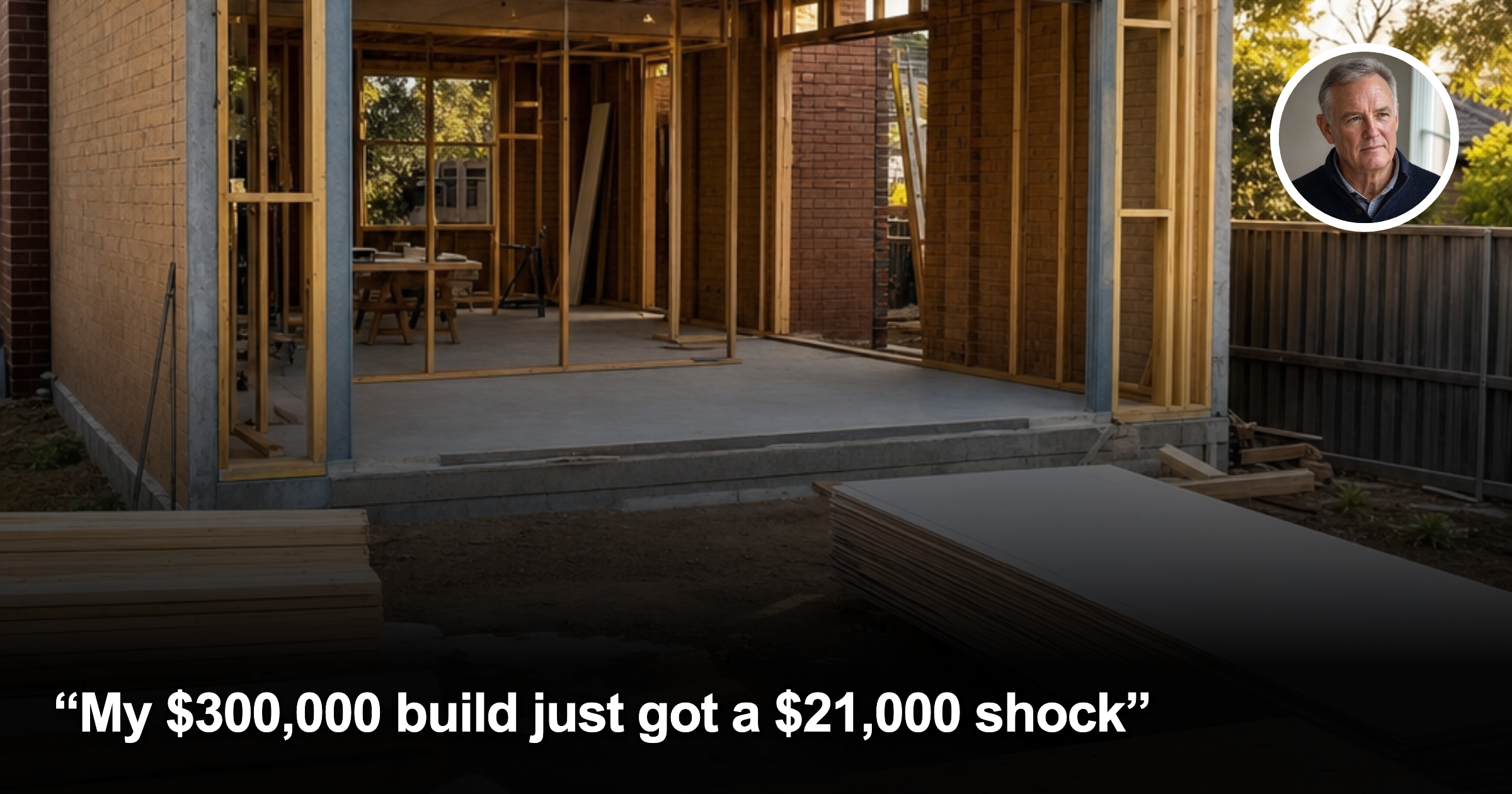
An empty-nester had a clear plan: spend about $300,000 improving the family home, create a better place to live for the next decade, and protect the property’s resale appeal at the same time.
Then the number moved.
The latest construction-cost pressure being felt across Australia has put an extra $21,000 against every $300,000 of building work in some project estimates. At the same time, owners in busy markets are competing for the same limited pool of builders and tradespeople, with delays becoming part of the project rather than an unusual exception.
For a 66-year-old man who had spent years building equity in his address, the question was blunt: if the renovation keeps getting dearer, is it still a smart property decision—or is he throwing money at a house that will never give it back?
The question behind the price rise
His first instinct was to cancel the work. The kitchen could wait. The second bathroom could wait. The outdoor room could certainly wait.
But that response treats every dollar of building work as if it has the same purpose. It does not.
Some work is consumption: a highly personal finish, an expensive appliance or a layout designed for one family’s habits. Some work is protection: fixing water ingress, improving drainage, replacing unsafe wiring or preventing a small defect from becoming a major claim. Other work is an investment in the asset: adding useful living area, improving natural light, creating a practical second bathroom or making the home easier to maintain.
The $21,000 question is therefore not simply “Can the owner afford the renovation?” It is “Which part of the renovation earns its place in the property?”
For a practical look at why responsibility matters before work starts, see the renovation accountability question.
Why the headline number can mislead
A percentage or dollar-cost increase is powerful because it makes the pressure visible. On a $300,000 project, an additional $21,000 is material. It can wipe out the contingency, push the owner into a more expensive loan bracket or turn a comfortable project into a cash-flow problem.
But a headline estimate is not a project budget. The final number depends on the scope, site conditions, approvals, fixtures, contract inclusions, builder capacity and variations. A low initial quote can be less useful than a higher quote that spells out demolition, engineering, waste removal, waterproofing, connection fees and the finish standard.
The practical test is to separate the project into three columns: essential protection, value-adding function and personal luxury. Price each column independently. If costs rise, the owner can defer luxury without abandoning the work that protects the asset or improves its broad appeal.
Owners weighing a larger project should also consider the risks that sit behind an off-the-plan build, particularly when timing and funding are already tight.
That is also why a fixed-price label alone is not enough. An owner needs to understand what can trigger a variation, who pays when an unexpected site condition appears, how provisional sums are calculated and what happens if a key trade is unavailable for months.
The renovation risk is also an address risk
A renovation can be beautifully executed and still disappoint if the surrounding market cannot support the spend.
The same $300,000 addition may be sensible on one street and difficult to recover on another. The difference is rarely visible in a suburb-level median. It sits in the exact address: the quality of nearby sales, the depth of buyers looking for that type of home, the time comparable properties spend on market and whether new supply is arriving nearby.
Ripehouse Advisory’s street-level analysis is designed for that gap. Before approving a major project, an owner can compare achieved sales, achieved rent, vacancy, days on market, buyer depth and the local supply pipeline around the specific property—not just the suburb headline.
That analysis may show that a second bathroom is highly valued on a family-oriented pocket but that a premium outdoor room is unlikely to be paid for by buyers on the next street. It may show that a renovation improves rental appeal but does not justify the same spend in a location with soft applicant depth. It may also reveal that a nearby construction pipeline will make timing more important than the finish.
The property is not just the building. It is the building, the street, the competing stock and the buyers who can actually pay for it.
What should an owner do before signing?
First, obtain a scope that another builder could understand without guessing. Vague allowances are where apparently manageable budgets become arguments.
Second, protect a genuine contingency. The correct buffer depends on the project and site, but it should be money the owner can access without relying on a best-case valuation or a last-minute refinance.
Third, test the holding cost of delay. If the owner must rent elsewhere, pay interest while the property is uninhabitable or carry an empty investment, a three-month delay has a real price. That cost belongs in the decision before work begins.
Fourth, compare the planned finish with the homes that set the local ceiling. A renovation should make the property competitive, not accidentally make it the most expensive experiment on the street.
Finally, stage the work where possible. Protect the structure and services first. Add flexible, broadly useful improvements next. Leave highly personal upgrades until the budget, timeline and resale evidence justify them.
Is renovating still worth it?
For this empty-nester, the answer was not an automatic yes or no. The original plan was split into work that protected the home, work that improved everyday function and work that was mostly personal preference. The first two categories still made sense after the cost shock. The third could wait.
That is the broader lesson for investors and owners. Rising construction costs do not make property investment irrational; they make undisciplined renovation harder to hide. The right project can preserve equity, lift rentability and improve resale demand. The wrong project can consume capital while leaving the owner exposed to delay, debt and a ceiling set by the surrounding street.
The winning decision is not the cheapest quote. It is the right asset, the right scope, the right street and the right data. When those line up, a carefully controlled renovation can still turn property equity into a stronger long-term investment. For a practical look at why responsibility matters before work starts, see the renovation accountability question.
If there's a specific street you're weighing up right now, check its Street Score first — it's free, takes ten seconds, and tells you whether that street is pulling the suburb average up or riding on it.
Frequently asked questions
Why did the $21,000 cost increase matter so much on a $300,000 renovation?
Because an extra $21,000 on a $300,000 project is large enough to wipe out the contingency, push the owner into a more expensive loan bracket, or turn a manageable job into a cash-flow problem. The article says the headline number is a warning, not the whole budget.
Which parts of a renovation are most worth keeping when costs rise?
The article says to separate the work into three groups: essential protection, value-adding function, and personal luxury. If costs rise, luxury items can be deferred while work that protects the asset or improves broad appeal still goes ahead.
What should an owner check before signing a renovation contract in Australia?
They should get a scope another builder could understand, make sure the contingency is real and accessible, and understand what can trigger variations. The article also says to check who pays for unexpected site conditions, how provisional sums are calculated, and what happens if key trades are unavailable.
How can a renovation be a risk even if the work itself is good?
A renovation can still disappoint if the surrounding market cannot support the spend. The article says the exact street matters, including comparable sales, buyer depth, days on market, rental demand and the local supply pipeline.
Is it still worth renovating if construction costs keep rising in Australia?
Yes, but only if the scope, street and data all line up. The article says rising costs do not make property investment irrational, but they do make undisciplined renovations easier to expose and more likely to leave the owner with debt, delay and limited resale upside.
General information only. It does not take your objectives, financial situation or needs into account, and nothing here is legal, financial, taxation or investment advice specific to your circumstances.