News · 18 September 2026 · 5 min read
The record fine nobody announced: what does a buyer get told about their own building?
NSW's building watchdog imposed its largest ever fine on a major developer in April, then quietly shelved the media release announcing it. What buyers are actually told about their own building, and the street-level checks that do not depend on anyone choosing to publish.
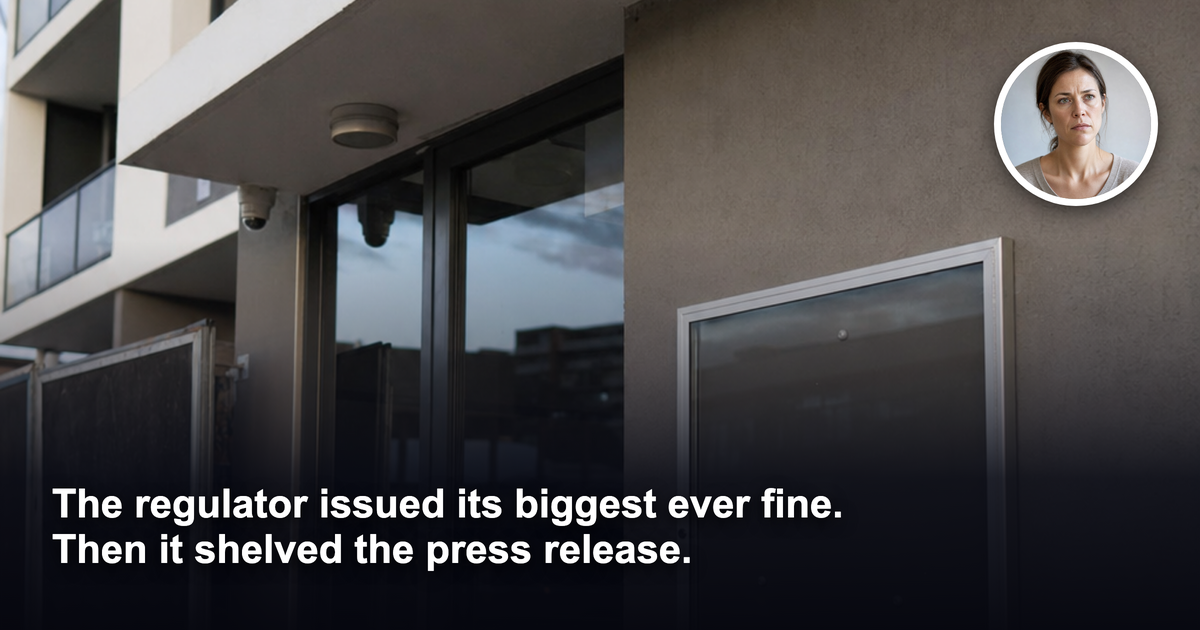
In April, Building Commission NSW handed down the largest penalty it has ever imposed on a developer. The construction arm of Aland — one of Western Sydney's largest builders, and a company central to the state government's housing targets — was fined $220,000. Its founder, Andrew Hrsto, was fined $40,000 personally and ordered to sit compliance training to keep his licence.
The breaches were not paperwork. According to ABC reporting published this week, they included the use of unlicensed contractors and the unauthorised removal of a power pole, overhead wires and street lighting at a St Marys construction site — which cut electricity to a childcare centre and risked public safety.
A draft media release was written. It was titled "Building Commission NSW takes disciplinary action against Aland." It was never sent.
Internal emails obtained under Freedom of Information and reported by the ABC show that within two days the release had been downgraded to a holding statement, to be released only if a journalist specifically asked. "Please see approved lines … these are for reactive only at this stage," one email said. When a staff member later asked why nothing had gone out, the answer was: "We've got ALAND in hand — no proactive comms at this stage."
Five months before the release was shelved, the Building Commissioner had attended an Aland event marking the opening of its $375 million Archibald project on the Central Coast, while the company was under investigation. He told budget estimates in August he was aware of the investigation but was "not concerned about the optics of it", as the probe had "all but concluded".
The person this actually lands on
Consider a 34-year-old who settled on her first apartment in Western Sydney this year. She did the things buyers are told to do. She read the contract. She checked the strata report she was given. She looked at the developer's website and saw a gold-star iCIRT rating.
What she did not see, because nobody published it, was that the company that built her home had months earlier been issued the largest fine the regulator had ever imposed.
A Department of Customer Service spokesperson told the ABC the watchdog does not "routinely issue a media release for every disciplinary action", and that the action was published on the Verify NSW website, which the public can search. In the same month, though, the regulator did issue a media release about two plumbers who had used fake advertisements.
That is the injustice, and it is a structural one rather than a personal one. The information existed. It was written up. The decision was made not to push it toward the people whose net worth sits inside those buildings. A buyer is expected to know to search a register she has probably never heard of, for a company name she may only know from a hoarding.
So what is the question?
The question is not "is my developer bad". The question is: when the public record about a building is discretionary, what can I rely on instead?
The answer is that you stop relying on announcements and start relying on measurement. Disclosure is a decision someone else makes. Performance is a number you can go and get.
The answer, in numbers
At Ripehouse we do not assess a property at suburb level, because suburb level is where this kind of risk hides. A suburb median absorbs everything — the well-built stock and the problem stock, the good street and the street backing the arterial. We work at street and address level, and the questions we ask are deliberately unglamorous:
- Achieved rent versus advertised rent on that exact street, for that exact stock type. Advertised rent is a hope. Achieved rent is a contract. Where the gap is wide, something about the asset is being discounted at the negotiating table — and often it is the building, not the suburb.
- Street-level vacancy, read off street heatmaps rather than suburb averages. A single street inside a strong suburb can carry persistent vacancy because of one oversupplied complex.
- Days on market for that precise stock type. New apartments in a building with a reputation problem sit. They sit before anyone writes an article, and they sit after the news cycle moves on. Days on market is the market pricing information that has not yet been announced.
- Approved-but-unbuilt competing supply within walking distance. If the pipeline is full, your resale and your re-letting both compete with product that does not exist yet.
- Buyer depth on exit. How many buyers were genuinely active for that price point, on that street, in the last twelve months? Thin depth is what turns a defect story into a loss.
Pulled together, that is what the R-Score is for: a street-and-address-level read that does not wait for a regulator, a media release or a rating badge to tell you what an asset is worth holding.
What it means for you
Two practical conclusions.
First, if you are buying into new or near-new attached stock anywhere in Australia, treat the builder and developer as a research task you perform yourself. Search the state register. Search the company and every related entity. Read the strata minutes, not the strata summary. Assume nothing will be announced to you.
Second — and this is the part that gets lost in the outrage — none of this is an argument against property. It is an argument against buying headlines and badges instead of assets. The asset that performs is the right dwelling type, on the right street, with measurable tenant demand and measurable buyer depth behind it. That is knowable in advance. A decision in a government media inbox is not.
The buyers who get hurt in stories like this are almost never the ones who did the street-level work. They are the ones who were told a suburb was "going well" and took it at face value.
The point
A record fine was issued and nobody was told. You cannot control that. You can control whether your next purchase rests on what somebody chose to publish, or on what the street actually does.
If you want the street-level numbers behind a specific address before you commit — achieved rent, vacancy, days on market, competing supply and buyer depth — that is exactly the work Ripehouse Advisory does.
If you are still relying on suburb averages and ratings badges, the webinar shows how to test an address for vacancy, demand and competing supply before you commit.
Frequently asked questions
What did Building Commission NSW fine the Aland construction arm and its founder for in this case?
According to the article, the construction arm of Aland was fined $220,000 and founder Andrew Hrsto was fined $40,000 personally. The breaches included using unlicensed contractors and the unauthorised removal of a power pole, overhead wires and street lighting at a St Marys site.
Why did the article say buyers may not have been told about the fine?
A draft media release about the disciplinary action was written but never sent, and internal emails said it would be kept for reactive use only. The article says the information existed, but the regulator chose not to proactively publish it to the public.
What should a buyer in NSW check instead of relying on announcements or developer badges?
The article says buyers should search the state register, check the company and related entities, and read the strata minutes rather than relying on summaries. It also says to focus on measurable street-level performance instead of headlines or ratings alone.
What street-level factors does the article say are more useful than suburb averages when assessing an apartment?
It points to achieved rent versus advertised rent, street-level vacancy, days on market for that stock type, approved-but-unbuilt competing supply, and buyer depth on exit. The article says these measures can show risks that suburb medians hide.
What is the main risk for buyers of new or near-new apartments in Australia, according to the article?
The risk is buying based on what is publicly announced, rather than on how the specific building and street actually perform. The article says the property can be hurt by weak demand, oversupply, or a building reputation problem even if the broader suburb looks fine.
General information only. It does not take your objectives, financial situation or needs into account, and nothing here is legal, financial, taxation or investment advice specific to your circumstances.