News · 4 October 2026 · 5 min read
Rate bets moved overnight. Should she finally use the $650,000 pre-approval she has paused twice?
She is 41. She and her partner own their home in Adelaide's inner south, have two children in primary school, and have been meaning to buy their first investment property since the start of the year.
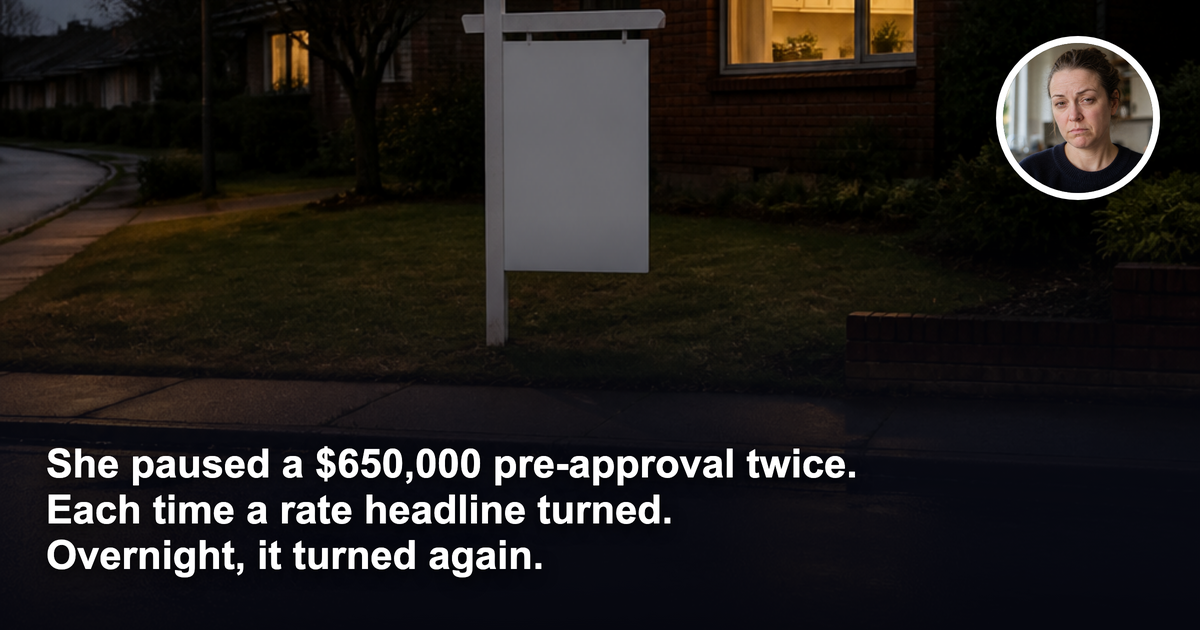
She is 41. She and her partner own their home in Adelaide's inner south, have two children in primary school, and have been meaning to buy their first investment property since the start of the year.
In March they got a $650,000 pre-approval. It is still sitting there, unused.
She is a composite illustration, not a real person. But the pattern she represents is one we see constantly, and it is costing people more than they realise.
The pre-approval that keeps not getting used
Twice this year she has had a property shortlisted, a building inspection booked, and a number in her head.
Twice she has pulled out.
The first time, the talk was of more rate rises to come. She decided to wait until the picture was clearer. The second time, the talk had flipped the other way, and a friend told her prices would run if rates eased, so she went back to the listings and found the one she liked had sold.
Then, over the weekend, the picture changed again.
The ABC reported that Wall Street closed higher on Friday night after a disappointing US jobs report. Weak jobs data in the United States wound back expectations of rate rises, and the ASX was set to open higher on Monday.
Her broker sent a message before 8am. "Rate expectations have shifted. This might be your window."
The question
"The market changed its mind on rates again overnight. I have a $650,000 pre-approval I have been sitting on since March. My broker says this could be the moment. Do I buy now, before the mood changes back?"
The answer: the headline is about traders, not about her loan
Read the ABC report carefully and notice what actually happened.
One jobs report in another country came in weaker than expected. Share traders adjusted their guesses about what central banks might do next. Futures markets pointed to a stronger open in Australia.
Nobody cut a rate. Nobody announced a policy. The Reserve Bank did not meet. Her mortgage rate this morning is identical to her mortgage rate on Friday.
What moved overnight is a forecast. Forecasts are what moved in winter, too, when she pulled out the first time. They moved again in spring, when she pulled out the second time. They will move again next month, possibly the other way, on the back of a different number from a different country.
If she buys because expectations shifted, she is buying on a guess made by people who will change that guess the moment the next release lands.
The test that actually matters
There is a simple way to find out whether this property works, and it has nothing to do with Friday night's trading.
Take the rate on her pre-approval. Run the repayments and the rent at that rate.
Then run it half a percentage point higher. Then a full point higher.
If the property still holds at the higher numbers, with a buffer she can live with, it works. She can buy it this month or in three months and the overnight news is irrelevant.
If the property only works at the rate the market is now hoping for, she does not have an investment. She has a bet on a headline, and the headline will not be around to help with the repayments in two years.
That is the question her broker's message skipped. Not "has the window opened" but "does this asset survive the window closing again".
The expensive mistake nobody prices in
The real cost of waiting for a rate signal lies in what people buy when the signal finally arrives, more than in the months lost.
After months of hesitation, the moment the mood turns, buyers feel they have to move. So they buy the property that is available that weekend, in the suburb they happened to be watching, at the price the agent put on the board. Speed replaces selection.
We have watched this happen in every cycle. The asset chosen under time pressure is almost always worse than the asset chosen on data. And a weak asset at a slightly lower rate underperforms a strong asset at a slightly higher one for the whole time you hold it.
What this means for you
If you have a pre-approval you have been nursing through the year's rate headlines, three things are true.
The overnight shift in expectations changes nothing about your borrowing capacity today. Your lender assessed you at a buffered rate already. Run your own stress test above that and see what survives.
The question "should I buy now" is the wrong question. The right one is "does this specific property work at rates higher than today". Answer the second and the first answers itself.
And two streets in the same suburb can be having completely different outcomes right now. Days on market, vacancy and resale depth vary street by street in ways a national rate headline cannot see. The difference between those two streets will matter far more to her result than the difference between the rate she gets this month and the rate she might get in December.
The Ripehouse reframe
We do not time rates. We cannot, and nobody who says they can has published the record to prove it.
What we do is build portfolios so that the structure holds across a range of rates, and then pick the street and the asset using data rather than mood. Across 997 client portfolios since 2021, that approach has produced a median portfolio growth of +19.0 per cent a year on a 5-year rolling basis, against roughly 4.3 per cent nationally. We publish the full distribution, including the portfolios that underperformed. Benchmark figures are drawn from CoreLogic/Cotality data. Past performance is not a guarantee of future results.
She should not buy this week because Wall Street had a good night. She should buy when a property passes the stress test at a higher rate, on a street the data supports, and she should be indifferent to what the futures market is pricing that morning.
Structure beats timing. The right street beats the headline.
Want to see how we stress-test a purchase like hers at higher rates and street by street before anyone signs? Join Jacob's free live webinar.
General information only. It does not take your objectives, financial situation or needs into account, and nothing here is legal, financial, taxation or investment advice specific to your circumstances.