News · 4 October 2026 · 5 min read
$2.3m for two homes on one Surrey Hills title: is one dual-income asset better than two separate ones?
$2.3 million. That is the bottom of the price guide on a Surrey Hills block that went to market on 4 October with two separate homes on it, according to the realestate.com.au listing report.
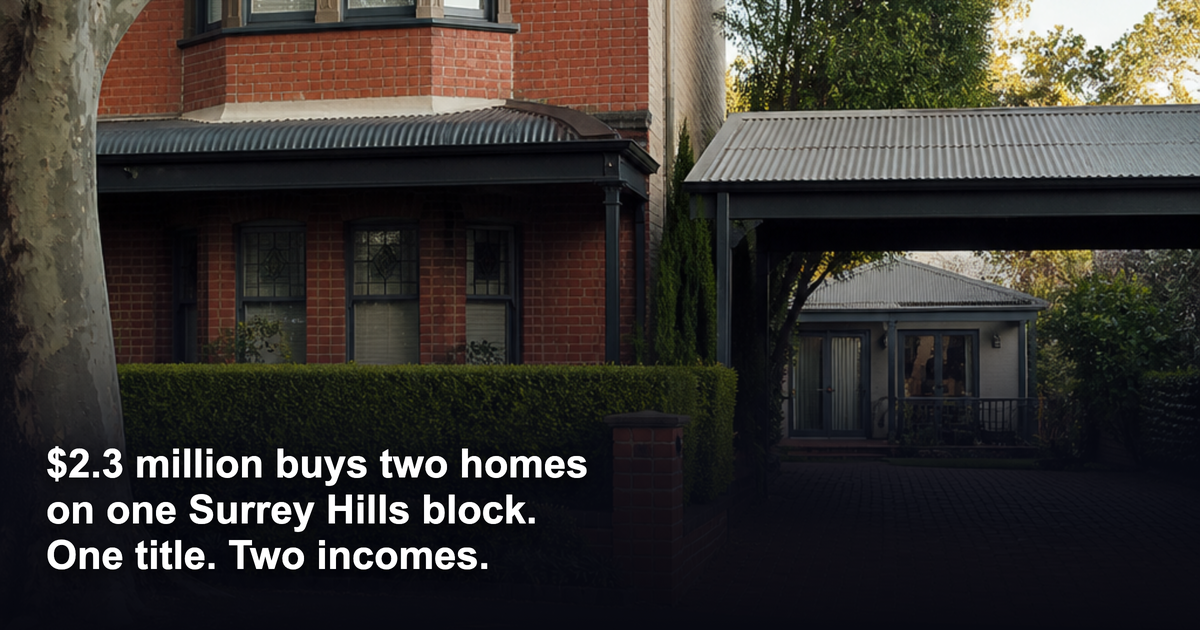
$2.3 million. That is the bottom of the price guide on a Surrey Hills block that went to market on 4 October with two separate homes on it, according to the realestate.com.au listing report.
The guide runs from $2.3 million to $2.5 million. The auction is on 17 October.
If you own a home with equity, or you have cash waiting for the right asset, this listing is a useful one to think with. Not because you should buy it. Because it puts a very common decision in plain sight.
What is actually for sale
The block is 916 square metres on a leafy street. At the front is a two-storey, four-bedroom period house. Behind the double carport sits a self-contained unit with its own kitchen, bathroom and terrace.
The vendor has held it for seven years and describes the second dwelling as flexible: a cottage for elderly relatives or adult children, a home office, or in his words a "fantastic rental income opportunity" for the next owner.
All of that is true. Two dwellings on one established-suburb block in Melbourne's inner east are uncommon, and the listing says so.
The question for an investor is different from the question for a family. The family asks whether the layout works. The investor has to ask what $2.3 million on one title does to the rest of their position.
What changed, and why it matters now
Nothing about the rules changed here. What changed is that a real, current example of the dual-dwelling pitch is sitting in the market with a real price on it.
The pitch is seductive because it sounds like two assets for the price of one. A main residence to live in, plus a second income from the unit out the back. Or two rental incomes from one purchase if you do not live there.
For a household with $180,000 to $500,000 of income and usable equity, that is exactly the sort of idea that turns into a Saturday morning inspection and a Sunday night spreadsheet.
So it is worth being precise about what you are buying.
One title, two incomes
Here is what the dual-dwelling structure gives you.
- One purchase, one set of stamp duty, one settlement, one loan.
- Two income streams, or one income plus a place to live, from one block of land.
- Family flexibility that a standard house does not have.
And here is what it costs you, in structural terms rather than dollars.
- Concentration. The whole $2.3 million to $2.5 million rides on one street in one suburb. If that street has a slow decade, both incomes have a slow decade.
- Liquidity. You cannot sell the unit and keep the house. When you need capital out, you sell the lot, and the buyer pool for a $2.3 million-plus dual-dwelling property is narrower than the pool for a standard family home or a standard rental.
- Rent ceilings. A self-contained unit behind a carport rents like a self-contained unit behind a carport. The listing does not state a rent, and we will not invent one, but the second income on a block like this is usually the smaller of the two by a wide margin.
- Valuation. Banks value a single title. Two dwellings on one title do not automatically value as two properties.
Two titles, one income each
Now take the same $2.3 million and imagine it split across two separate properties, in two different streets, possibly in two different cities.
You pay stamp duty twice. You run two loans and two property managers. That is the honest cost.
In return you get two independent bets on two independent streets. You can sell one and keep the other. You can refinance one against the growth of the other. If one suburb stalls, the other may not. Your exit options double.
The arithmetic that matters is this. At $2.3 million on one title, a 5 per cent fall in that one street's values is $115,000 off your position, with nowhere else in the portfolio to offset it. Spread the same capital across two assets and the same 5 per cent fall in one street is roughly half the damage, and only if the second street falls too.
Surrey Hills is just the example here. This is how risk works for any single asset at this price, wherever it sits.
The decision a reader with equity actually faces
Strip the listing away and the decision looks like this.
If you want to live in the main house and keep family close, the second dwelling is a lifestyle feature with some rent attached. Buy it as a home, judge it as a home, and treat the unit income as a bonus you do not rely on.
If you are deploying equity to build wealth, the second dwelling is a reason to be more careful, not less. The extra income can make a single expensive asset feel safer than it is. Two incomes on one title is still one asset.
The expensive mistake is buying concentration because it was marketed as diversification.
Where the street comes in
This is the part the listing cannot tell you.
Surrey Hills is one suburb, but two streets inside it can be having completely different years. Days on market, the depth of the buyer pool at $2.3 million-plus, how many comparable sales there have been, and what the rental vacancy looks like for a self-contained unit all vary block by block.
We do not have street-level figures for this address in front of us, so we will not quote any. What we can say from 1,352 properties bought for clients is that the street decides more of the outcome than the floor plan does.
The right asset in the right street, chosen with data, is what has produced our clients' +19.0 per cent median portfolio growth per year on a 5-year rolling basis, against roughly 6.3 per cent for the combined capitals (CoreLogic/Cotality). Past performance is not a guarantee of future results.
Structure beats headlines. A rare dual-dwelling block is a headline. Whether it belongs in your portfolio is a structure question, and that is a question you can test before auction day rather than after.
If you are weighing one dual-income title against two separate assets, join Jacob's free live webinar and see how we test a decision like this street by street.
General information only. It does not take your objectives, financial situation or needs into account, and nothing here is legal, financial, taxation or investment advice specific to your circumstances.