News · 20 September 2026 · 5 min read
The penalty to downsize: what stamp duty really costs the person who wants to move
More older Australians want to move into something smaller, and the stamp duty on the move is stopping them. The ABC reports duty on a million-dollar home runs from about $30,000 to more than $50,000, with pensioner concessions in only two jurisdictions. Here is why the cost of moving — not the cost of housing — is the real barrier, and the five street-level checks that tell you the smaller home is the right one.
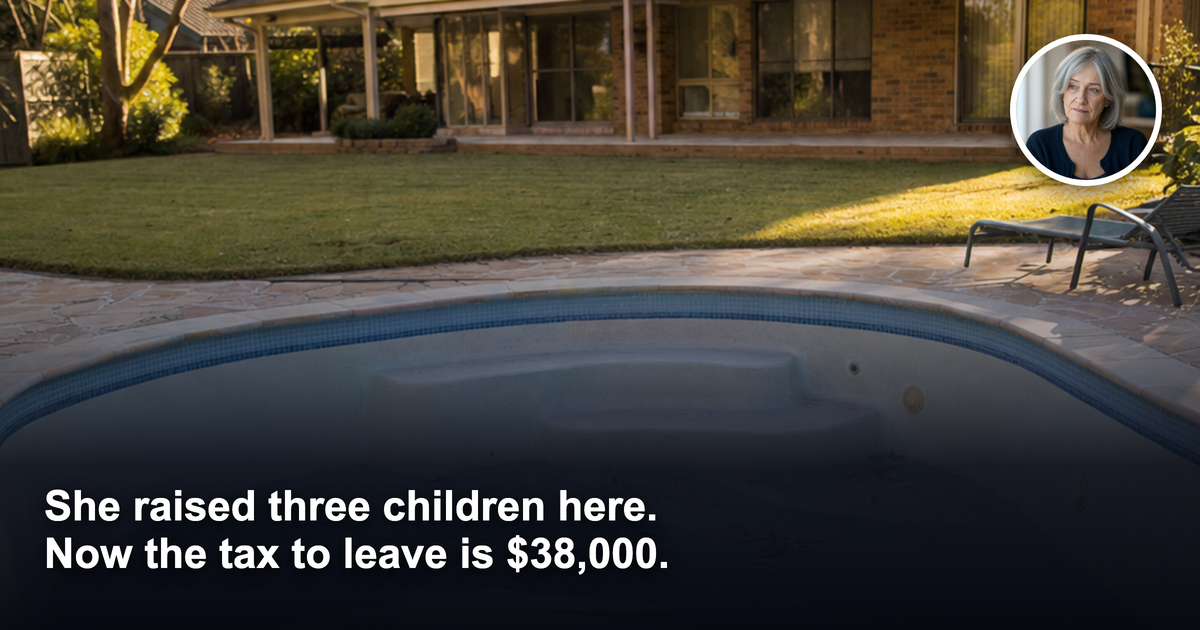
She raised three children in that house. The youngest moved out years ago. The pool still gets cleaned, and nobody swims in it. She wants something smaller and newer, with less to look after and fewer rooms she never opens.
The thing standing between her and that move is not the market. It is not the bank. It is not her family. It is a tax bill of roughly $38,000 that she would have to pay for the privilege of moving into a cheaper home.
That is the bind the ABC reported on Monday 21 September 2026. More older Australians want to downsize, and the stamp duty on the move is putting them off.
What the reporting actually found
Michael and Leisa McLennan have lived in their five-bedroom Queensland home with a pool for fourteen years. Two of their three adult children have moved out and the third is likely to follow. They want something smaller that requires less maintenance. The tens of thousands of dollars in stamp duty they would have to pay is, in their words, a "significant concern" — and may be the thing that keeps them where they are.
"Instead of giving that money to government, we could buy ourselves a new car, we could have multiple overseas holidays, or we could renovate the house," Mr McLennan told the ABC.
He put the unfairness plainly: "It doesn't feel right that there are effectively significant financial penalties for someone such as us to move out of a five-bedroom house to move into, say, a three-bedroom apartment." And: "It's a significant obstacle."
His sharpest line is the one that should worry every policymaker reading it: "At the moment, there is no incentive. In fact, there's a penalty to downsize."
The numbers behind that sentence are not small. According to the ABC's reporting, stamp duty on a million-dollar home varies across Australia from around the $30,000 mark to more than $50,000 in some jurisdictions. South Australia has announced exemptions for over-60s who move into new builds. Only Victoria and the ACT offer stamp duty concessions for pensioners. In Queensland, where the McLennans live, the government is not considering it — Treasurer David Janetzki said the government was focused on no stamp duty for first home buyers on new homes, along with other home ownership schemes.
Brendon Radford, director of policy and research at National Seniors Australia, said repeated surveys over the years have shown the cost of moving is among the biggest barriers for people who want to downsize. Taxes and legal fees pile up quickly, he said, especially for people on fixed incomes like the pension.
The owner in the middle of it
Consider a woman who is a composite illustration. She is not a real person, and she is not the McLennans or anyone else named in the ABC's reporting. She is 68. She has been in the same five-bedroom house for two decades. Call it worth $1.15 million and the townhouse she wants $820,000 — illustrative figures only.
On the ABC's reported range, the duty on that smaller purchase lands somewhere around $38,000 before she has paid an agent, a conveyancer or a removalist. She is moving down in price and down in space, and the transaction still takes a five-figure bite out of the capital that has to last her.
So she stays. The house is too big, the stairs are getting harder, and she stays — because the arithmetic of leaving is worse than the inconvenience of staying.
That decision has a second victim nobody sends a bill to: the family that would have bought her five-bedroom house.
The question this raises
Here is the part most coverage misses. If the cost of moving is the real barrier, then the only move worth making is one you will not have to undo.
The McLennans said exactly this. They have never lived in an apartment or a townhouse and they are wary: "We wouldn't want to be in a position where we buy something — we pay our stamp duty plus the other costs, and then in two years' time, we're having to go through all of that again because we weren't comfortable."
Read that again, because it is an investment thesis in plain language. When the entry cost is $38,000, being wrong twice is not an inconvenience. It is a retirement.
So what actually tells you the smaller home is the right one?
The answer is smaller than a suburb
Not the suburb median. A median tells you what a mixed bag of houses and units did on average; it cannot tell you what a three-bedroom townhouse on one specific street is worth.
What answers the question is street-level evidence, and it is the same evidence we build for investors:
- Achieved versus advertised prices on that exact street, not the asking prices that never transacted.
- Days on market for that exact stock type — townhouses and small units often behave nothing like the detached houses around them.
- Street-level vacancy, because thin rental demand is the earliest signal that the resale pool is thin too.
- Approved-but-unbuilt competing supply, which is the single most underrated risk in downsizer stock. If forty similar townhouses are approved two streets away, her resale in six years competes with brand-new product.
- Buyer depth on exit — how many genuine buyers exist for that dwelling type at that price point in that pocket.
Tied together, that is what our R-Score is built to express: not whether a suburb is "good", but whether a specific address stacks up on the things that actually move value.
What this means for you
Two things follow.
First, if you are considering downsizing, the tax is a fixed cost you mostly cannot avoid — so spend your energy on the variable you can control, which is picking an address you will still be happy with in ten years. The duty is painful once. The wrong street is painful for as long as you own it.
Second, if you are an investor, the policy settings described above are a supply signal. Every older owner who decides staying is cheaper than moving is one large family home that does not reach the market. That has consequences for the stock that does.
None of this is an argument against property. It is an argument for property done properly — chosen on evidence at the street level rather than on a headline about a suburb.
General information only, not personal, financial or tax advice. Stamp duty rates, thresholds and concessions vary by state and territory and change over time — check the current rules in your jurisdiction and seek advice for your circumstances. All property investment carries capital risk, and past performance is not a guide to future returns.
If you want to know what a specific street is actually doing before you commit, that is the work we do. Start with the R-Score, or read more of our analysis on the Ripehouse blog.
For downsizers facing a five-figure duty bill, the real question is whether the smaller home will still suit in a decade, and our webinar can help you test the street-level risks, resale depth and competing supply before you make that costly decision.
Frequently asked questions
Why is stamp duty stopping older Australians from downsizing in Australia?
Because the cost of moving can be tens of thousands of dollars even when the new home is cheaper. The article says that for many older owners, that tax bill is a bigger barrier than the housing market itself.
How much stamp duty can you pay when buying a million-dollar home?
According to the article’s reporting, stamp duty on a million-dollar home ranges from about $30,000 to more than $50,000 depending on the jurisdiction. That cost can apply even if you are moving into a smaller, lower-priced property.
Which Australian states or territories offer stamp duty concessions for pensioners or older downsizers?
The article says only Victoria and the ACT offer stamp duty concessions for pensioners. It also says South Australia has announced exemptions for over-60s who move into new builds.
What should I check before buying a smaller home if I might stay there for years?
The article says to focus on street-level evidence, not suburb averages. It highlights achieved prices, days on market, vacancy, approved-but-unbuilt competing supply, and buyer depth on exit.
What is the biggest risk in downsizer property according to the article?
The biggest risk is paying the stamp duty and other moving costs, then realising the smaller home is the wrong one. The article says being wrong twice is much more expensive when the entry cost is already in the tens of thousands.
General information only. It does not take your objectives, financial situation or needs into account, and nothing here is legal, financial, taxation or investment advice specific to your circumstances.