News · 26 August 2026 · 5 min read
The builder was licensed. Why did a $38,000 payment still leave him exposed?
A licensed builder and detailed contract did not stop a renovation from stalling after $38,000 was paid. The checks that protect an owner and the investment underneath the work.
The builder was licensed. Why did a $38,000 payment still leave him exposed?
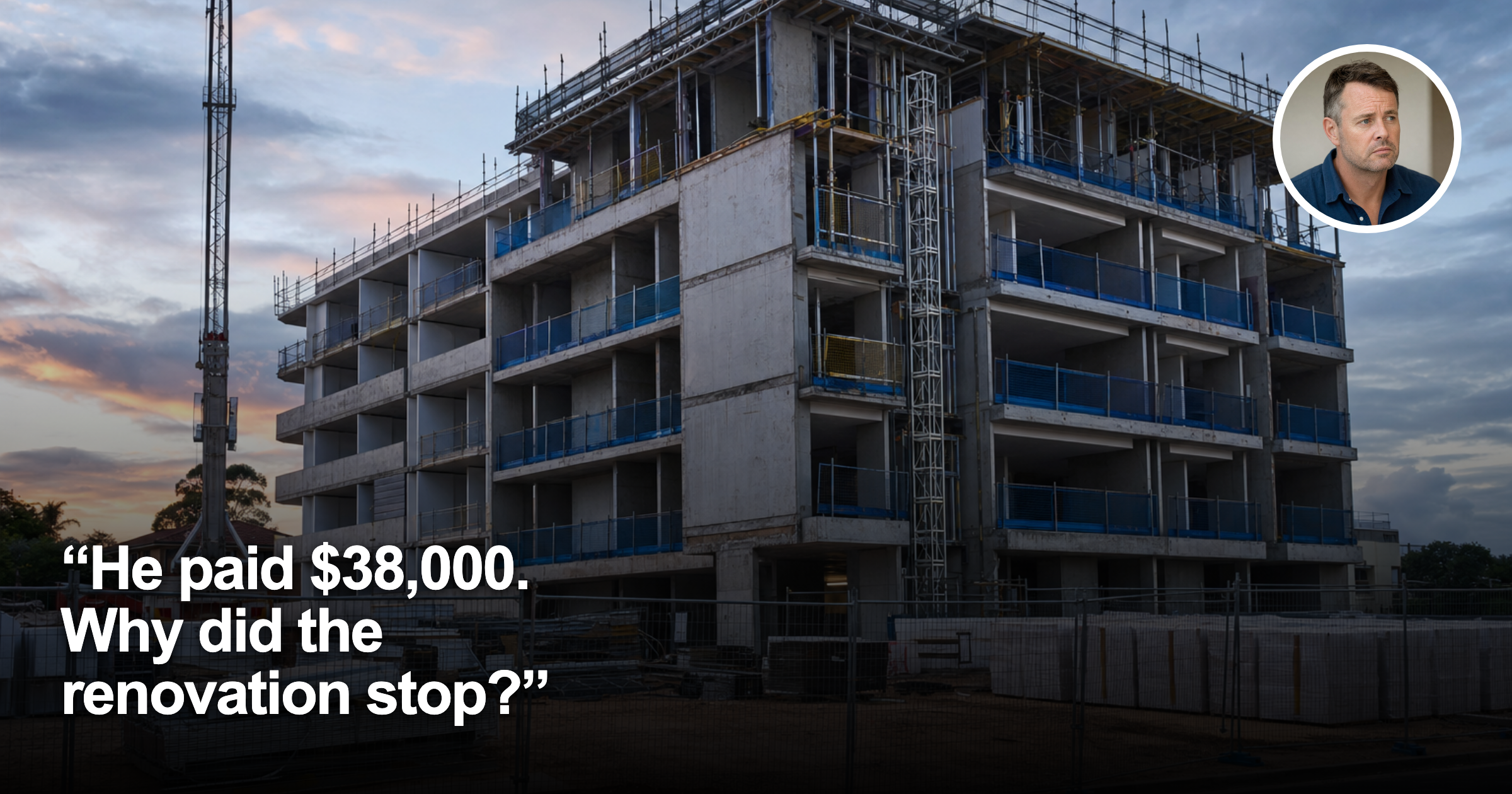
A 67-year-old self-funded retiree thought he had reduced the risk of renovating by choosing a licensed builder and signing a detailed contract. Six months later, he had paid $38,000, the work had stopped and the builder’s phone had gone quiet.
His question was simple: if the builder was licensed, how could the renovation still become a financial trap?
A licence is a starting point, not a completion guarantee
A building licence can tell an owner that a person or company is authorised to perform certain work. It does not guarantee that the business will remain solvent, that every subcontractor has been paid, that the work will be completed on time or that a dispute will be resolved quickly.
That distinction matters as governments and industry bodies continue to examine building-site conduct, defective work and the people operating behind construction businesses. A licence check is valuable. It is only one part of checking who is actually taking the deposit, controlling the site and carrying the project through to completion.
For the owner in this scenario, the renovation was meant to add a second bedroom and improve the home’s long-term rental appeal. The contract price was $190,000. His first progress payments totalled $38,000. Once the site stopped moving, the payment was no longer just a line in a budget: it was money tied to a partly completed project.
Where can the risk hide?
The first risk is the contracting entity. The name on a quote, the name on a licence, the name receiving payment and the name shown on insurance documents should align or be explained clearly. If a separate company, individual or trust receives the money, an owner needs to understand why.
The second risk is the payment schedule. Progress payments should follow identifiable stages of work, not simply calendar dates or a builder’s cash-flow needs. Paying ahead of visible progress can leave the owner financing the project while having little leverage if the job stalls.
The third risk is the contract’s security and insurance framework. State rules differ, and the protections available can depend on the type of work, the value of the contract, the parties involved and when the problem occurred. An owner should know whether there is domestic-building insurance, what it covers, how a claim is triggered and what records must be kept.
The fourth risk is the site itself. A builder can be licensed while the project remains vulnerable to poor supervision, unpaid trades, missing approvals or incomplete inspection records. The owner needs a paper trail that connects the approved plans, inspections, variations, invoices and progress photos.
Why the cheapest quote can be the most expensive one
The cheapest quote is not automatically bad. But a low price can conceal a thin contingency, excluded work or a business that needs the next deposit to finish the previous stage. RHA’s earlier look at fixed-price renovation surprises explains why “fixed” must always be read alongside the inclusions and exclusions.
Suppose three builders quote on the same $190,000 renovation: $190,000, $208,000 and $224,000. The lowest quote appears to save $18,000 against the middle proposal. If the lowest contractor then requires a $38,000 payment before the next stage is complete, the apparent saving has to be tested against the cost of delay, replacement work and legal recovery.
If a replacement builder charges $24,000 to rectify incomplete work, the original $18,000 “saving” has vanished before rent, storage, temporary accommodation or professional fees are counted. These are worked examples, not a forecast of what every stalled renovation will cost. They show why a quote must be assessed for scope, sequencing and business resilience as well as price.
The property can be good while the renovation plan is bad
This is also an investment question. A suburb-level growth headline cannot tell an owner whether a particular renovation will add value or simply add debt.
Ripehouse Advisory tests the address at street level: achieved rents, vacancy duration, days on market, competing listings, buyer depth and the supply pipeline within the property’s practical catchment. A second bedroom may be highly valued on one street and poorly rewarded on another if the local tenant pool prefers parking, outdoor space or a different layout.
The same analysis can expose renovation risk. If comparable renovated homes on nearby streets achieve only $40 more per week than sound unrenovated homes, spending $190,000 for a modest rent lift may be hard to justify. If the completed design moves the property into a scarce segment with stronger buyer depth, the work may create a durable advantage.
The building decision and the property decision should therefore be made separately. First ask whether the work is properly controlled. Then ask whether the finished asset will be demanded by renters and buyers.
What should an owner check before signing?
Start with the licence and insurance registers relevant to the state and the work. Confirm the legal entity, licence class, recent status and any required warranty cover. Keep a dated copy rather than relying on a verbal assurance. The same evidence-first approach applies when checking what a later owner can do about a building defect.
Read the scope line by line. Identify approvals, engineering, demolition, waste, temporary protection, service upgrades, painting, landscaping and any provisional sums. An attractive headline price may exclude the items most likely to surface after work begins.
Make the payment schedule evidence-based. Photograph each stage, obtain inspection records and avoid paying for work that cannot be verified. If a variation is proposed, require its reason, price and effect on time in writing before the work proceeds, subject to the applicable state rules.
Check who is on site. A principal contractor may use subcontractors, but the owner should know who is responsible for supervision, safety, quality records and correcting defects. Keep all invoices, messages, plans, approvals and photos in one file.
Finally, plan the failure scenario before it arrives. Know where to get independent contract advice, how disputes are escalated and what evidence an insurer, regulator or tribunal may request. Early advice is usually more useful than reconstructing the project after the relationship has broken down.
The opportunity after the warning
The lesson is not that renovation or property investment is too risky. It is that a good asset can be damaged by a weak delivery plan.
A carefully scoped renovation, a financially credible builder and a street-level demand test can turn improvements into useful equity and stronger rental appeal. The owner who checks the person behind the licence, matches payments to visible progress and measures the finished product against nearby alternatives has a much better chance of protecting the upside.
Property investment still rewards preparation. The right home on the right street, improved for a demonstrable tenant and buyer need, can outperform a cheaper project built on assumptions. A licence is important. The complete contract, the payment trail and the local evidence are what make the investment defensible.
If there's a specific street you're weighing up right now, check its Street Score first — it's free, takes ten seconds, and tells you whether that street is pulling the suburb average up or riding on it.
Frequently asked questions
If a builder is licensed in Australia, why can a renovation still fail after payments have been made?
A licence shows the builder is authorised to do the work, but it does not guarantee solvency, subcontractor payment, timely completion or a quick dispute resolution. The article says the owner can still be exposed if the site, contract and payment controls are weak.
What should an owner check before paying a deposit or progress payment on a renovation?
The article says to confirm the legal entity, licence class, insurance and warranty cover, and to make sure the name on the quote, licence, payment details and insurance documents align. Progress payments should also match visible work, with photos and inspection records kept as evidence.
Why is a fixed-price renovation quote not always safe?
A low or fixed price can hide exclusions, provisional sums or a business that relies on the next payment to keep going. The article says the quote needs to be read for scope, sequencing and business resilience, not just the headline price.
What happens if a renovation adds a second bedroom but the local market does not value it?
The article says the property decision should be separate from the building decision. If nearby renovated homes achieve only a small rent premium, a costly upgrade may be hard to justify unless it creates a stronger segment position with clear buyer and tenant demand.
What is the most practical way to reduce the risk of a stalled renovation?
Use an evidence-based process: verify the licence and insurance, read the contract scope carefully, link payments to completed stages, and keep a paper trail of plans, approvals, invoices, photos and variation requests. The article also says to plan the failure scenario before it happens.
General information only. It does not take your objectives, financial situation or needs into account, and nothing here is legal, financial, taxation or investment advice specific to your circumstances.