News · 26 August 2026 · 4 min read
She was asked to guarantee $84,000 for a home. Why the housing target is becoming a family problem
A grandmother asked to guarantee $84,000 for a first home discovers why national housing promises do not remove the valuation, lending and family risks attached to one address.
She was asked to guarantee $84,000 for a home. Why the housing target is becoming a family problem
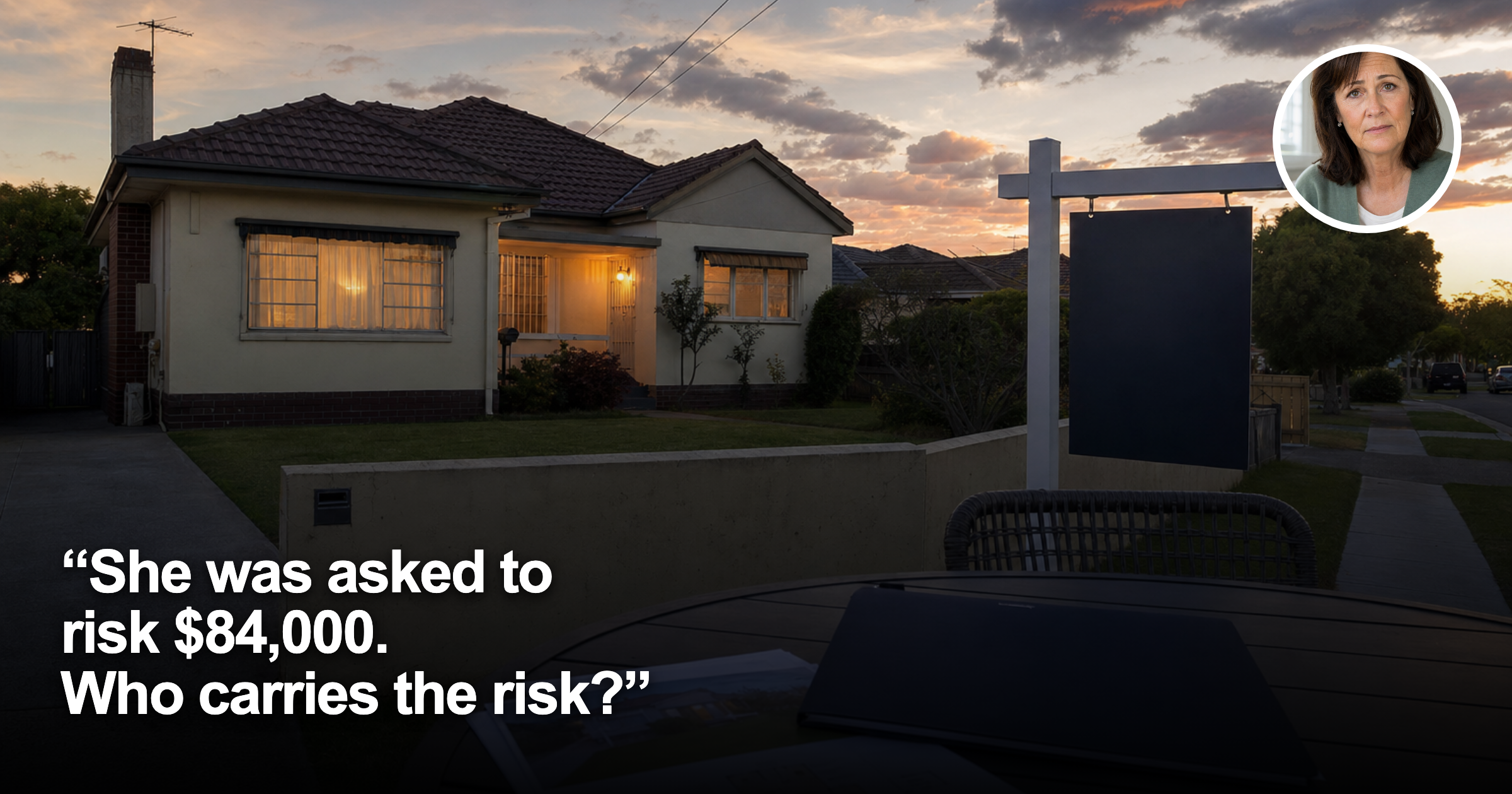
When a 58-year-old grandmother was asked to help her grandson buy a modest home, the number on the paperwork was $84,000.
That was not a gift. It was the amount of additional security the bank wanted before it would consider the application. Her grandson had saved, worked through the budget and found a property he could afford to hold. But the deposit gap, the valuation and the lender’s risk settings still left the family with one uncomfortable choice: walk away, or put a grandparent’s home in the line of fire.
She asked a question we hear in different forms all the time: if governments promise more homes, why are ordinary families still being asked to carry the risk of a housing system that cannot deliver them?
The answer is that a target is not a home
The national promise of 1.2 million additional homes is politically powerful. It is also easy to misunderstand. A target is a pipeline ambition. It does not guarantee that a finished dwelling will appear in the suburb where a buyer can pay the mortgage, near the transport route they need, at the price their bank will accept.
Even when approvals and construction improve, the benefit arrives unevenly. Some projects are delayed by infrastructure, financing or planning constraints. Some new dwellings are apartments in locations that do not suit a family. Some are built into a market with weak rental demand. And existing owners may see a headline about “supply” while their own street still has too few homes for the number of qualified buyers.
That gap feels like an injustice because the risk is immediate for the family and abstract for the system. The grandmother has a real property, a real retirement plan and a real legal exposure. The promise is measured nationally and over years.
What does a guarantor actually risk?
The first mistake is to treat a guarantee as a signature of support. Depending on the structure, a lender may take security over part of the guarantor’s property. If the borrower cannot meet the loan, the guarantee can be called. The exposure may be limited to a set amount, or it may be wider. The documents matter more than the family conversation.
The second mistake is to assume that a rising market will solve every problem. A valuation can come in below the contract price. Insurance, rates, repairs and vacancy can change the holding cost. A buyer who passes a repayment test today may have less room after a rate change or an unexpected bill.
The sensible question is not simply “Can she help?” It is “What is the maximum loss, when can the security be released, and what evidence will prove that the release conditions have been met?” Independent legal advice and a direct conversation with the lender are essential before anyone signs. A family should also model the loan without assuming a quick price rise or a future refinance.
Why national supply still needs street-level evidence
The housing debate often stops at suburb averages. That is where buyers and guarantors can be misled.
Two homes can share a postcode and a median price while carrying very different risks. One may sit on a street with frequent listings, longer days on market and several competing developments. Another may be close to a school boundary, a reliable transport connection and a pocket where well-presented homes move quickly. National supply can eventually influence both, but it will not do so at the same speed or with the same effect.
Ripehouse Advisory’s approach is to test the address and its immediate competition: street heat, rental demand, vacancy signals, days on market, supply entering the radius and the price gap between nearby streets. Our case study on a school-catchment boundary creating a $45,000 house-value gap shows why a suburb-wide average can hide a very local result. That does not turn a guarantee into a safe bet. It can reveal whether the family is taking a risk on a property with durable demand or merely hoping a national headline lifts every asset equally.
The same discipline helps an investor assess the new supply itself. A suburb receiving thousands of dwellings is not automatically a bad investment. If demand is deep, the product is scarce within its micro-location and the numbers survive realistic costs, new supply may create an opportunity. For a wider look at how buyers can compare government support with their own deposit position, see our guide to first-home buyer schemes and the questions they leave unanswered. But buying because a minister announced a target is not research.
So what should families do?
Start with the guarantee, not the dream. Set a written maximum exposure. Confirm whether the liability is capped and exactly how it ends. Stress-test the borrower’s repayments, the guarantor’s retirement income and the property’s costs. Then assess the address at street and radius level, including competing supply and actual rental demand.
The grandmother did not need another slogan. She needed to know whether the home could stand on its own after the politics, the family emotion and the national target disappeared.
Australia needs more homes, but investors and families still need better decisions. The opportunity is not in chasing the loudest housing promise. It is in finding the right asset, on the right street, with the right data — and making sure the numbers work before anyone else’s home is placed behind it.
If there's a specific street you're weighing up right now, check its Street Score first — it's free, takes ten seconds, and tells you whether that street is pulling the suburb average up or riding on it.
Frequently asked questions
What does the article mean when it says a housing target is not the same as a home?
A national housing target is only a pipeline ambition, not a guarantee that a suitable home will be built in the right suburb, at the right price, or with lending conditions a buyer can meet. The article says the benefits of more supply can arrive unevenly and take time.
If someone in Australia is asked to guarantee a home loan, what are they actually risking?
Depending on the structure, a lender may take security over part of the guarantor’s property, and the guarantee can be called if the borrower cannot repay. The article says the exposure may be limited or wider, so the documents matter more than the family conversation.
Why can a family still be asked to provide extra security even when a buyer has saved and found an affordable property?
The article says the deposit gap, valuation and lender risk settings can still leave a shortfall after saving and budgeting. Even if the buyer can hold the property, the bank may still want additional security before approving the loan.
What should families check before signing a guarantee on a home in Australia?
They should set a written maximum exposure, confirm whether the liability is capped, and find out exactly when the security can be released. The article also says independent legal advice and direct discussion with the lender are essential.
Why does the article say suburb averages can be misleading when judging housing risk?
Two homes in the same postcode can face very different outcomes depending on street-level factors like competing supply, days on market, vacancy signals, rental demand and nearby school boundaries. The article says families should assess the address and immediate competition, not just the suburb median.
General information only. It does not take your objectives, financial situation or needs into account, and nothing here is legal, financial, taxation or investment advice specific to your circumstances.