News · 30 August 2026 · 4 min read
Her $95,000 quiet-street premium collided with a new flight path
A new airport can change the value of a home street by street. The question is whether buyers should panic — or measure the exact exposure before they buy.
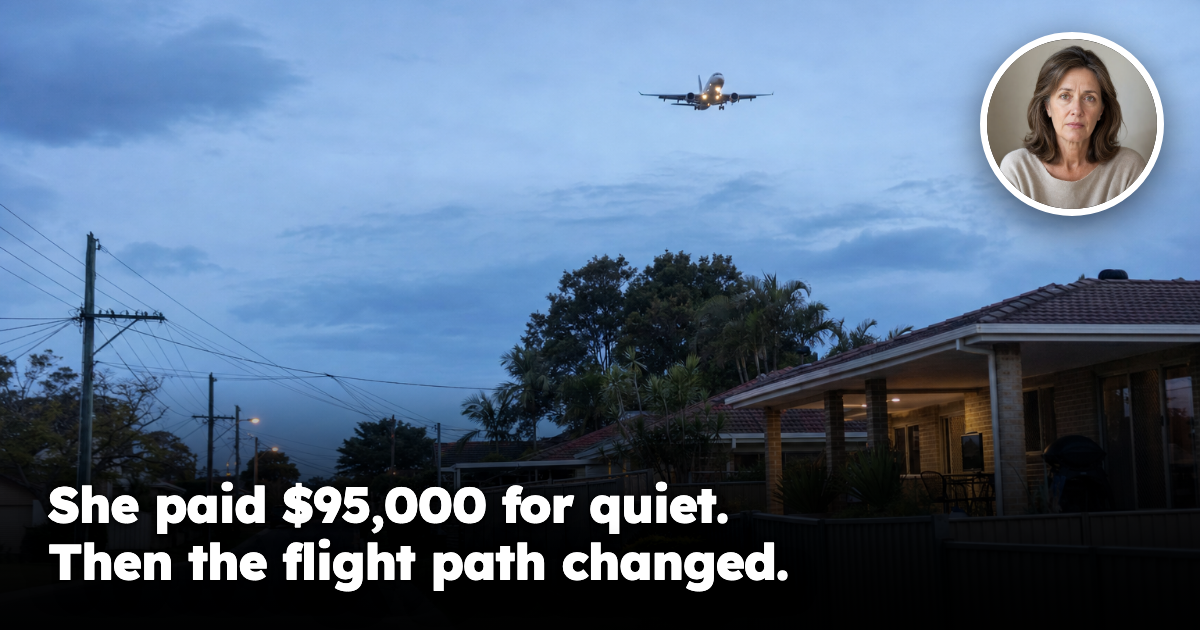
When a 58-year-old woman inspected the house, the extra $95,000 seemed easy to explain.
The home was on the quieter side of the suburb. It had the same bedroom count, a similar block and almost the same renovation level as another property a few streets away. But the street was calmer, the backyard felt more usable and the evening inspections were noticeably less busy.
Then the airport maps changed.
The question she brought to Ripehouse Advisory was blunt: if aircraft begin using a corridor above the suburb, has the quiet-street premium disappeared — and has she just overpaid for a feature that no longer exists?
The short answer
Possibly, but not automatically.
Aircraft noise is not a suburb-wide switch. It is a location factor. The number of flights, the direction of the approach, the height at the property, the time of day and the design of the house all matter. Two homes with the same postcode can have very different exposure.
That is precisely why a broad suburb median is a poor answer to a street-level question.
The current debate around flight activity near Western Sydney’s new airport has made the issue much more visible. Reports of night-flight concerns and thousands of homes sitting beneath new corridors have turned an abstract planning line into a buyer question: what will it sound like in the backyard at 11pm?
For an owner, the emotional reaction is understandable. For an investor, the useful response is more disciplined: measure the address, then price the risk.
Why the $95,000 matters
The $95,000 was not really paying for four walls. It was paying for a bundle of small advantages: a quieter road, less traffic, a better outdoor area and the expectation that future buyers would value the same experience.
If aircraft noise weakens that experience, the risk is not necessarily an overnight crash. It may show up as fewer inspections, longer days on market, a smaller pool of owner-occupiers or a buyer who negotiates harder after discovering the flight corridor.
That distinction matters. A property can retain a strong rent and still lose some resale appeal. It can also perform well if its particular position is outside the meaningful exposure, despite being in the same suburb as affected homes.
The mistake is treating “near the airport” as the analysis. Near is not a measurement.
What street-level data can reveal
Ripehouse Advisory’s address-level review looks beyond a suburb average. It can compare achieved sales, achieved rent, days on market, buyer depth, vacancy and competing supply around a specific property. For a flight-path question, that dataset is paired with the physical location: approach direction, road position, outdoor living orientation, likely noise timing and the gap between exposed and sheltered streets.
In a recent comparison of otherwise similar homes, the street-level difference between the quieter pocket and the more exposed pocket was about $95,000 at the upper end of the local market. That does not mean every home under a corridor loses that amount. It shows why the question has to be asked at the address level.
The same principle applies to other hidden value factors. A flood-map line can split two apparently comparable homes, as explored in the street-level flood-risk question. A road, easement or school-catchment boundary can do the same. The suburb label is only the beginning of the investigation.
For another example of how a physical feature changes buyer behaviour, see the street parking and driveway value test. It is the same discipline: isolate what the address actually delivers, then compare it with what the market is paying.
What should a buyer check?
First, identify whether the property sits beneath a proposed or active corridor, rather than relying on a sales description saying “convenient to the airport”. Check the likely direction and the operating hours that matter to the household or tenant.
Second, visit at different times. A ten-minute inspection on a quiet afternoon cannot answer a night-noise question. Stand in the backyard, open the windows and listen from the bedrooms.
Third, separate amenity from investment resilience. A home may be personally perfect but difficult to resell if its likely buyer pool narrows. Conversely, a less exposed street may hold demand even when the wider suburb is being discussed negatively.
Fourth, test the price against actual nearby outcomes. Asking prices are not evidence. Compare settled sales and days on market for properties with similar construction, land, parking and exposure. Then ask whether the proposed premium is supported by buyers — or merely by the vendor’s story.
Finally, model the tenant. Some renters will accept airport access and a lower weekly rent. Others will reject the property immediately. The right question is not “will everyone hate it?” It is “which tenant pool remains, and is the rent compensating for the narrower pool?”
So did she overpay?
Not enough information exists to answer from a postcode alone.
If her address sits directly under a busy night corridor, the quiet-street premium deserves to be re-tested. If the map passes nearby but the home remains sheltered from the main exposure, the premium may still be real. The answer could even be an opportunity: public anxiety can create a discount on a street where the measured impact is modest and the underlying rental demand remains strong.
That is the broader lesson for property investors. Headlines can identify a risk, but they cannot value an individual asset. The winning decision is usually made by finding the right street, measuring its buyer and tenant depth, and refusing to pay a suburb-wide premium for a feature the exact address does not deliver.
The right property, on the right street, bought with the right data, can remain a powerful long-term investment even when a new flight path changes the conversation.
If there's a specific street you're weighing up right now, check its Street Score first — it's free, takes ten seconds, and tells you whether that street is pulling the suburb average up or riding on it.
Market data & R-Scores for locations in this article
Drill Down Into the Markets Mentioned Above
Inspect live monthly R-Scores, median prices, rental yields, and street-by-street scores for the cities and council areas referenced in this article:
Frequently asked questions
How can a new airport flight path affect a home’s value in Australia?
It can change value street by street rather than across an entire suburb. Homes directly under or near a corridor may face less buyer demand, longer days on market or tougher negotiations, while sheltered streets may be less affected.
Should buyers panic if a property is near a flight path?
No. The article says aircraft noise is a location factor, not a suburb-wide switch, so the right approach is to measure the exact address exposure before deciding what it is worth.
What should I check before buying a home near Sydney’s new airport corridors?
Check whether the property sits beneath a proposed or active corridor, the likely flight direction, and the operating hours that matter to you or a tenant. It also helps to inspect at different times and listen from the backyard and bedrooms.
Can a property still be a good investment even if it is near an airport?
Yes. A home may still hold strong rent and resale demand if its exact position is outside the meaningful exposure. The article says the key is whether the address still appeals to buyers and tenants, not just whether it is in the suburb.
What is the main mistake buyers make when pricing airport noise risk?
Treating “near the airport” as the full analysis. The article says you should compare settled sales, days on market and local buyer depth for similar properties, then judge whether the premium is supported by actual market evidence.
General information only. It does not take your objectives, financial situation or needs into account, and nothing here is legal, financial, taxation or investment advice specific to your circumstances.