News · 5 October 2026 · 5 min read
He was told to wait for the bottom. Then the house he wanted passed in and the agent rang him
He is 41. He and his partner own their home in Sydney's inner west, the bank says there is about $160,000 of usable equity sitting in it, and for seven months he has done exactly what everyone told him to do.
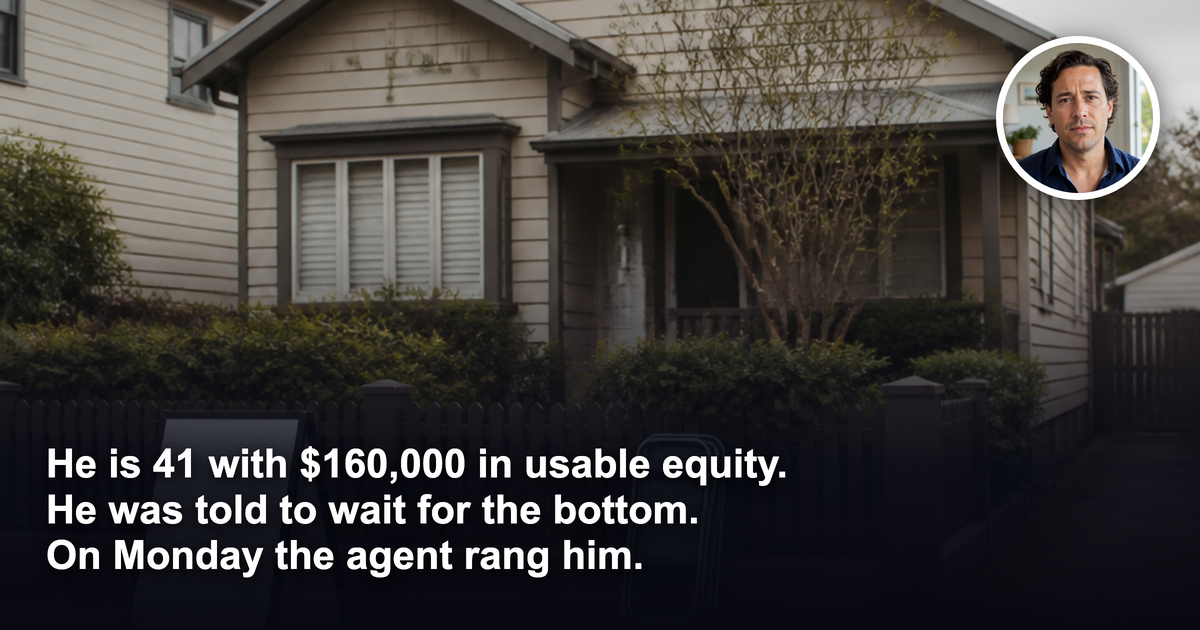
He is 41. He and his partner own their home in Sydney's inner west, the bank says there is about $160,000 of usable equity sitting in it, and for seven months he has done exactly what everyone told him to do.
He has waited.
He is a composite illustration, not a real person, but the position he is in is one a great many Australian households recognise this spring.
He had a house in mind. A plain three-bedder on a wide street two suburbs over, the kind of place that would have gone under the hammer in twelve minutes in 2024. He went to the open homes. He read the contract. He ran the rent. Then his brother-in-law, his broker and a podcast all said the same thing: prices are falling, do not catch a falling knife, wait for the bottom.
On Saturday the house passed in. There was one bid, below the vendor's number, and the auctioneer called it off in front of eleven people and a dog.
On Monday morning the selling agent rang him. Would he like to make an offer?
The question
"Everyone keeps telling me to wait for the bottom. Now the agent is chasing me and I have no idea whether that means I am about to get a bargain or about to make the mistake everyone warned me about. What do I actually do with this?"
The answer: the data that scared him is the data that gives him leverage
Start with what happened last week, because it is the reason the agent picked up the phone.
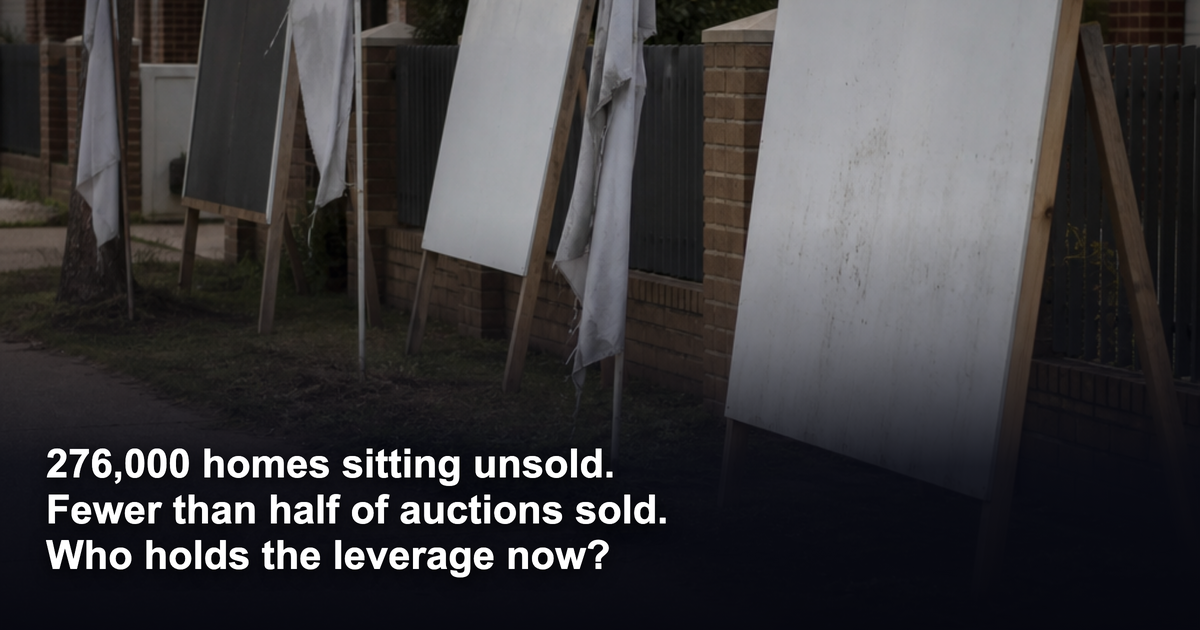
According to Cotality figures reported by the ABC on 5 October, the preliminary auction clearance rate across the capitals fell to 48.2 per cent, a three-month low and the second-lowest preliminary reading of the year. Only 1,223 auctions were held nationally, down 47.5 per cent on the same week a year ago. In Melbourne the number of auctions has fallen 45.6 per cent over twelve months, the steepest drop of any capital.
Then the stock side. SQM Research counted 276,000 unsold homes across the country, up 21.6 per cent in a year. Listings older than 180 days are up 10.5 per cent. Brisbane has 43.5 per cent more property for sale than it did a year ago, Adelaide 39.5 per cent, Melbourne 30.3 per cent. Distressed sales reached 4,872 in September, up 29 per cent.
SQM's Louis Christopher put the Sydney picture in one line: fewer vendors are listing than a year ago, yet total stock is up almost a fifth. "That's a demand problem, not a supply surge."
Read that again from the buyer's side of the table. Fewer buyers. More stock. More of that stock stale. More vendors under pressure. Agents ringing the under-bidder on a Monday morning.
That describes a market where the buyer sets the pace. For the first time in years he can ask for a longer settlement, a building and pest clause, a finance clause, a price below the guide, and access for a second inspection, and the answer is likely to be yes.
The expensive mistake
The mistake he was warned about is overpaying. Fair enough.
The mistake nobody warns him about is treating a national clearance rate as a personal buy signal or sell signal.
We make no claim about where the bottom is. Nobody can. The ABC piece itself quotes economists expecting further falls, and values have now dropped for six straight months. A buyer who purchases this spring may well see a lower valuation next autumn.
But "wait for the bottom" has a cost that never appears in the headline. The bottom is only visible after it has passed, and by then the conditions that gave him leverage have gone with it. Clearance rates recover, the agent stops ringing, the finance clause gets struck out, and he is back to bidding against nine other people on a Saturday.
The seven months he has already spent waiting are not a mistake. Waiting with no plan for what triggers a move is the mistake.
What a 48.2 per cent clearance rate does not tell you
It does not tell you anything about the street.
That Sydney stock figure is an average across suburbs where nothing is moving and suburbs where well-priced houses still sell in a fortnight. Two streets in the same postcode can be having completely different years. One has four stale listings and a vendor who has already bought elsewhere. The other has had no sales since March because nobody wants to leave.
The same is true in Brisbane and Adelaide, where the rise in stock is largest. More choice in a city is useless if you cannot tell which of those houses sits on land that will still be scarce in ten years, in a street where days on market and vacancy behave differently from the suburb median.
That is the work. Price per square metre of land, who the other owners are, what happened to rents in the last downturn, how long the stale listings have really been sitting, and why.
The Ripehouse reframe
Markets like this one are the reason we publish our results across the full spread of client portfolios, including the ones that underperformed. On a 5-year rolling basis the median client portfolio has grown at 19.0 per cent a year, against roughly 4.3 per cent nationally on the CoreLogic/Cotality benchmark. Past performance is not a guarantee of future results.
The point of that figure is what sits underneath it. Those portfolios were built through rate rises, through soft springs and through plenty of weekends with the clearance rate under 50. The result came from the asset, the street and the structure, held through the cycle. It did not come from calling the turn.
So his answer is this. The phone call on Monday means the leverage has moved to him. He should use it, on the right house, on the right street, with every clause he can get. If this particular house does not pass the street-level test, he walks away and keeps looking while the conditions still favour him.
Structure beats timing. The data beats the headline.
Want to see how we test a decision like this street by street? Join Jacob's free live webinar.
General information only. It does not take your objectives, financial situation or needs into account, and nothing here is legal, financial, taxation or investment advice specific to your circumstances.