News · 5 October 2026 · 4 min read
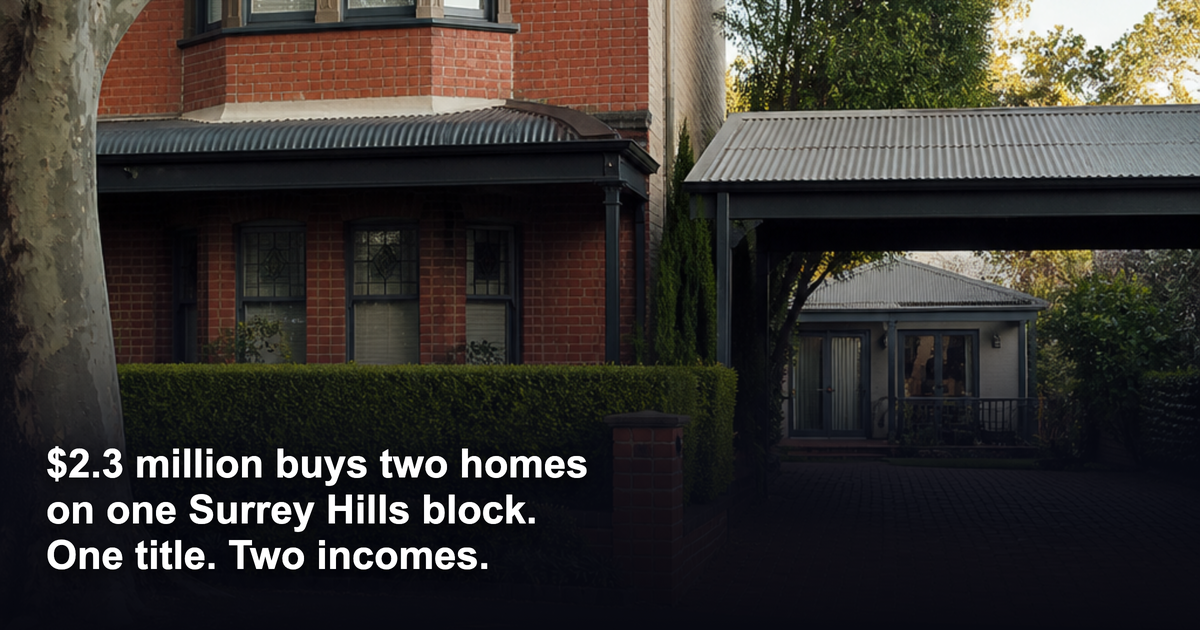
$2.3m buys two homes on one Surrey Hills block. Does one title with two rents beat buying two properties?
$2.3 million. Two homes. One block in Surrey Hills.
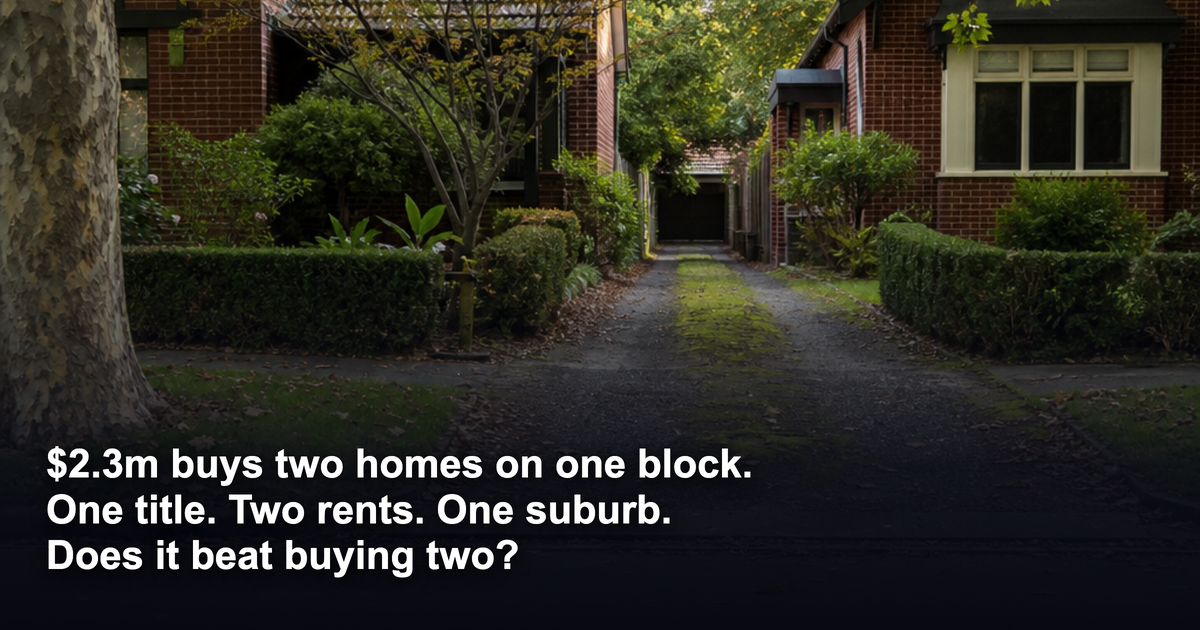
$2.3 million. Two homes. One block in Surrey Hills.
That is the price guide on a dual-dwelling property listed in Melbourne's inner east on 4 October, as reported by realestate.com.au. It is a guide, not a sale result, and it should be read that way.
But the listing matters for a reason that has nothing to do with Surrey Hills.
It puts a concrete number on an idea that a lot of equity-rich owners have been turning over for a couple of years. One title. Two incomes. The second home paid for by the first.
So the useful question is a structure question. If you have $2.3 million of buying power, or a fraction of it, do you want two rents on one piece of land, or two properties in two different markets?
What changed
Dual-dwelling and dual-income properties used to be a fringe product. A granny flat at the back, a converted garage, a knock-down rebuild on a wide block.
Two things moved them into the mainstream.
First, holding costs went up. Rates rose, land tax thresholds in Victoria came down, and single-income properties that once washed their own face started costing their owners money every month. A second rent on the same land looks like the obvious fix.
Second, planning rules in several states loosened around secondary dwellings and multi-generational living. Councils that once fought a second home on a residential block now wave many of them through.
The result is listings like this one. A middle-ring block, two homes, a seven-figure guide, and a pitch that writes itself: one purchase, two tenants.
What it means if you have equity
If you own your home and have usable equity, you are the buyer this product is designed for.
The maths that gets presented to you is simple. Borrow once, settle once, pay one set of stamp duty, collect two rents. The combined income covers more of the loan than a single tenancy would, and you have one property manager, one insurer and one set of council rates.
Some of that is true. Some of it needs a closer look.
The decision, and the trade-offs
Take the $2.3 million guide at face value for a moment and compare it with the alternative.
Option one: one title, two homes, one suburb. All $2.3 million sits in Surrey Hills, on one block, under one title. If Surrey Hills has a good decade, you are fully exposed to it. If the street has a bad one, you are fully exposed to that as well.
Option two: two properties, two markets. The same $2.3 million could, in principle, be two purchases of roughly $1.15 million each in two different suburbs, or even two different states. Two titles. Two land tax positions. Two sets of buyers when you come to sell.
Here is where the two options separate.
Valuation
A valuer will often treat a dual-dwelling property as one asset, and will look for comparable sales of other dual-dwelling properties nearby. In many streets there are very few. When comparables are thin, valuations tend to be conservative. Two rents do not automatically produce a valuation that reflects two rents.
Lending
Lenders treat these properties differently from one another, and policy varies. Some will count both rents in full. Some will shade the second. Some will lend less against the property than you expect because of how they classify it. None of this is a reason to walk away, but it is a reason to know the treatment before you bid, not after.
The buyer pool at exit
This is the one almost nobody prices in.
A standard family house in Surrey Hills sells to owner-occupiers, upgraders, downsizers and investors. A dual-dwelling property on the same street sells to a much smaller group: investors who want two incomes, and families who want two generations under one roof.
Fewer buyers means less competition on the day you sell. That can show up as a longer campaign, a lower price, or both. The premium you paid for the second dwelling is only recovered if the next buyer values it as much as you did.
Concentration
Two rents on one block are still one address. One council. One land tax assessment. One flood map, one school zone, one planning overlay. If anything changes on that street, both incomes feel it at the same time.
Two separate properties spread that risk. They also double the transaction costs and the management load. There is no free option here. There is only the option you have priced correctly.
The street-level view
At Ripehouse we look at streets before we look at listings, because the same product can be having completely different outcomes two kilometres apart.
In one street, a dual-dwelling property sits among other wide blocks, with a track record of similar sales and a rental market that absorbs two tenancies without a pause. In another street, it is the only one of its kind, the comparables are a guess, and the second dwelling is a rent that a valuer cannot see.
The listing does not tell you which street you are looking at. The data does.
So the question is never whether dual-income property works. It is whether this block, on this street, in this suburb, with this lender, produces a better measured outcome than two ordinary assets in two well-chosen markets.
That is a structure decision. The right asset on the right street, judged on the numbers, beats a headline every time.
Want to see how we would test a decision like this street by street before you commit $2.3 million to one block? Join Jacob's free live webinar.
General information only. It does not take your objectives, financial situation or needs into account, and nothing here is legal, financial, taxation or investment advice specific to your circumstances.