News · 5 October 2026 · 5 min read
276,000 homes are sitting unsold. What that means if you have equity and have not bought yet
There are 276,000 homes for sale in Australia and nobody is buying them.
There are 276,000 homes for sale in Australia and nobody is buying them.
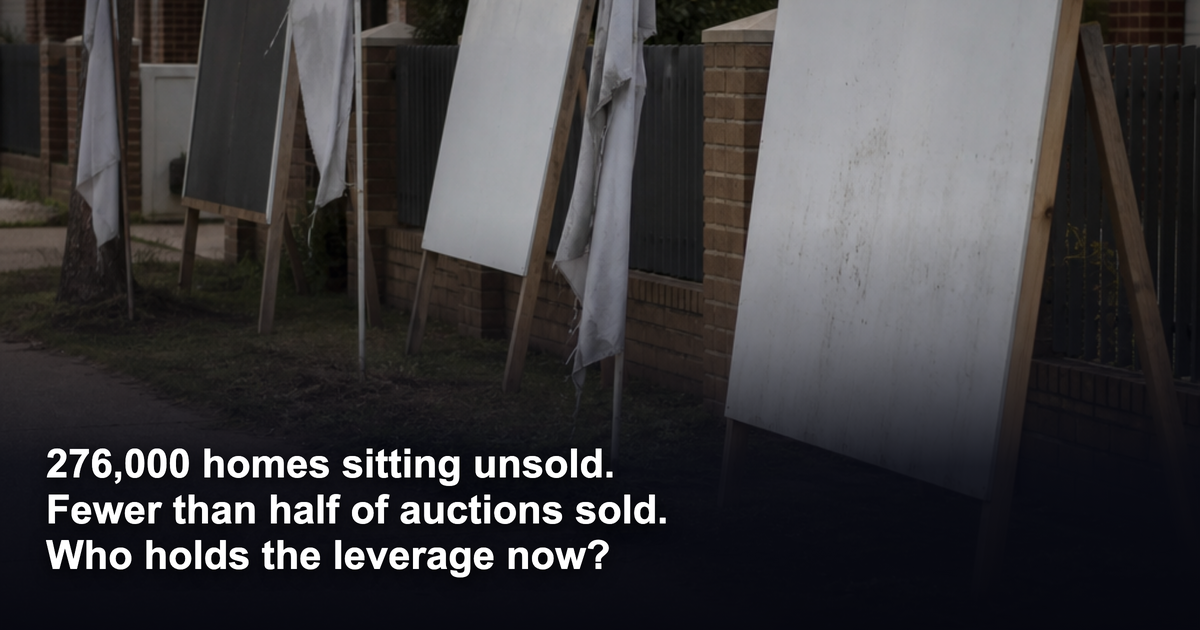
That is the SQM Research count of unsold stock reported by the ABC on 5 October. It is up 21.6 per cent on a year ago. In the same report, Cotality's preliminary auction clearance rate for last week came in at 48.2 per cent, a three-month low and the second-lowest reading of the year.
Fewer than half of the homes taken to auction found a buyer.
The headlines call this a downturn getting worse. For a seller who needs a result by Christmas, it is. For a homeowner with equity who has been waiting on the sidelines, it is something else entirely.
What actually changed
Three things are moving at once, and they all push the same way.
First, stock is building. The ABC reports 276,000 unsold homes nationally. SQM's director Louis Christopher said the bulk of the increase is property that has been listed for one to six months and has not sold. Listings older than 180 days are up 10.5 per cent on a year ago.
Second, the increase is not evenly spread. Brisbane has 43.5 per cent more property for sale than a year ago. Adelaide is up 39.5 per cent. Melbourne is up 30.3 per cent, Perth 21.3 per cent, Canberra 17.8 per cent. Sydney has fewer vendors listing than last year, yet total stock is up almost a fifth. Christopher called that a demand problem.
Third, auction volumes have collapsed. Cotality counted 1,223 auctions across the capitals last week, 47.5 per cent fewer than the same week a year ago. Melbourne's auction count is down 45.6 per cent over twelve months, the largest fall of any capital.
Cotality's Tim Lawless put the cause down to long weekends, a fourth rate rise this year, and budget changes to negative gearing and capital gains tax that have left households deeply pessimistic.
So: more homes for sale, sitting longer, in front of fewer bidders.
Why that is leverage, and who holds it
A 48.2 per cent clearance rate is a measurement of who needs whom.
When seven in ten homes sell under the hammer, a buyer is competing with the room. The vendor sets the terms, the timeline and the price. Due diligence gets squeezed into a fortnight and the building and pest report becomes a formality you pay for after you have already emotionally committed.
When fewer than half sell, the vendor is competing with every other unsold home on the street. More than half of last week's vendors walked away from their auction with no buyer and a marketing bill. Many of them will take a private offer this week.
That is where a buyer with finance in place and equity ready to draw now sits. Time to inspect properly. Time to compare the street, not just the house. Room to negotiate on settlement, on conditions, on price. The ABC also reported 4,872 distressed sales in September, up 29 per cent on the same month last year, which tells you some vendors have no choice about the timeline at all.
None of that is a guarantee the price will not fall further. The ABC reported values have dropped for six straight months and many economists expect more. We make no call on where the bottom is, and you should be suspicious of anyone who does.
The decision in front of you
If you own a home with usable equity and borrowing capacity, you have two realistic options.
Option one: wait for certainty. The appeal is obvious. The cost is less obvious. Certainty arrives as a clearance rate back above 60 per cent, three months of rising prices and a headline that says the market has turned. By then the 276,000 unsold homes have been absorbed, the vendor who would have taken your conditional offer has sold to someone else, and you are back to bidding against the room.
Waiting for certainty means paying for it.
Option two: buy well into softness. This only works if three things are already true. Your finance is approved and current, because the rate has risen four times this year and a stale pre-approval is not an approval. Your structure is settled, because the budget changes to negative gearing and capital gains tax alter how a holding should be owned and that is a question for your accountant before you sign, not after. And you have a way of telling a good street from a bad one that does not rely on the listing photos.
The expensive mistake is a third option most people take without noticing: half-waiting. Watching listings, attending the odd open, finance lapsing, and then rushing in when the headlines change.
The street beats the headline
Here is what a national clearance rate cannot tell you.
Brisbane stock is up 43.5 per cent. That does not mean every Brisbane suburb is softening at the same pace, and it does not mean every street in a suburb is softening at all. In our experience two streets in the same postcode can be having completely different outcomes: one with listings stacking up past 180 days, one where the few homes that come up still sell within weeks.
A soft market rewards the buyer who can see that difference. It punishes the one who buys the suburb's average because the headline said it was a buyer's market.
This is why we care less about timing than about what gets bought and how it is structured. Our client portfolios have grown at a median of 19.0 per cent a year on a 5-year rolling basis, against roughly 4.3 per cent nationally over the same measure (benchmark: CoreLogic/Cotality). Those results include the portfolios that underperformed, and we publish them. Past performance is not a guarantee of future results. The point of the figure is what produced it: asset selection and structure across full cycles, through strong markets and weak ones, with the weak ones often the better entry.
276,000 vendors are waiting for a buyer. The question is whether you are ready to be one of the few who buys the right street rather than the cheapest headline.
Want to see how we test a decision like this street by street before committing equity? Join Jacob's free live webinar.
General information only. It does not take your objectives, financial situation or needs into account, and nothing here is legal, financial, taxation or investment advice specific to your circumstances.