News · 31 August 2026 · 4 min read
He Put Down $72,000. Then the Builder Ran Out of Cash. Who Protects Buyers?
A Sydney buyer puts down $72,000 before a major developer enters administration. The real question is who carries the risk when a new home is left unfinished.
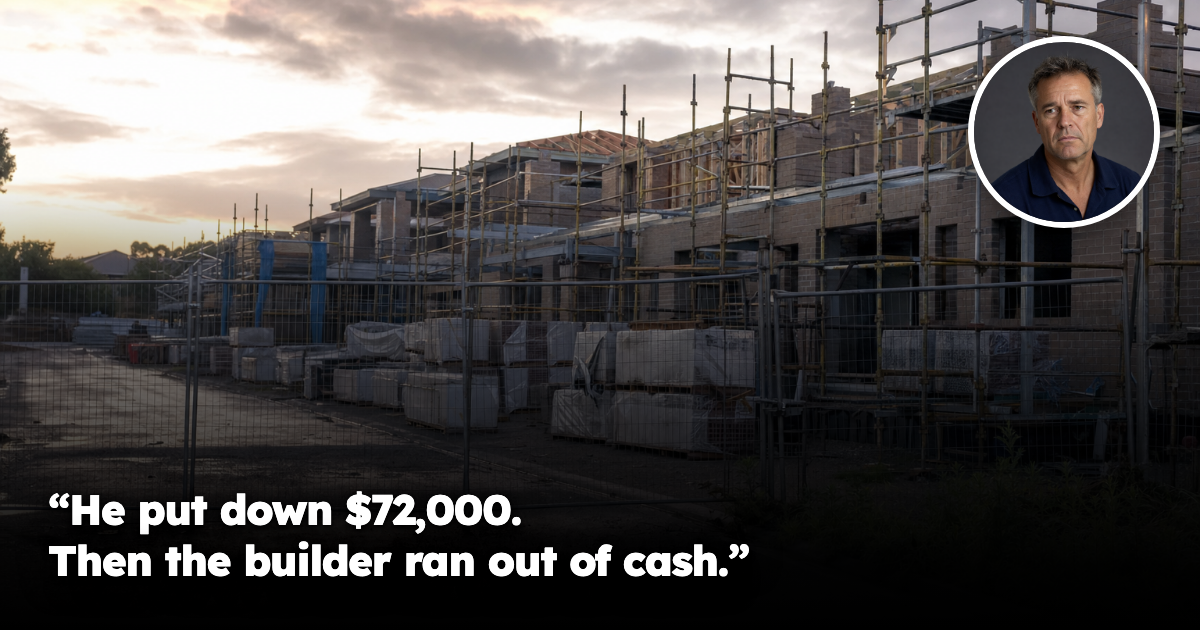
A 58-year-old Sydney man had done what buyers are told to do: saved a deposit, checked the contract and committed to a new home before prices moved further away. Then the builder behind the project entered voluntary administration, leaving the next question much harder than “What is the property worth?”
It became: “Will the home ever be finished, and what happens to the money already committed?”
The question buyers are now asking
The collapse of a major residential developer has put thousands of customers into an uncomfortable queue. The company entered administration with almost $3.6 billion in debt. Hundreds of staff reportedly went unpaid for weeks, suppliers were owed money and the administrators warned the business could close unless emergency funding arrived.
For buyers, the headline is frightening. A partially built home is not a normal property asset. It may have a contract price, a deposit and a location that looked attractive on paper, but it does not yet have the completed building, final approvals, established defects history or a settled valuation that a lender can treat as ordinary security.
The immediate focus is on dozens of projects already under construction, potentially representing 2,000 to 2,500 homes. That creates a political and commercial fairness problem: the people who made the least speculative decision — buying a home to live in — can be left carrying the greatest uncertainty when the corporate structure fails.
Why a “good suburb” does not solve the problem
A common reaction is to say that a strong suburb will eventually rescue the buyer. Sometimes it will. But suburb-level confidence cannot answer the address-level questions that decide whether a project is recoverable.
Two sites can sit inside the same postcode while having very different outcomes. One may be close to established retail, a frequent transport route and a street with proven resale demand. Another may be surrounded by competing new stock, have awkward access or depend on infrastructure that has not arrived. If a project is delayed, those differences become more important, not less.
Ripehouse Advisory’s street-level approach tests the property against achieved sales, current rent, vacancy, days on market, buyer depth and competing supply. For a stalled development, that means asking whether completed homes on the same street have a deep resale audience — or whether the project was relying on a future story that has now been delayed.
The same check applies to rental demand. A completed dwelling may still be a solid asset if tenants want that exact pocket and comparable homes lease quickly. But an investor should not count a forecast rent as though it were already being earned. Holding costs, body corporate charges, interest and the cost of alternative accommodation can change the arithmetic while construction stands still.
That exact-address discipline matters in ordinary purchases too: an easement can create a six-figure gap between similar homes, while a valuation-created funding gap can derail a seemingly approved deal. A development collapse makes those hidden differences even more expensive.
What should a buyer do first?
The first step is to stop treating the contract as the whole asset. Build a simple exposure schedule:
- deposit paid and any additional instalments; - finance approval expiry and lender valuation conditions; - rent or accommodation costs during delay; - sunset-date and termination provisions; - construction stage, approvals and outstanding variations; - insurance, warranty and statutory protection that may apply; - every notice received from the administrator, lender or project representative.
Do not assume that a deposit is immediately refundable, or that a government rescue will arrive because the project contains future housing supply. The administrators’ job is to assess the company and creditors’ position. A buyer’s job is to preserve evidence, obtain independent contract advice and understand the exact financial exposure before signing anything new.
There is also a lesson for investors who are considering buying into a new project. “Off the plan” is not one risk. It is a bundle of risks: developer balance sheet, builder performance, presales, funding, approvals, settlement timing and the market’s ability to absorb finished stock.
Is new housing still worth investing in?
Yes — but the answer is not to abandon property or to buy the loudest growth story. It is to separate the quality of the asset from the quality of the delivery vehicle.
A completed home on a proven street can have observable evidence: what similar properties actually sold for, how long they took, what tenants paid and how much competing supply is coming. A proposed home inside a large pipeline needs a more demanding test. The investor must price delay, funding uncertainty and the final buyer pool before calling the discount a bargain.
That is where precise data beats political promises and glossy project material. The right property, on the right street, with verified demand and a delivery structure that can be understood, can still be a powerful long-term investment. The mistake is assuming that a national housing shortage automatically protects every contract.
The 58-year-old buyer’s $72,000 is not just a deposit. It is time, optionality and trust tied to an address that has not yet become a finished asset. Before committing to any new project, test the builder, the funding structure and the exact street — because in property, the opportunity is real, but so is the cost of being wrong.
If there's a specific street you're weighing up right now, check its Street Score first — it's free, takes ten seconds, and tells you whether that street is pulling the suburb average up or riding on it.
Market data & R-Scores for locations in this article
Drill Down Into the Markets Mentioned Above
Inspect live monthly R-Scores, median prices, rental yields, and street-by-street scores for the cities and council areas referenced in this article:
Frequently asked questions
What happens to a buyer’s deposit if a Sydney builder goes into voluntary administration before the home is finished?
The article says buyers should not assume a deposit is immediately refundable. The administrator’s role is to assess the company and creditors’ position, so the buyer needs to preserve evidence and review the contract and notices received.
Why doesn’t being in a strong Sydney suburb guarantee a stalled new-home project will be okay?
Because the article says outcomes can differ street by street, even within the same postcode. Address-level factors like competing new stock, access, transport and proven resale demand can matter more than suburb-wide confidence.
What should a buyer check first if their off-the-plan home is left unfinished in Australia?
The article recommends building a simple exposure schedule. That includes the deposit and any extra payments, finance approval and valuation conditions, delay costs, sunset-date terms, construction stage, insurance and every notice from the administrator, lender or project representative.
Is off-the-plan buying just one risk, or are there several risks involved?
The article says it is a bundle of risks, not a single one. Those risks include the developer’s balance sheet, builder performance, presales, funding, approvals, settlement timing and whether the market can absorb the finished stock.
How should an investor judge whether a new housing project is actually a good idea?
The article says to separate the quality of the asset from the quality of the delivery vehicle. Investors should test the builder, funding structure and exact street, and price in delay, funding uncertainty and the final buyer pool before treating a discount as a bargain.
General information only. It does not take your objectives, financial situation or needs into account, and nothing here is legal, financial, taxation or investment advice specific to your circumstances.