News · 12 October 2026 · 5 min read
He owns one unit in the block. Should he buy the one upstairs for $666,000?
He is 42. He owns a one-bedroom unit in a converted heritage building in inner Sydney, bought six years ago and tenanted the whole time. On Saturday a renovated corner flat a few floors up went under the hammer for $666,000.
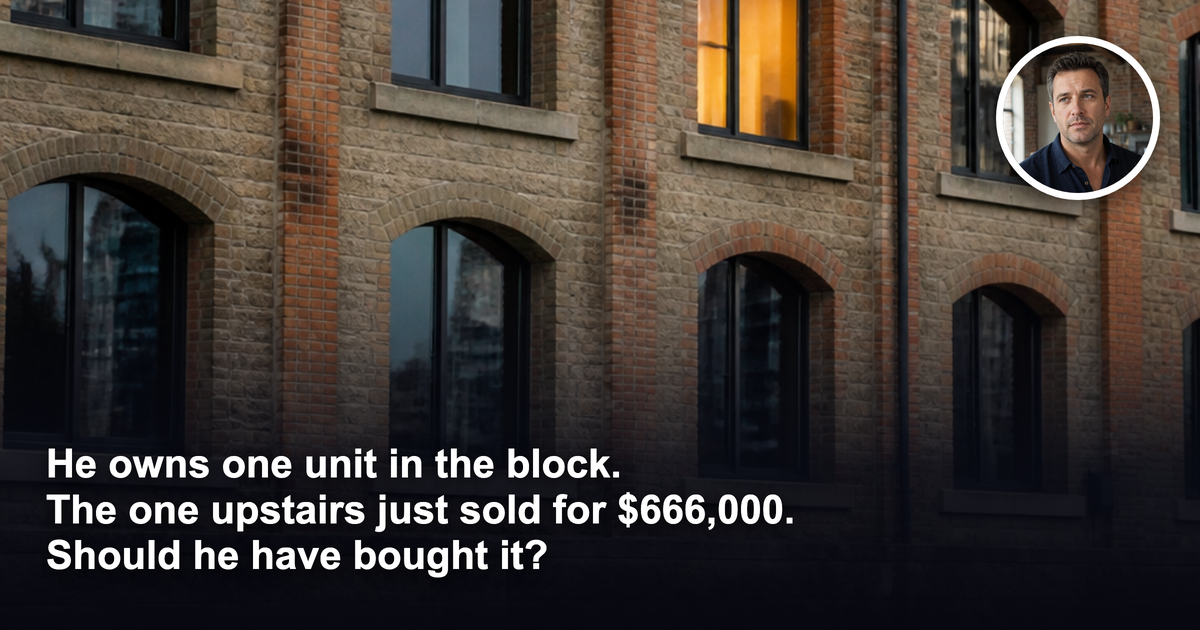
He is 42. He owns a one-bedroom unit in a converted heritage building in inner Sydney, bought six years ago and tenanted the whole time. On Saturday a renovated corner flat a few floors up went under the hammer for $666,000.
He had thought about bidding. He did not. Now he is turning it over.
He is a composite illustration, not a real person, but the auction is real. The Sydney Morning Herald reported on 12 October that a one-bedroom apartment in a heritage wool store in Pyrmont was guided at $595,000 to $645,000, carried a reserve of $635,000 and sold for $666,000, which is $31,000 over reserve. Two parties registered. The winner already owns multiple units in the building. The underbidder was a first home buyer who had been renting that exact flat for three years.
The question
"I already own one in this building. I know the strata, I know the rents, I know which units get the light. If another one comes up, surely that is the safest second purchase I could make?"
It is the most comfortable second purchase he could make. Safe is a different word.
The answer: you would be buying the same risk twice
Start with what is appealing about it, because the appeal is real.
He knows the building. He knows the levies, the sinking fund, the lift, the committee. He knows what the one-bedders rent for and how long they sit empty between tenants. The agent quoted in the SMH piece said buyers could live in it, rent it or hand it to the serviced-apartment operator in the building to manage. That flexibility is worth something.
Now look at what he would actually own.
Two units. One building. One strata scheme. One body corporate budget. One heritage facade that will one day need work the committee cannot defer. One suburb, one postcode, one buyer pool for one-bedroom apartments with city views.
Every single thing that could go wrong with the first unit would go wrong with the second on the same day. A special levy hits both. A new tower next door that takes the view hits both. A change in how short-stay accommodation is handled in that building hits both. A tenant pool that thins out hits both.
That is the part the auction report does not say. Buying a second unit in your own block doubles down on a single micro-market and calls it experience. It diversifies nothing.
What the price actually tells you
The flat last traded for $462,000 in 2014, according to records cited in the SMH report. Saturday's price of $666,000 is $204,000 higher. Over roughly twelve years that works out to about 3 per cent a year compounded, before holding costs, before strata, and before whatever the renovation cost somebody in between.
That is a respectable result for a unit. It is also well short of the kind of growth that funds a retirement on its own. For a buyer who already has exposure to that building, the question is whether the next $666,000 of borrowing capacity should go into the same asset type, in the same strata scheme, at a rate of growth the building has already shown you.
Borrowing capacity is the scarce thing. Most households between 32 and 48 get a limited number of purchases in their investing life. Spending one of them to own more of what you already own deserves a better reason than "I know the building".
The market around it
The same report put Sydney's preliminary auction clearance rate at 46 per cent from 472 reported results, the lowest reading for the city this year, with 176 auctions withdrawn in the week. PRD's chief economist tied the nerves to a fourth cash rate rise and to buyers wanting to see what happens between now and November.
And yet this unit still sold over reserve with two bidders. The selling agent said anything under $800,000 was moving fast.
Those two facts sit next to each other without contradiction. The bottom of the Sydney unit market is competitive because it is where first home buyers and investors collide. That is exactly where the first home buyer in this story lost, after three years of paying rent on the flat he wanted to own. Competition at that price point makes a one-bedroom unit expensive to buy. It does not make it a better long-term asset.
What it means for you
If you own one investment property and are thinking about the next, the pull toward the familiar is strong. The same suburb. The same building. The same agent who sold you the first one.
Familiarity lowers the fear of the purchase. It does nothing for the structure of the portfolio.
Two streets in the same suburb can be having completely different outcomes. Two buildings on the same street can have different strata finances, different tenant pools and different exposure to the next development approval. A second property that moves in lockstep with the first adds leverage and nothing else.
The useful question for the composite buyer above is whether he would buy this unit if he did not already own one in the building. If the honest answer is no, the only thing selling it to him is comfort.
The Ripehouse reframe
A single auction result is a story. A portfolio is a structure.
We judge one purchase against everything a client already holds: which state, which asset type, which price band, which growth driver, which risk they are already carrying. The second property should be chosen because it adds something the first one cannot, in a location where the street-level data supports it, whatever the headline on the building says.
We do not ask you to take that on faith. We publish our client results, including the portfolios that underperformed, because a method you cannot audit is just another auction story.
The buyer who paid $666,000 on Saturday may do perfectly well. Their holdings are also more concentrated than they were on Friday. Both things are true, and only one of them was in the headline.
Want to see how we weigh a second purchase against the whole portfolio, street by street? Join Jacob's free live webinar.
If there's a specific street you're weighing up right now, check its Street Score first — it's free, takes ten seconds, and tells you whether that street is pulling the suburb average up or riding on it.
General information only. It does not take your objectives, financial situation or needs into account, and nothing here is legal, financial, taxation or investment advice specific to your circumstances.