News · 12 October 2026 · 5 min read
$666,000 at a 46 per cent clearance rate: why the saver lost the auction and the equity holder won
On Saturday a renovated one-bedroom apartment in the Goldsbrough building in Pyrmont, a converted wool shed near Darling Harbour, sold at auction for $666,000. That was $31,000 above the $635,000 reserve and above the top of the $595,000 to $645,000 guide, according to the...
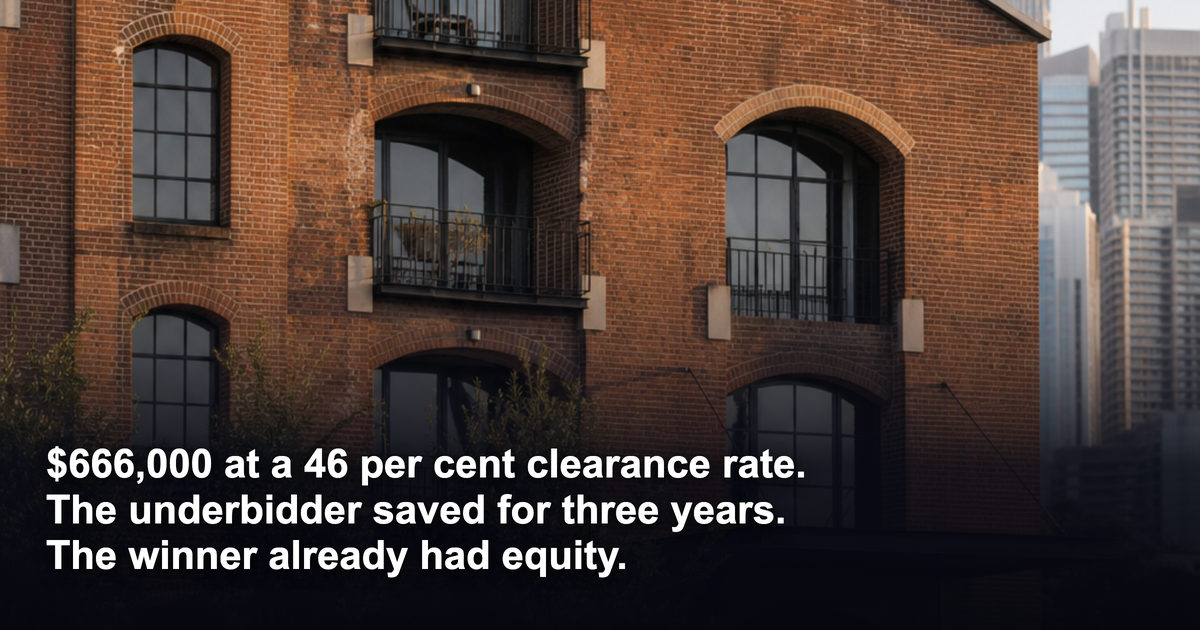
On Saturday a renovated one-bedroom apartment in the Goldsbrough building in Pyrmont, a converted wool shed near Darling Harbour, sold at auction for $666,000. That was $31,000 above the $635,000 reserve and above the top of the $595,000 to $645,000 guide, according to the Sydney Morning Herald's auction report.
Two bidders registered. One was a first home buyer who had been renting in the building for three years. The other already owned several units in the same block.
The owner of several units won.
That is the whole story, and it is a more useful story than the headline suggests.
The week it happened in
This was one of 807 auctions scheduled in Sydney last week. Domain's preliminary clearance rate came in at 46 per cent from 472 reported results, with 176 auctions withdrawn. The report called it the lowest Sydney reading of 2026 and tied it to the fourth cash rate rise.
Across town the same weekend, an Ashfield house drew four registered bidders and only one would bid. It passed in at $1.55 million and sold that evening for $1.65 million to a buyer who had not even attended the auction. A Bondi Beach two-bedroom apartment sold for $2,035,000, with two of the four active bidders being fathers helping their children.
Read those together. Fewer people are bidding. The people still bidding are the ones who do not need to save for another year.
What changed
The fourth rate rise reduces borrowing power for everyone. The economist quoted in the report said exactly that. It does not reduce it evenly.
For a renter saving a deposit, higher rates cut the loan they can qualify for at the same time as rent eats the money they were trying to put aside. Three years of renting in that building bought the underbidder a close look at the apartment and not much else.
For someone who already owns property, the rate rise cuts borrowing capacity too. What it does not touch is the equity already sitting in the asset. The Pyrmont flat last traded for $462,000 in 2014. Whoever bought it then was holding roughly $200,000 of paper gain before Saturday's result. An owner with several units in the block has that several times over, and a bank will lend against it.
That is the structural difference between the two bidders. One was trying to build a deposit from income. The other was deploying a deposit that already existed.
What this means if you own a home with equity
Most of the people who read this page are closer to the winner than the underbidder, and many do not realise it.
If you bought a home five or more years ago in most Australian capitals, you may well be holding six figures of usable equity. It earns no rent. It does not compound on its own. It sits in a valuation until you either sell the house or borrow against it.
A 46 per cent clearance rate is the market telling you the crowd has stepped back. Agents in the report described buyers waiting for auction day, then sending offers under the guide and working up slowly over several weeks. That is a buyer's negotiating position. It only exists for a buyer who can act.
So the question for an equity holder moves from "should I wait until I have saved more?" to "what can the equity I already have support, and how should it be structured so a fifth rate rise does not force my hand?"
The trade-offs, with numbers
None of this is a recommendation to buy a one-bedroom apartment, or anything in Pyrmont.
Look at the numbers in this sale. $462,000 in 2014 to $666,000 in 2026 is about $204,000 over twelve years. That is roughly 3 per cent a year, before strata, costs and twelve years of interest. A heritage building with a serviced-apartment operator on site is a specific kind of asset, with a specific tenant pool and its own set of strata questions. The agent's pitch was that you could live in it, rent it, or hand it to the operator to manage. That flexibility is also a sign of how many ways the income can vary.
The same agent said anything under $800,000 was selling fast. That is where first home buyers, downsizers and small investors all compete, and it is where the equity holder has the biggest edge, because they are not relying on a savings rate to keep pace with prices.
So the trade-off is real. Equity lets you act while others wait. It also lets you act badly, at scale, with borrowed money. The expensive mistake is to treat "I can borrow" as "I should buy this".
The Ripehouse reframe
One auction proves nothing. A $31,000 result over reserve on a Saturday tells you about two bidders and one apartment.
What we care about is the full distribution. Across 997 client portfolios since 2021, the median portfolio has grown 19.0 per cent a year on a 5-year rolling basis, against roughly 4.3 per cent nationally (benchmark: CoreLogic/Cotality). We publish that figure including the portfolios that underperformed, because an average that hides its tail is a highlight reel. Past performance is not a guarantee of future results.
That result comes from asset selection, street by street. Two streets in the same suburb can be having completely different outcomes in the same month, under the same clearance rate on the news. A single Sydney-wide figure hides a street where days on market are shortening and a street two blocks over where they are stretching out.
The equity holder's advantage is the ability to act. The data decides where.
The buyer at Pyrmont got the structure right years ago. Whether they got the street right on Saturday, nobody will know for a decade.
Want to see how we test which streets an equity position should be pointed at before the next rate decision? Join Jacob's free live webinar.
If there's a specific street you're weighing up right now, check its Street Score first — it's free, takes ten seconds, and tells you whether that street is pulling the suburb average up or riding on it.
General information only. It does not take your objectives, financial situation or needs into account, and nothing here is legal, financial, taxation or investment advice specific to your circumstances.