News · 30 September 2026 · 5 min read
He owes $1.9 million across three properties. The fourth rate rise this year is the one that broke his broker
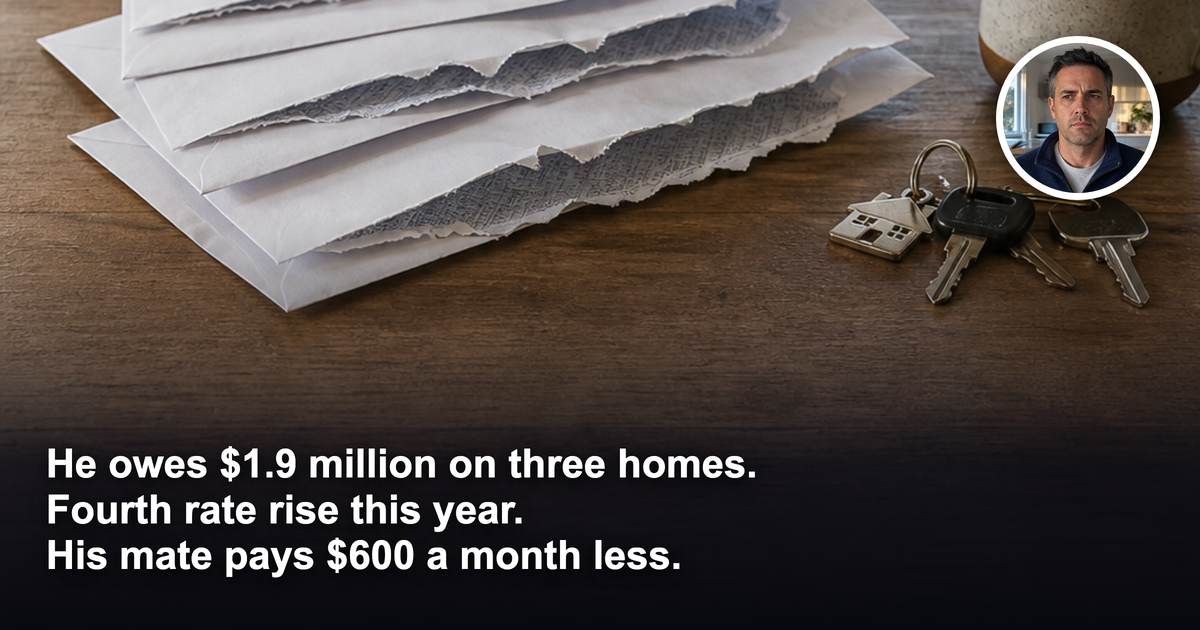
He is 41. He owes about $1.9 million across his own home and two investment properties, all on variable rates, all with one of the big four, all bought between 2019 and 2022 with the plan of holding them for twenty years and never thinking about them again.
He is 41. He owes about $1.9 million across his own home and two investment properties, all on variable rates, all with one of the big four, all bought between 2019 and 2022 with the plan of holding them for twenty years and never thinking about them again.
He has never missed a payment.
On Tuesday the Reserve Bank lifted the cash rate by 0.25 percentage points to 4.6 per cent, the fourth increase this year and the highest it has been since November 2011 (ABC News, 30 September 2026). Within hours Commonwealth Bank, NAB, Westpac and ANZ said their variable home loan rates would go up by the same amount from October 9.
On Wednesday his broker rang and suggested he sell one of the rentals.
He is a composite, drawn from the questions that have come into our inbox this week. The numbers are his, not the Reserve Bank's. But if you own more than one property on variable debt, you have probably had a version of this conversation in the last 48 hours.
### The question he sent us
*"I've done everything I was told to do. Bought good properties, held them, paid every month. Four rate rises this year and now my broker says I should sell one to 'take the pressure off'. A mate of mine owes about the same, with the same bank, and he's paying around $600 a month less than me. How is that possible, and why am I the one being told to sell?"*
He is asking the right question. Almost nobody asks it.
### The answer: the rate is the same for everyone. The bill is not.
Here is what 0.25 per cent looks like on his debt. On roughly $1.9 million, this week's rise alone adds about $390 a month to his interest. Add the three earlier rises this year and he is paying somewhere around $1,500 a month more than he was in January.
That is real money and it is the reason the banks themselves conceded, in their own announcements, that many mortgage holders may struggle with the increased payments.
But notice what the $390 figure depends on. It depends on the whole $1.9 million being variable. It depends on none of it sitting against an offset. It depends on every loan being priced as a standalone product, on the same lender's rate card, with nobody having asked for a better one since settlement.
His mate's debt is the same size. It is not built the same way.
Part of it was fixed before the first rise this year, so the rate change does not touch it yet. The rest sits against an offset account that holds his buffer, so he pays interest on less than his balance. His loans are split, so he could refinance one without disturbing the others. Same cash rate. Same bank. Roughly $600 a month less in interest.
The Reserve Bank did not decide that gap. The two of them did, years ago, on the day they signed the loan documents and stopped thinking about it.
### The expensive mistake almost nobody names
The mistake is not buying three properties. The mistake is treating debt as a formality.
Most investors spend months choosing the property and about twenty minutes choosing the loan. They take the product the broker puts in front of them, they leave every dollar variable because fixing felt like a bet, and they let one lender hold everything because it was easier. In 2021 that cost nothing, so it looked like a good decision.
Four rises later, the same structure is deciding which of them keeps their portfolio.
Selling one property to "take the pressure off" converts a cash flow problem into a permanent one. He gives up the asset, pays an agent, crystallises whatever capital gains tax is owed, and drops his monthly interest by a third at best. He still has the same badly built debt on the other two, and the next rise will land on it in exactly the same way.
NAB's own advice this week was that concerned customers should contact the bank early. That is decent advice. But the conversation to have is not "can I have hardship relief". It is "why is my $1.9 million priced like this and what would it cost to rebuild it".
### What this means for you
If you own one property on a variable rate, this rise is a line in your budget. If you own three, it is a test of how your debt was designed.
The questions worth answering before October 9:
How much of your total debt moves on every RBA decision, and how much does not?
Where does your buffer sit, in a savings account earning something, or in an offset saving you the loan rate?
If you had to refinance one loan tomorrow, could you do it without the bank re-assessing all of them?
Has anyone actually asked your lender for a lower rate since you settled?
None of that is advice for your situation. It is the checklist the investors who are not selling this week already had.
### The Ripehouse reframe
The headline says rates hit a 15-year high. The number that decides whether you hold or sell is not 4.6 per cent. It is the shape of your debt, and the quality of what it is secured against.
Two owners in the same suburb, with the same balance, can be having completely different Octobers. So can two streets. A property that is renting quickly, in a street where days on market are short and vacancy is tight, carries a rate rise very differently to one that took eight weeks to let. Structure and asset selection compound in both directions.
Our clients' portfolios have grown at a median of +19.0 per cent a year on a 5-year rolling basis, against roughly 6.3 per cent for the combined capitals over the same period (benchmark: CoreLogic/Cotality). Past performance is not a guarantee of future results. We publish the full distribution, including the portfolios that underperformed, because a rate cycle like this one is exactly when a highlight reel stops being useful.
Being behind on this is a structure problem, not a discipline problem. He proved the discipline part by never missing a payment. What he never got was a design.
If this week's letter from your bank made you reach for a sale listing rather than your loan documents, start with the documents.
15-minute Legacy Sequence Diagnostic: ripe.house/4bV7I8u. No pressure. No obligation. Just a clearer picture than you had before.
General information only. It does not take your objectives, financial situation or needs into account, and nothing here is legal, financial, taxation or investment advice specific to your circumstances.