News · 14 October 2026 · 5 min read
He let his tenants fall $11,400 behind because they had three kids. Then they wrecked the house
He is 45 and about $11,400 behind on rent that was never his to lose. He is a composite illustration, not a real person, and the numbers in his story are illustrative. The case that prompted it is real, and it was reported by realestate.com.au this week.
He is 45 and about $11,400 behind on rent that was never his to lose. He is a composite illustration, not a real person, and the numbers in his story are illustrative. The case that prompted it is real, and it was reported by realestate.com.au this week.
He lives in Perth with his partner and two teenagers. His only investment property is a three-bedroom house in a Queensland hinterland town, bought in 2019 for a little under $490,000. The tenants were a family with three kids. The father had a small trade business that was going under.
When the first missed payment came, he did what most decent people would do. He waited.
Then he waited some more. The business folded, the arrears grew, and the father offered to do some paid work to clear the debt. The owner arranged the work and paid for it. The rent still did not arrive.
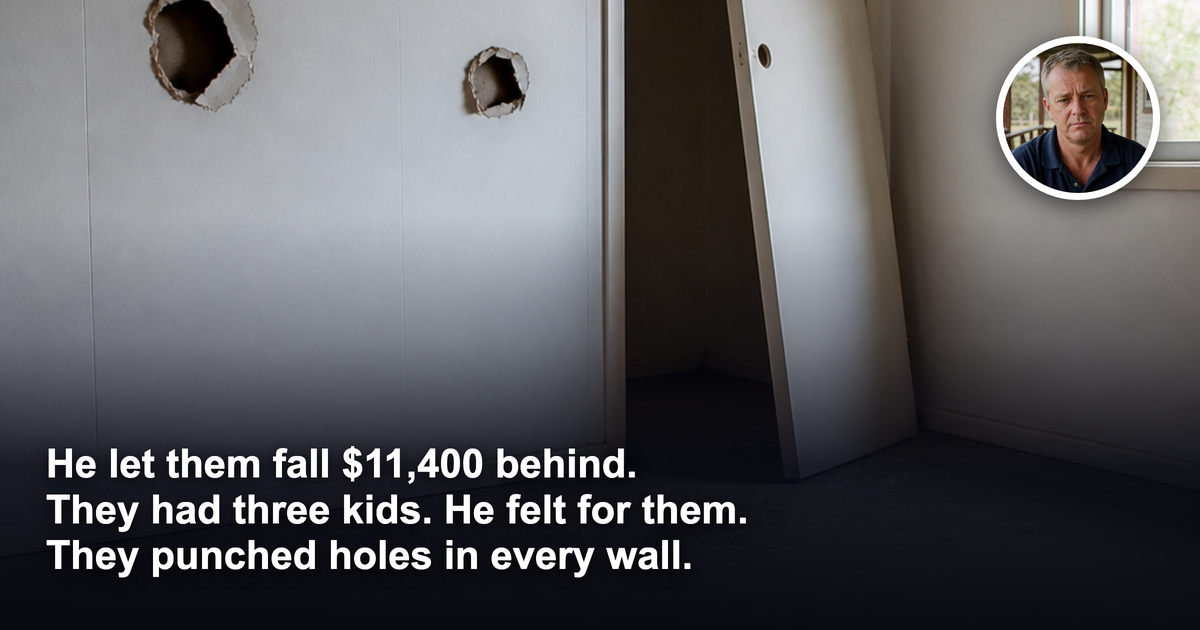
Six months in, the matter went to the tribunal. The tenants were ordered out. He drove up to inspect the house and found holes punched through the plasterboard in several rooms, a door off its hinges and broken glass on the floor.
The question he is asking
"I tried to do the right thing by a family in trouble and I have ended up with six months of unpaid rent, a wrecked house and a bond that covers a fraction of it. Where did I go wrong, and should I just sell?"
The case that put this on everyone's feed
The story realestate.com.au ran on 14 October describes a Queensland owner near Gympie who regained possession of her house after a family of five was evicted over repeated rent arrears.
By her own account, she waited too long out of sympathy. When the husband said he could earn income through concreting work and pay the arrears down, she says she passed on around 90 per cent of the payments for that work. The rent still was not paid.
The matter went to the Queensland Civil and Administrative Tribunal. She says it took 202 pages of text messages to prove her case. The tenants were ordered out, and the photos she posted afterwards show fresh holes smashed through walls in several rooms and a door pulled off its hinges.
One comment under her post should stop every owner reading this. Another landlord wrote that it had happened to them twice, that they kept the bond but never recovered the true cost, and that their insurance "wasn't worth the paper it was written on". They sold up and left property altogether.
That is the actual risk in this story. The holes get patched. The exit is permanent.
The answer: goodwill is fine, as long as the structure was built first
Nobody should read this as an argument against sympathy. Rent arrears usually start with a real hardship, and a tenant who is talked to early and honestly will often sort it out.
The expensive mistake is different. It is extending goodwill from a position that had no buffer underneath it.
Under Queensland tenancy rules, an owner can seek compensation for wilful damage, but only with solid evidence: entry condition reports, inspection records, photos and repair quotes. If the bond does not cover the loss, the claim goes to the tribunal. That is a process that takes months, and it depends on paperwork that was either done at the start of the tenancy or was not done at all.
So the questions that decide the outcome were all answered long before the first missed payment:
- Was there an entry condition report with photos, signed by both sides?
- Were routine inspections actually carried out and recorded?
- Did the property manager have a written arrears procedure, with a breach notice issued on the day the rules allowed it?
- Does the landlord insurance policy cover rent default and malicious damage, and what are the excess and the limits? Check your policy wording, because policies differ widely.
- Is there a cash buffer that can carry the loan through six months with no rent and a repair bill at the end?
Our composite owner had a bond, a mortgage and good intentions. He did not have a written arrears process, his insurance was the cheapest option the broker offered, and his buffer was his offset account, which also happened to be the family holiday fund.
The result was that every week of patience cost him money he could not afford to lose, which made each decision harder than the last, which is why he waited.
What it means for you
If you own a rental, the real test of your setup is a tenant who stops paying. Everything else is weather.
A property with the right paperwork, a property manager who acts on day one of a breach, a policy you have actually read, and a buffer that is separate from the household budget can absorb a bad tenancy and keep going. The same property without those things turns one bad year into a forced sale, often at the worst possible time.
Here is the part the headline leaves out. The damage in that Gympie house is a few thousand dollars of plasterboard and a door. The expensive outcome in the comments was the owner who sold up, because the cost of exiting a market and never coming back dwarfs any repair invoice.
The Ripehouse reframe
Tenant quality is a street-level variable, and it is also a management variable.
Two streets in the same regional town can be having completely different tenancy outcomes. One has long tenancies, low vacancy and a property manager who inspects on schedule. The other churns through tenants every year and sits empty for weeks between them. The suburb median tells you nothing about which one you bought on.
We publish our client results, including the portfolios that underperformed, because a bad tenancy is part of the full distribution and pretending otherwise helps nobody. The owners who come through a default intact are rarely the ones who were toughest on tenants. They are the ones who bought the right house on the right street, set up the paperwork and the insurance on day one, and had the cash to let the process run without panic.
That is structure. It was in place before the goodwill, which is the only order in which it works.
If you want to see how we test an investment property decision like this one before the keys change hands, join Jacob's free live webinar.
If there's a specific street you're weighing up right now, check its Street Score first — it's free, takes ten seconds, and tells you whether that street is pulling the suburb average up or riding on it.
General information only. It does not take your objectives, financial situation or needs into account, and nothing here is legal, financial, taxation or investment advice specific to your circumstances.