News · 14 October 2026 · 5 min read
A $324 fee just became $600 for short-stay homes. The number that decides if a holiday house pays is bigger
The number in the headline is $600.
The number in the headline is $600.
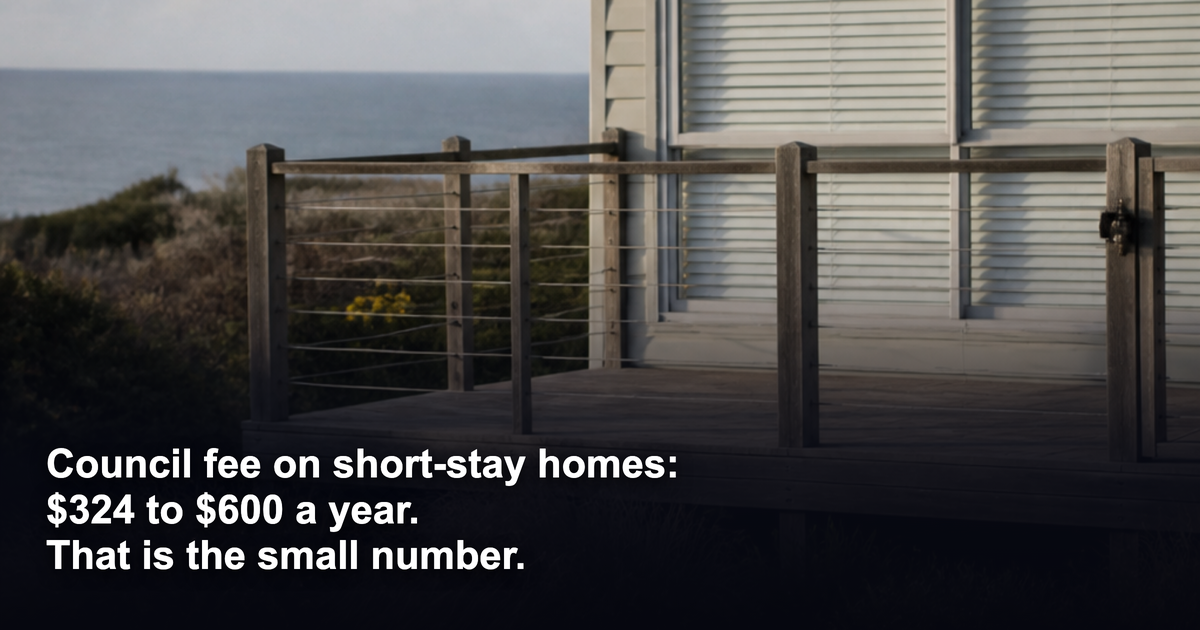
That is the new annual registration fee Bass Coast Shire Council charges anyone renting a home as short-stay accommodation. It was $324. For houses with more than five bedrooms it is now $900. The ABC reported on 14 October that hundreds of owners want it reversed, with one calling it "extortionate" and a petition drawing about 550 responses.
The fee went up by $276 a year. Hold that figure, because it is the smallest number in this story.
What changed
Bass Coast takes in Phillip Island and Inverloch. It has had a short-stay registration process since 2023 and, according to the ABC, now has the highest short-stay fees in Victoria.
On top of the council fee sits a statewide levy. Victoria introduced a 7.5 per cent levy on short-stay bookings in 2025. The ABC reports it raised $85.8 million in its first year, and that money goes to social housing, not to the councils picking up the bins.
The council's argument is simple. Peak-season visitors generate waste, beach and park costs, and complaints from permanent residents. Mayor Brett Tessari told the ABC the previous fee was "nowhere near where we needed to be".
Owners' argument is also simple. They already pay the state levy. A second charge from council feels like paying twice.
Both can be true. Neither changes the arithmetic you need to do before you put equity into a coastal holiday house.
What the fee actually costs
One owner quoted in the ABC piece lists her Phillip Island home at a base rate of about $220 a night.
At that rate, the $276 increase is one and a quarter nights of bookings a year. The whole $600 fee is under three nights.
Now look at the levy. On a $220 night, 7.5 per cent is $16.50. If that house is booked 100 nights a year, the levy takes about $1,650 from the gross. At 150 nights it is closer to $2,475. Those are illustrative occupancy figures, not a forecast, but they show the shape of it. The levy scales with your success. The council fee does not.
Then there is everything that was already there before either charge existed: cleaning between every stay, linen, platform commission, higher insurance, furniture replacement, the manager's cut if you are not doing it yourself, and the weeks in winter when nobody books a beach house.
If a $276 rise is the thing that tips your holiday home from viable to unviable, the house was never viable. It was being carried by a gross nightly rate that looked good on a listing.
The number nobody puts on the listing
Short-stay is sold on gross. The nightly rate is big, round and easy to multiply by 365.
Nobody multiplies by 365. The ABC article contains a clue to how much supply is chasing the same visitors: more than 1,000 properties are registered with council, but AirDNA counted more than 2,300 listings across Airbnb and Stayz in the area in August.
That is a lot of beds competing for the same summer. The Inverloch Tourism Association says the town does not have enough accommodation at peak times. Peak is a few weeks. The rest of the year is where the net return is decided.
So the real question for anyone with equity to deploy is this. After the levy, the fee, the cleaning, the platform, the empty weeks and the management, what does this house return as a percentage of the money tied up in it? And how does that compare with the same house on a twelve-month lease to a local family?
The ABC notes Bass Coast has had a shortage of long-term rentals since city residents moved in during the pandemic. That shortage is a market signal. A standard lease carries no state levy, no $600 registration, no changeover cleaning and no empty July.
The decision, and the trade-offs
If you own a coastal short-stay now, you have three options and each has a cost.
- Keep it short-stay. Rerun the numbers with the levy and the fee in. Decide whether the net result, after your own labour, justifies the equity sitting in it.
- Move it to a long-term lease. Lower gross, far lower costs, no seasonal gap. You lose personal use of the house.
- Hold it empty and use it yourself. The ABC quotes owners saying this is exactly what they will do. It is a lifestyle decision. Call it that, and stop counting it as an investment.
If you are thinking of buying one, the trade-off is sharper. The deposit and the borrowing capacity you commit to a holiday house in a tourist shire are the same deposit and capacity you could commit to a house in a street where tenants stay for years and the rent arrives every week of the year.
Two streets, two different outcomes
This is where council-wide headlines fail investors.
A fee is set at shire level. A levy is set at state level. Returns are made at street level. Within the same coastal town, one street can sit walking distance from the beach with strong year-round demand, and another three blocks back can be mostly dark from April to November. Same council, same fee, same levy, completely different result.
We test that before any client commits equity. Net yield after every cost, days on market, vacancy by street, and the full spread of outcomes, including the ones that did not work. Short-stay highlight reels only show the summer.
The reframe
The $600 fee is a reason to recheck the numbers. It is not the number that matters. What matters is whether the asset, in that street, with that cost structure, pays you after every charge is taken out. The right asset in the right street beats a headline about a council fee every time.
Want to see how we test a decision like this street by street? Join Jacob's free live webinar.
If there's a specific street you're weighing up right now, check its Street Score first — it's free, takes ten seconds, and tells you whether that street is pulling the suburb average up or riding on it.
General information only. It does not take your objectives, financial situation or needs into account, and nothing here is legal, financial, taxation or investment advice specific to your circumstances.