News · 6 October 2026 · 5 min read
A $26,000 upgrade saves the tenant $1,000 a year. Why NSW landlords may still come out ahead
$26,000.
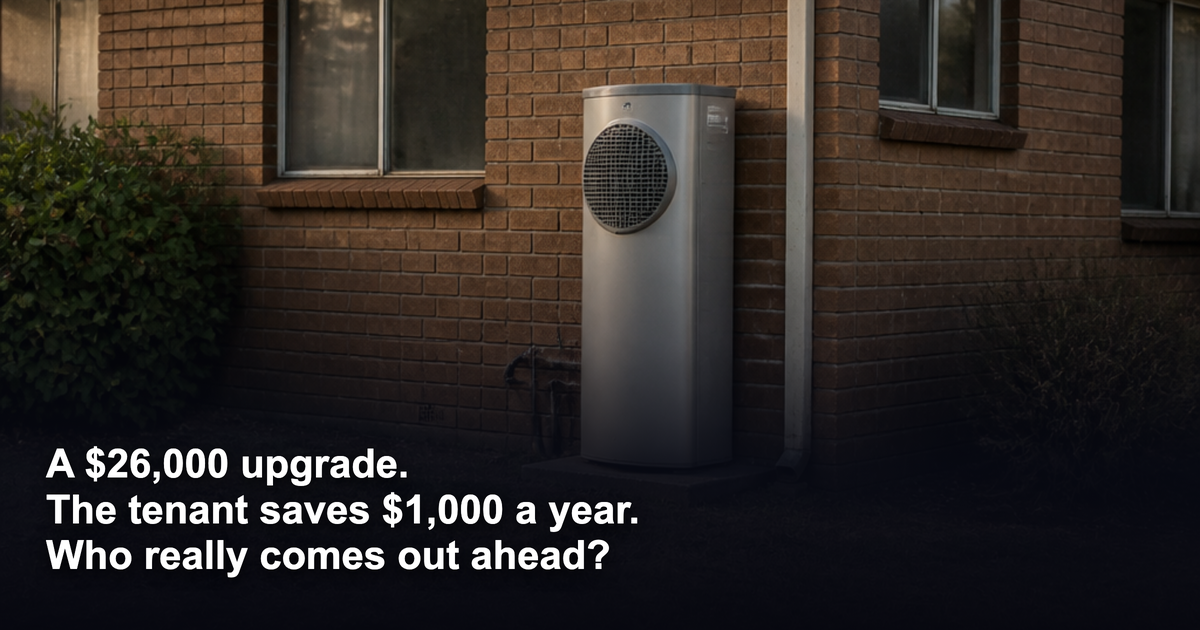
$26,000.
That is the figure sitting underneath a report released this week by sustainability not-for-profit Renew, as reported by realestate.com.au. It is what Renew estimates it costs to take a typical 1970s brick house in New South Wales from the energy rating most rentals sit at today to a "moderate" standard: ceiling and wall insulation, draught sealing, window awnings, two efficient reverse-cycle air conditioners, heat pump hot water and a 4.5kW solar system.
Most NSW rentals, according to Renew chief executive Helen Oakey, rate about two stars out of ten.
The headline said the upgrade could save renters up to $1,000 a year and lift landlord returns. Both halves of that sentence deserve a closer look. The first is a research estimate. The second is where the money decision sits for anyone holding or buying NSW stock.
What changed this week
Nothing is law yet. The NSW government is considering minimum energy efficiency standards for rental properties. Consultation closed on 31 May and the government's findings are expected later this year.
What changed is that someone put costs on the table.
Renew modelled three upgrade packages for the same 1970s brick house across seven NSW climate zones. The minimum package comes in at about $15,000. The moderate package at about $26,000. The "excellent" package at just under $34,000.
Financed over 20 years, the moderate upgrade costs about $1,600 a year. Renew found tenant energy bills fell by two-thirds to three-quarters, a saving of more than $1,000 a year, while holding indoor temperatures in a healthy 18 to 25.5 degree range.
The NSW Government's Home Energy Saver Program already offers zero-interest loans of up to $15,000 for this kind of work.
The arithmetic nobody put in the headline
Read those two numbers again. The landlord pays about $1,600 a year. The tenant saves about $1,000 a year.
On the bills alone, the owner is out of pocket. If the upgrade did nothing but cut power bills, the honest description would be a transfer of roughly $600 a year from landlord to renter, before the zero-interest loan narrows the gap.
So where does "increased landlord returns" come from?
From rent and value, according to a second report, The Efficiency Edge, cited in the same article. It found efficient homes achieved higher rental yields and higher property values than comparable homes in the same areas. The examples given: an efficient WA property rented for $300 a week more than its suburb's median rent, and an efficient ACT property rented for $350 a week more than the median.
Those are two examples, in two other states. They are not NSW averages and we would not treat them as a forecast. But the direction matters. If a tenant's total cost of living in a home falls by $1,000 a year, an owner only needs to recover part of that in rent for the arithmetic to turn.
Who this helps
Three groups, differently.
Anyone already holding an older NSW rental faces a timing choice. Upgrade now, on a zero-interest loan, while trades are available and before any mandate creates a queue. Or wait for the rule and do it under deadline, when every other owner in the state is calling the same insulation installers.
Anyone with equity or borrowing capacity looking at NSW stock now has a new line in their due diligence. A cheap 1970s brick house with no insulation and old hot water is carrying a potential $15,000 to $34,000 bill that the listing price does not mention. Price it in, or walk.
Anyone weighing a newer dwelling against an older one just got a reason to look again at the boring option. A property already at a decent rating has no upgrade bill coming.
The trade-offs, with numbers
- Minimum package, about $15,000. Sits inside the zero-interest loan cap. Smallest comfort gain.
- Moderate package, about $26,000. About $1,600 a year financed over 20 years. Renew calls it the sweet spot.
- Excellent package, just under $34,000. Highest upfront cost, and the bill savings flatten out.
Against that, Energy Consumers Australia found 68 per cent of NSW renters avoid heating or cooling their homes to save money. A tenant who no longer has to choose between comfort and the power bill is a tenant who stays. Vacancy and re-letting costs are the drag on yield that owners feel most and measure least.
The same research found 75 per cent of landlords support or do not oppose minimum standards. The industry argument is largely settled. The money argument is what remains.
The mistake we expect to see
The expensive version of this story is the owner who treats the upgrade as a compliance cost, does the cheapest possible job the week before a deadline, and collects none of the rent or value upside the research describes.
The second expensive version is the buyer who screens on price per square metre, wins a bargain, and discovers a $26,000 bill attached to it.
Two streets, same suburb, different outcomes
This is where a state-wide rule meets a street-level market.
An energy upgrade adds the most where tenants are competing for stock and will pay for comfort. It adds the least where vacancy is already high and the rent ceiling is set by the cheapest house on the street. Two streets in the same suburb can be having completely different outcomes on both counts.
The research tells you the cost. It cannot tell you whether your street will reward it.
That is the question we would ask before spending $26,000. What is the rent spread between the best and worst house on this street? How long do homes here sit vacant? Does the upgraded version of this asset move from the bottom of that spread toward the top?
Structure, not timing. The right asset on the right street absorbs a $26,000 upgrade and comes out with a better tenant and a higher rent. The wrong one absorbs the cost and nothing else.
Want to see how we test a decision like this street by street before any money is spent? Join Jacob's free live webinar.
General information only. It does not take your objectives, financial situation or needs into account, and nothing here is legal, financial, taxation or investment advice specific to your circumstances.